

This guide provides a practical breakdown of where AI generates value, which metrics matter, and what separates organisations that see returns from those that don't. It's designed for content leads, digital publishers, and marketing decision-makers at media houses, brands, and BFSI organisations investing in AI-powered workflows.
Key Takeaways
- Production efficiency delivers fastest returns, content creation time drops 65-75% within the first 1-3 months
- AI-driven distribution improves targeting and timing, boosting engagement by 10–41%
- Measurement frameworks matter more than technology, 63% of high-maturity organisations quantify AI benefits, versus just 38% overall
- Revenue ROI takes 6–12 months to materialise; expect 2–4 years for substantial returns from deeper AI transformation
- Siloed platforms and vanity metrics block ROI; consolidation and clear attribution are what close the gap
The ROI Reality Check: What AI in Content Actually Returns
The gap between AI investment and realised returns is wider than most organisations expect. McKinsey's 2025 Global Survey of 1,993 respondents across 105 nations found that only 39% attribute any level of profit impact to AI use. Even among those reporting returns, the majority state that less than 5% of total profit is AI-driven. Just 6% qualify as "AI high performers" generating significant measurable value.
Yet marketing and sales emerges as one of the top three business functions where organisations report revenue increases from AI,a pattern consistent across eight years of McKinsey surveys. For content teams, that's a clear signal: the returns are real, but capturing them requires a deliberate approach.
The Investment vs. Returns Paradox
Deloitte's 2025 AI Survey reveals the timeline challenge: most organisations achieve satisfactory ROI within 2 to 4 years, far longer than the 7- to 12-month payback typically expected for technology investments. Only 6% reported payback in under a year.
Within that 2- to 4-year window, content automation tends to be one of the faster-payback areas. Only 15% of generative AI users report significant measurable ROI today; that figure drops further to 10% for agentic AI. Content-layer tools close the gap quickly. Efficiency gains, time saved, cost reduced, output increased, show up in the numbers within weeks, not quarters.
Two Types of ROI: Efficiency vs. Revenue
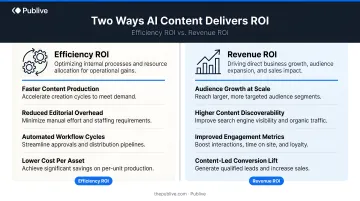
AI content tools generate returns in two distinct categories that require different measurement approaches:
Efficiency ROI includes:
- Time saved in content production cycles
- Reduced outsourcing and freelance dependency
- Lower cost per published asset
- Increased output volume per editor
Revenue ROI includes:
- Traffic growth from optimised content
- Lead generation from personalised distribution
- Audience growth and retention improvements
- Ad yield increases from higher engagement
McKinsey's data shows that 80% of organisations start with efficiency as their primary AI objective. But the companies generating the most value don't stop there, they layer in growth and innovation goals alongside cost reduction. Notably, high performers are 3x more likely to redesign workflows from the ground up. That distinction matters: efficiency gains from AI are a floor, not a ceiling.
AI-Driven Content Creation: Where the ROI Shows Up
Speed and Output Volume
Harvard Business School research documents approximately 75% reduction in writing time and 63% reduction in ideation time with AI assistance. Carnegie Mellon's study independently confirmed a 65% writing time reduction with quality improving from B+ to A grade. Students credited 66% of productivity improvement specifically to AI rather than practice effects.
For digital publishers, this compression of the content production cycle translates to competitive advantage. Reuters developed Fact Genie, an AI tool that scans entire press releases in under 5 seconds and enables first news alerts within 6 seconds of receiving source material,far exceeding their 30-second editorial target.
Cost Per Asset Reduction
The 65-75% time reduction documented in academic studies translates directly to cost savings at scale. Consider a typical mid-size newsroom producing 100 assets per month:
- AI cuts per-asset creation time from 4 hours to 1 hour, freeing 300 hours monthly
- At ₹1,000 per editor hour, that's ₹3,00,000 in monthly labour savings
- Annualised: ₹36,00,000 recovered from efficiency gains alone
This calculation becomes more compelling when AI reduces outsourcing spend. Zamaneh Media, a 13-15 person newsroom, built AI tools that reduced newsletter creation from nearly a full day to just over an hour,an 85-90% reduction. Their translation tool cut article publication time from days to less than an hour, eliminating reliance on external translation services.
Content Repurposing and Scale
Cost savings per asset are only part of the picture. AI's multiplier effect, producing more from the same source material, is where media houses with multilingual audiences see compounding returns.
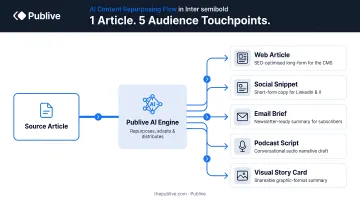
A single long-form article can generate:
- Social snippets for Twitter/X, Instagram, and LinkedIn
- Push notification copy tuned for mobile audiences
- Email newsletter summaries
- Regional language variants for Hindi, Tamil, Telugu, and other markets
The result: 5x audience reach at roughly 20% of the manual effort cost.
McKinsey reports that AI-enabled content personalisation at scale can increase content ROI by 5-15% through better audience targeting and reduced production overhead, a figure that compounds as content volume grows.