Introduction
Newsletter teams at media houses and brands spend hours each week manually curating articles, writing summaries, and scheduling sends. The result: inconsistent output and fluctuating engagement. According to Litmus's 2024 State of Email Marketing Tech Stack report, a single email takes approximately two weeks to produce, with 46% of email marketers juggling up to five emails in production simultaneously.
The tension is real: audiences expect high-volume, high-quality content, yet editorial teams lack the capacity to deliver it consistently without burning out.
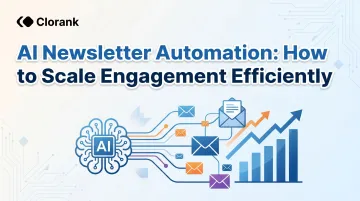
AI newsletter automation has moved from experimental to essential. It now serves as the operational backbone of high-output publishing teams, enabling scale without proportional headcount growth. This article covers what parts of the newsletter workflow AI can automate, how to build an effective pipeline, and how to turn automation into measurably better engagement.
TLDR
- AI handles curation, summarisation, subject line writing, segmentation, and send-time optimisation — cutting hours of manual production work
- Effective workflows connect content sourcing, AI processing, editorial review, distribution, and analytics in one pipeline
- Behavioural segmentation and personalisation drive measurably higher open and click-through rates than generic sends
- Analytics enable continuous improvement at scale, not just automation for its own sake
- Human editorial oversight remains essential for brand voice, accuracy, and reader trust
Why Newsletter Automation Is a Game-Changer for Publishers
Manual newsletter production is resource-intensive. Content teams spend multiple hours per edition on tasks that pile up fast:
- Sourcing and vetting stories
- Writing section intros and summaries
- Editing for tone and accuracy
- Formatting for email clients
- Scheduling and QA before send
This compounds across daily, weekly, and vertical-specific newsletters. Bottlenecks emerge at every stage: 41% of email professionals cite building, 40% cite designing, and 39% cite testing as primary workflow obstacles, according to Litmus.
The business cost of inconsistency is real. When newsletters go out irregularly or with thin content, subscriber churn rises and open rates fall. Typical subscription churn rates sit between 6% and 8%, with approximately 50% of an email list churning within the first year. Cadence breakdown directly erodes the newsletter's value as a retention and traffic channel.
Newsletters consistently outperform social media in reach per subscriber and conversion rates. AI automation is what allows media publishers and brands to maintain the cadence and quality needed to capitalise on this advantage.
Automation vs. Replacement: Getting the Balance Right
AI newsletter automation targets the repetitive, low-creativity work — not editorial judgment. The goal is to free teams for narrative, voice, and strategy by handling what doesn't require human creativity.
The "human-in-the-loop" model delivers this reliably: automated drafts are generated and queued for brief editorial review before sending. Teams retain full quality control without rebuilding the newsletter from scratch each time.
What AI Can Actually Automate in Your Newsletter Workflow
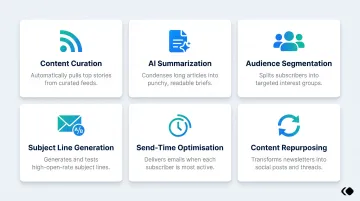
Six newsletter production tasks that once consumed hours can now run on autopilot — here's where AI does the actual work:
AI-Powered Content Curation
AI agents monitor RSS feeds, web searches, and curated sources in real time, classify articles by topic relevance and impact score, and surface only the highest-priority stories. This eliminates hours of manual browsing.
AI Summarization
Once relevant articles are identified, AI models (GPT-4, Claude) generate concise, reader-friendly summaries in a specified tone and format, producing newsletter-ready copy without human drafting.
Subject Line and Preview Text Generation
AI can A/B test multiple subject line variants based on historical open-rate data for a specific audience. AI-optimised subject lines can achieve 30% to 40% open rate improvements, according to HubSpot. Question formats outperform statements by 32%, and subject lines under 40 characters showed 28% higher opens.
Automated Audience Segmentation
AI analyses subscriber behaviour — opens, clicks, scroll depth, topic preferences — to segment readers dynamically and serve different content blocks to different groups within the same send.
Send-Time Optimisation
AI predicts per-subscriber optimal send times based on historical engagement patterns. Results from Braze's Intelligent Timing illustrate the gains:
- OneRoof: +218% total clicks, +57% unique clicks
- KFC Ecuador: +15% open rates
- foodora: +9% email CTR, -26% unsubscribe rates
Content Repurposing Automation
For media publishers with existing article archives, AI can automatically pull from published content, extract key passages, generate newsletter snippets, and link back to full pieces — so a single article can generate a newsletter story in seconds rather than hours.
How to Build an AI-Powered Newsletter Automation Workflow
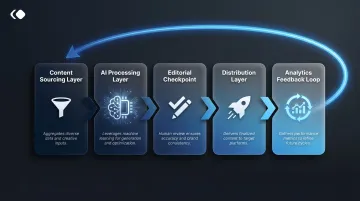
A complete AI newsletter pipeline consists of five key components:
- Content sourcing layer
- AI processing layer
- Approval/editorial checkpoint
- Distribution layer
- Analytics feedback loop
Step 1 — Content Sourcing
Set up automated content feeds using RSS integrations, web search APIs (such as Perplexity), or CMS-connected content libraries. Configure topic filters and relevance scoring so only high-quality, on-brand stories enter the pipeline.
Example sources:
- RSS feeds from industry publications
- Internal CMS article archives
- Web search APIs for trending topics
- Curated topic-specific feeds
Step 2 — AI Processing
Use AI models to classify, summarize, and format sourced content. Prompt engineering is critical: specify role, context, task, and output format to get consistent, on-brand summaries. Well-crafted prompts are the difference between generic AI output and content that sounds like your publication.
Prompt structure example:
- Role: "You are a senior editor for [Publication Name]"
- Context: "Writing for [audience description]"
- Task: "Summarize this article in 2-3 sentences"
- Format: "Use conversational tone, active voice, no jargon"
Step 3 — Editorial Review Checkpoint
Build in a lightweight approval step — a staging document, a shared draft, or a queued preview — so editors can review, tweak, or reject AI-generated sections before the newsletter goes live.
Step 4 — Automated Distribution
Connect the finalized newsletter to email distribution platforms and set up scheduling triggers (daily, weekly, event-based). Platforms like Publive connect your CMS, distribution, and analytics in one place — so you're not exporting content into a separate email tool or manually pulling performance data after each send.
That distribution consistency only holds up if your content sounds like you — which brings the workflow full circle to brand voice.
Maintaining Brand Voice in Automated Newsletters
The most common complaint about AI-generated newsletters is that they sound generic. The fix is deliberate, not accidental: you have to actively shape how the AI writes, not just what it writes about.
Build brand voice into the system from the start:
- Feed the AI writing samples from your best-performing newsletters
- Set explicit tone guidelines in your system prompts (e.g., "direct, no passive voice, no jargon")
- Use brand memory or custom instruction features where your platform supports them
- Build a prompt library — reusable prompts for each recurring section (intro, article summary, closing CTA)
A prompt library pays off quickly. Instead of rewriting instructions every issue, editors approve output rather than rewriting it.
Personalizing at Scale: How AI Drives Deeper Reader Engagement
AI tracks which topics, formats, and send frequencies each subscriber responds to, then dynamically adjusts content blocks. A fintech subscriber and a lifestyle subscriber can receive different featured stories from the same send without building multiple versions manually.
Dynamic content blocks allow certain sections within a single newsletter template to swap content based on subscriber segment. This approach delivers relevance without operational overhead.
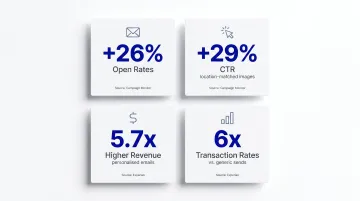
The data on personalisation is hard to ignore:
- Personalised subject lines increase open rates by 26%, per Campaign Monitor
- Location-matched images lift CTR by 29%
- Emails with personalisation generate 5.7x higher revenue, according to Campaign Monitor
- Experian found personalised emails deliver 6x higher transaction rates than generic sends
Morning Brew demonstrates what this looks like in practice. After implementing personalised re-engagement workflows, the publication saw a 125% open rate improvement and 200% daily subscriber growth — while removing 100,000 inactive users and holding 99% deliverability.
Measuring Success: Analytics That Tell You What's Working
Track these core engagement metrics for newsletters:
- Open rate — signals subject line effectiveness and send-time relevance
- Click-through rate (CTR) — indicates content relevance and CTA strength
- Scroll depth — shows how far readers engage with content (if supported)
- Unsubscribe rate — reflects content-audience fit and send frequency tolerance
- Conversion rate per issue — measures downstream action (site visits, purchases, sign-ups)
These metrics tell you what happened. AI-powered analytics tell you why — by correlating specific content topics or formats with downstream behavior — site visits, session duration, return visits — so editors know exactly which topics to double down on.
Platforms like Publive offer integrated analytics dashboards that combine newsletter performance signals with site engagement data via GA4 and GSC connectors. Publishers can see the full content-to-traffic loop and refine their newsletter strategy based on real data.
Benchmark context (Mailchimp, 2023):
- Media, Entertainment, Publishing: 23.9% open rate, 2.9% CTR, 0.1% unsubscribe rate
- Business + Finance: 31.35% open, 2.78% CTR, 0.15% unsubscribe
- Newsletters (GetResponse, 2024): 40.08% open rate
- Welcome emails: 83.63% open rate
Common Pitfalls to Avoid When Automating Newsletters
Most newsletter automation failures come down to three recurring mistakes — and each one is avoidable.
No editorial oversight: Sending newsletters without any human review opens the door to factual errors, tone mismatches, and AI hallucinations reaching subscribers. Hallucination rates across 26 top AI models range from 22% to 94%, per Stanford's 2026 AI Index Report. A brief editorial checkpoint — even a 10-minute scan before send — protects brand trust.
Weak prompt design: Vague prompts produce generic output. Treat prompt writing as a craft to iterate on, the same way editorial teams refine their style guides over time.
Neglected list hygiene: Automation amplifies the effects of a stale or poorly segmented list. Sending irrelevant content at scale accelerates unsubscribes. Roughly 22.5% of B2B contacts become invalid each year, so removing inactive subscribers and updating segments should be part of the workflow — not an afterthought.
Frequently Asked Questions
Can ChatGPT generate newsletters?
Yes, ChatGPT can draft newsletter content — summaries, subject lines, introductions — when given clear prompts. It works best as one component in a larger automation workflow rather than a standalone solution, and always benefits from editorial review.
Can AI make an industry newsletter?
AI can curate industry news, summarise articles, and assemble formatted newsletters on a defined schedule, making it well-suited for industry roundup newsletters — especially when connected to real-time content sources like RSS feeds or web search APIs.
What is the best AI tool to create a newsletter?
The right tool depends on your use case. General marketers often start with Beehiiv or Mailchimp with AI add-ons, while media publishers and enterprise teams benefit from platforms that combine AI content creation, CMS, and analytics in a single workflow.
How do I maintain brand voice when automating newsletters with AI?
Brand voice is preserved through detailed system prompts, writing samples as references, and a reusable prompt library for recurring newsletter sections, combined with a brief human review before each send.
What tasks in newsletter creation can actually be automated?
Automatable tasks include content sourcing and filtering, article summarisation, subject line generation, audience segmentation, send-time scheduling, and performance reporting — while strategic editorial decisions and brand judgement still benefit from human input.
How do I measure whether my AI-automated newsletter is actually improving engagement?
Track open rates, click-through rates, and downstream site traffic per issue. Use A/B testing on subject lines and content formats to isolate what the AI-optimised elements are contributing to engagement gains.