
Meanwhile, content demand is skyrocketing. Marketers experienced a 54% increase in content volume expectations in 2023, then saw business demand surge another 93% between 2023 and 2024. Yet marketing budgets dropped to 7.7% of overall company revenue in 2024, down from 9.1% the previous year—a 15% year-over-year decline. The gap between demand and resources has never been wider.
AI offers a solution—not just as a writing assistant, but as an engine that automates the entire content supply chain. From ideation to performance feedback, AI can remove the manual handoffs, approval bottlenecks, and distribution chaos that plague content teams, helping them scale output without proportionally growing headcount.
TLDR
- Manual handoffs across planning, creation, review, publishing, distribution, and analytics create delays and inconsistency
- AI automates repetitive tasks at every stage, not just content generation
- Organisations with very high automation meet content demands 24% more often than peers with low automation
- Fix your workflow first, then automate, then scale: automating a broken process only amplifies inefficiencies
- Governance and quality standards must precede automation to maintain brand consistency
What Is the Content Supply Chain (and Where It Gets Stuck)
The content supply chain is the end-to-end system through which content moves: from strategy and ideation, through production and approval, to publishing, distribution, and performance measurement. Like a physical manufacturing supply chain, bottlenecks at one stage slow everything downstream.
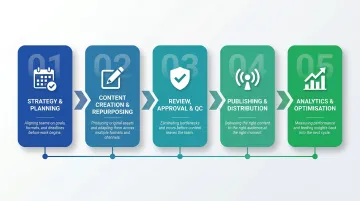
The chain consists of five core stages:
- Strategy & Planning — Teams identify topics, assign briefs, and build editorial calendars, typically through manual research and spreadsheet coordination.
- Content Creation & Repurposing — Writers produce drafts and adapt them across formats (social posts, newsletters, web stories). The most visible stage, but rarely the slowest.
- Review, Approval & Quality Control — Drafts move through stakeholders for feedback and sign-off. Version control happens in email threads, Google Docs comments, or not at all.
- Publishing & Distribution — Content goes live, then gets manually copied to social channels, pushed to newsletters, and shared across platforms—often with inconsistent formatting.
- Analytics & Optimisation — Teams track performance and adjust future strategy. In practice, most teams lack time to close this loop meaningfully.
Where the Chain Breaks Down
The most common failure points are manual handoffs between tools and teams. A brief starts in email, moves to a Google Doc, gets revised in a CMS, and requires metadata tagging in a separate system. Each transition introduces delay and error.
These handoffs pile up fast. Three failure modes show up repeatedly across content teams:
- Approval delays: Without routing rules or version tracking, drafts sit in limbo. One CMI case study found a 9-day approval cycle cut to a few hours after workflow restructuring.
- Distribution repetition: Social managers paste the same article into five channels, adjusting formatting each time. Push notifications and newsletters require separate tools and duplicate effort.
- Analytics gaps: Performance data rarely feeds back into planning. Most teams track metrics but don't have time to act on them.
The pressure grows with volume. What works for a team publishing 10 pieces a month breaks at 100. 45% of B2B marketers say they have no scalable model for content creation — and that gap is exactly what AI-driven automation is built to close.
How AI Automates Each Stage of the Content Supply Chain
Content Planning and Ideation
AI tools analyse search trends, social signals, and historical content performance to surface high-potential topics automatically. Rather than spending hours researching keywords and guessing what will resonate, teams receive data-backed recommendations.
62% of marketers use generative AI to brainstorm new topics, while 32% use it to outline assignments. AI-driven editorial calendar generation suggests what to write, for which audience, and when to publish—reducing the strategic guesswork that slows planning cycles.
The catch? Only 19% of B2B marketers have integrated AI into daily workflows, meaning most teams brainstorm with AI but don't systematically apply it to ongoing planning.
Content Creation and Repurposing
Generative AI accelerates first-draft production and adapts a single long-form piece into multiple formats—social posts, newsletters, summaries, push notifications—without starting from scratch.
A randomised controlled trial with 453 college-educated professionals found that access to ChatGPT decreased writing task completion time by 40% and raised output quality by 18% as measured by blind evaluators. AI handles the repeatable, format-shifting work so human writers can focus on original reporting and editorial judgment.

Platforms like Publive embed AI-powered content creation and repurposing directly into the CMS, allowing teams to generate and adapt content in minutes rather than hours. For publishers managing multilingual audiences, AI-driven translation and localisation eliminate the need to restart production from scratch for each language.
Review, Approval, and Quality Control
AI handles the mechanics of review workflows, including:
- Tracking version changes and maintaining a single source of truth
- Flagging tone inconsistencies or brand voice deviations before they reach a reviewer
- Checking for duplicate content across the archive
- Routing drafts to the correct approver based on content type or topic
52% of marketers cite "collecting quality data" as their #1 challenge in marketing automation workflows, which compounds at the review stage. When approval rules are undefined and workflows lack structure, content stalls regardless of how fast the initial draft was created.
Automated review systems track changes, notify stakeholders when action is required, and flag deviations from brand guidelines before content goes live. The result: fewer errors and no time lost chasing approvals.
Publishing, Distribution, and Amplification
AI-driven distribution automation triggers publishing across channels—website, social media, push notifications, newsletters—based on pre-set rules and audience behaviour data.
59% of marketers have partially automated their customer journey, with 32% having "mostly automated" it. Only 9% have fully automated journeys.
AI determines optimal publish times per channel and personalises content presentation by audience segment. Publive's platform automates social media sharing and includes an integrated push notification system, enabling editors to distribute content at scale without manual copy-pasting across channels. Companies publishing 16+ blog posts per month receive 3.5x more traffic than those publishing 0-4 posts monthly. Automated distribution makes this volume sustainable.
Performance Analytics and Feedback Loop
AI closes the loop by automatically aggregating performance signals—page views, engagement rates, time on page, referral sources—and translating them into actionable insights.
Only 51% of B2B marketers agree their organisation measures content performance effectively. Among top performers, this rises to 84%, but drops to just 15% among the least successful. The gap isn't a tools problem. It's a feedback loop problem: analytics rarely connect back to strategy in a structured way.
41% of B2B marketers say "easy access to enterprise analytics" is missing from their tech stack, and 47% lack "streamlined marketing data management and reporting." Only 12% currently use generative AI tools to analyse data or performance.
This feedback loop—where data from the last piece informs the strategy for the next—is what transforms a content supply chain from reactive to genuinely intelligent. AI surfaces patterns human teams would miss: which topics drive engagement, which formats perform on which channels, and when audience attention peaks.
The Business Case for AI-Powered Content Workflows
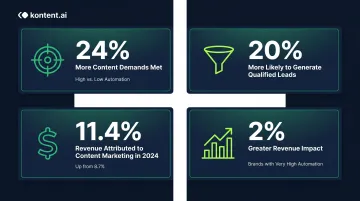
Organisations with a "very high level of automation" meet their content demands 24% more often than peers with low or moderate automation, according to Deloitte Digital's 2024 survey of 650 U.S. leaders. They are also 20% more likely to report more qualified leads and 12% more likely to report higher customer engagement.
AI automation doesn't just speed up tasks—it multiplies what a fixed-size team can produce and manage. When repetitive tasks (metadata tagging, format conversion, approval routing, social scheduling) are removed from human workflows, creative and strategic capacity increases without adding headcount.
The revenue impact is measurable too. Per the same Deloitte research, content marketing accounted for 11.4% of company revenues in 2024, up from 8.7% in 2023. Brands with "very high" automation reported a 2% greater revenue impact from content marketing.
Faster time-to-publish means more content is ranking, driving traffic, and generating revenue sooner. Reduced error rates—from automated review and version control—lower costly corrections and brand inconsistencies.
Automating the content supply chain is also a prerequisite for getting value from generative AI. Without a structured workflow, AI-generated content creates chaos: too much volume, no governance, inconsistent quality. The infrastructure has to exist before the scale does.
The adoption numbers make this gap concrete:
- 65% of organisations regularly use generative AI in at least one business function, nearly double from 10 months prior (McKinsey, 2024)
- Only 5% have scaled to the point of being fully operationalised
- 75% of companies that haven't adopted GenAI cite change management concerns as a primary barrier
The bottleneck isn't AI capability — it's workflow readiness. Teams that adopt GenAI without governance or automation in place stall before they can scale.
How to Start Automating Your Content Supply Chain with AI
Step 1 — Audit Your Workflow
Map every handoff before touching any tools. Identify where content stalls, define governance rules (who approves what, how metadata gets applied, what defines "published-ready"), and document the current state honestly.
Automating a broken process scales the chaos, not the output. If approval routing is unclear or metadata is inconsistent, fix those first — then automate.
Step 2 — Automate Repetitive Stages First
Once the foundational process is documented and clean, apply automation tools to the most time-consuming, repetitive stages:
- Approval routing and notifications
- Metadata tagging and content classification
- Social scheduling and cross-channel distribution
- Version control tracking

Choose a platform that integrates across your CMS, social channels, and analytics stack to avoid creating new silos. 40% of marketers cite "integrating technologies/data" as one of the most challenging aspects of using marketing automation.
Step 3 — Scale with AI
Once your automated workflow is stable — approval queues clearing on time, metadata applied consistently, no manual workarounds — that's the signal to layer in generative AI: content drafting, repurposing, and predictive planning. At this stage, AI accelerates an already functioning system rather than patching gaps in a broken one.
Teams that follow this sequence typically reach full AI-assisted workflows within one to two quarters, without the rework that comes from automating prematurely.
Common Mistakes to Avoid When Automating Content Workflows
Automating in Isolation
Many teams automate one stage (usually content creation) without connecting it to the rest of the workflow. The result? Faster drafts that still get stuck in manual approval chains or distributed inconsistently.
AI delivers compounding gains when it spans the full chain, not isolated tasks. Automating creation without touching distribution or analytics means speed gains stall the moment a draft hits a human queue.
Skipping Governance
AI-generated content at scale without editorial standards, review rules, or brand voice guidelines produces quantity without quality. Content governance—defined before automation—is the difference between scaling well and scaling noise.
Marketers shifted toward simpler GenAI use cases in 2024 (brainstorming, short-form text) and decreased usage for automating content production, a clear signal that scaling GenAI without governance foundations still breaks down in practice.
That breakdown often has another cause: the tools themselves don't talk to each other.
Treating Every Tool as a Separate Solution
The marketing technology landscape grew to 14,106 products in 2024, a 27.8% year-over-year increase. Yet martech utilisation has dropped to 33% in 2023, down from 58% in 2020—teams use only one-third of available capabilities.
A fragmented stack—one tool for creation, another for distribution, another for analytics—just replaces old handoff problems with new ones. Platforms that consolidate the content supply chain into a single governed environment reduce manual transitions between tools and, critically, improve actual adoption.
Frequently Asked Questions
What is a content supply chain?
The content supply chain is the end-to-end system through which content is planned, created, approved, published, distributed, and measured. Treating it as a connected system rather than isolated tasks is critical for scalability, as bottlenecks at one stage ripple downstream.
How does AI improve content workflow efficiency?
AI automates the most repetitive, high-volume tasks at each stage — from surfacing content ideas and generating drafts to routing approvals, scheduling distribution, and reporting on performance. This allows human teams to focus on strategy and quality while AI handles execution.
What is the difference between content automation and AI content generation?
Content automation refers to workflow automation (routing, scheduling, tagging, publishing triggers), while AI content generation specifically refers to using LLMs or generative AI to produce written content. Used together, they complement each other — neither replaces the other.
Which stages of the content supply chain benefit most from AI automation?
Distribution scheduling, metadata tagging, approval routing, and content repurposing deliver the highest ROI: all are high-frequency, rule-based, and time-consuming tasks that require minimal creative judgment. These stages scale far more efficiently with automation than with human-only processes.
Do you need a large team or big budget to automate your content supply chain?
Automation platforms have become more accessible, and even small editorial teams can start by automating one or two stages (like social scheduling or approval notifications) before expanding. The goal is a connected workflow, not a complete overhaul overnight.
How do you measure the success of AI-powered content workflow automation?
Track metrics like content velocity (pieces published per week), time-to-publish, content error rate, team capacity freed up, and downstream performance metrics like organic traffic and engagement rates. These indicators reveal whether automation is delivering real ROI or simply shifting bottlenecks elsewhere.