For teams managing content across regions, languages, and audiences, this shift isn't theoretical. ChatGPT now processes 2.5 billion queries daily, while AI referral traffic grew 527% year-over-year. Nearly 31.3% of the US population will use generative AI search in 2026. The brands that earn citations in AI answers gain disproportionate visibility. Those excluded lose market share.
Understanding AI search optimization — also called Generative Engine Optimization (GEO) or Answer Engine Optimization (AEO) — is no longer optional. It's a strategic requirement for maintaining brand presence across global markets.
TL;DR
- GEO focuses on earning citations inside AI answers, not ranking in traditional search results
- AI search is fragmented across ChatGPT, Perplexity, Google AI Mode, Gemini, and region-specific platforms like Baidu and Yandex
- Structured content with clear headings, schema markup, and factual clarity drives AI citations
- Multi-language GEO is an emerging frontier with limited competition in non-English markets
- Attribution tools now connect AI search visibility directly to revenue, making GEO ROI measurable
GEO Replaces Traditional SEO Rankings as the Primary Visibility Goal
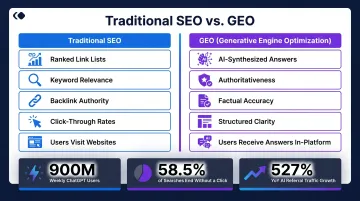
Traditional SEO optimizes content to appear in a ranked list of links on a search engine results page. Users scan the list, click a result, and visit a website. Generative Engine Optimization (GEO) operates differently: it optimizes content to be cited inside AI-synthesized answers, where the user receives information without necessarily clicking through to a source.
The mechanics, metrics, and content requirements differ at every level. SEO relies on keyword relevance, backlink authority, and click-through rates. GEO is evaluated on authoritativeness, factual accuracy, and structured clarity — the signals large language models use to decide which sources to cite.
How This Shift Manifests for Global Teams
Content is now evaluated on multiple dimensions beyond keyword optimization:
- Authoritativeness — Does the content demonstrate expertise through credentials, citations, or third-party validation?
- Factual accuracy — Are claims verifiable, specific, and free of contradictions?
- Structured clarity — Is the content organized with clear headings, bullet lists, and self-contained sections?
- E-E-A-T signals — Does the content reflect Experience, Expertise, Authoritativeness, and Trustworthiness across regions?
Global teams managing content in multiple languages must apply these criteria consistently, not just in English-language markets.
Real-World Adoption and Scale
The data shows how quickly this shift is playing out in practice:
- AI referral traffic to US retail sites grew 693% year-over-year during Holiday 2025
- ChatGPT referrals increased 52% YoY from September-November 2025, while Gemini referral traffic grew 388%
- 58.5% of Google searches in the US end without a click, meaning users receive answers directly from AI systems
For publishers and brands, the impact is direct. Ahrefs found that AI referral traffic drove 12.1% more signups despite representing only 0.5% of total visitors. The Washington Post reported that visitors from AI platforms converted to subscriptions at 4-5x the rate of traditional search visitors.
Why This Trend Is Accelerating
LLM usage is expanding rapidly. ChatGPT reached 900 million weekly active users in February 2026, up from 400 million one year earlier. With 58.5% of searches already ending without a click, research, comparison, and purchase-intent queries are increasingly resolved inside AI platforms before a user reaches any website. For global content teams, citation in AI-generated answers is now a measurable traffic and revenue channel — one that rewards authoritative, well-structured content over keyword density alone.
AI Search Fragmentation Creates a Multi-Platform Global Landscape
Unlike traditional search where Google commanded near-universal dominance, AI search is distributed across a fragmented ecosystem. Different AI platforms serve different use cases, audiences, and regions — and no single platform controls the market.
The Multi-Platform Reality
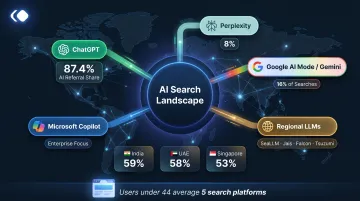
- ChatGPT leads for conversational research and general queries, holding 87.4% of AI referral traffic
- Perplexity specialises in real-time fact-finding, accounting for approximately 8% of AI referral traffic
- Google AI Mode and Gemini integrate AI answers directly into browsing, with Google AI Overviews appearing in at least 16% of all searches
- Microsoft Copilot targets enterprise workflows, gaining traction in North America and Europe
- Regional LLMs are emerging in specific markets, including SeaLLM (Southeast Asia), Jais and Falcon (Middle East), and tzusumi (Japan)
Users under 44 average five search platforms, meaning a single-platform strategy fails to capture the full landscape.
Global Implications of Platform Fragmentation
Platform reach varies sharply by region. AI adoption rates illustrate where the pressure is highest for global teams:
- India: 59% AI adoption (source)
- UAE: 58%
- Singapore: 53%
Copilot's stronger enterprise presence in Europe and North America, combined with Perplexity's growth in tech-forward markets, means no regional strategy translates cleanly across borders.
Leading brands now track brand visibility across 8-11 AI engines simultaneously using tools like Goodie and Profound, which monitor citations, sentiment, and competitive share across ChatGPT, Gemini, Llama, Perplexity, DeepSeek, and others.
Why Fragmentation Is Intensifying
AI startups raised $73.1 billion in a single quarter in late 2025, accounting for 58% of all global venture capital funding. New entrants like Grok, Meta AI, and DeepSeek are pulling users away from established platforms. For enterprise content teams, this means optimising for one or two AI engines is no longer sufficient — coverage now requires a deliberate, multi-platform content strategy.
Structured, Semantically Clear Content Becomes the Global AI Ranking Signal
AI systems parse content into discrete, usable chunks: evaluating headings, Q&A formats, schema markup, and self-contained factual statements, then assembling these pieces into synthesized answers. Brands whose content architecture enables this parsing consistently earn citations. Those relying on unstructured long-form prose remain invisible to AI systems.
Content Architecture That Wins Citations
Research shows clear patterns in what AI systems prioritise:
- Pages with sequential headings and rich schema markup achieve 2.8x higher citation rates
- 44.2% of AI citations come from the first 30% of content, meaning introductions must be self-contained and factual
- Content with statistics every 150-200 words sees 30-40% higher visibility
- FAQ, HowTo, and Article schema are linked to higher inclusion rates in Google AI Overviews
AI crawlers like OpenAI's GPTBot and OAI-SearchBot, Perplexity's PerplexityBot, and Anthropic's ClaudeBot evaluate content based on structural clarity, not just topic relevance.
Practical Implementation for Global Teams
Global teams must apply structural principles consistently across all content, including translated and localised pages:
- Use logical H1, H2, H3 heading hierarchies to guide both readers and crawlers
- Include FAQ sections that answer common queries in plain, direct language
- Break complex information into bulleted or numbered lists
- Implement JSON-LD schema for Article, FAQ, Product, and Organisation types
- Write sentences that stand alone as factual claims, without requiring surrounding context

Platforms built with AI search discoverability as a core design principle can handle much of this at the infrastructure level. Publive, for instance, delivers a 98% Core Web Vitals pass rate alongside AI-optimised content publishing, covering both traditional SEO and AI search requirements within a single platform.
Why Structural Optimisation Matters
Pages not updated in 3+ months are 3x more likely to lose citations. Content written at 8th-10th grade reading level earns citations more consistently. And critically, 85% of brand mentions in AI answers originate from third-party pages, not owned domains — meaning third-party citation presence is essential.
High-quality content alone is not enough. Without structural alignment, even well-researched pages are passed over — AI systems simply cannot extract what they cannot parse.
Multi-Language GEO and Content Localization Emerge as a Global Priority
While English-language GEO practices are maturing rapidly, AI search optimization in non-English languages is an early frontier. LLMs draw from deeply unequal training data across languages — brands with multilingual content strategies must work significantly harder to earn citation-worthy authority in non-English AI search environments.
The Language Gap in AI Search
The scale of the gap is significant:
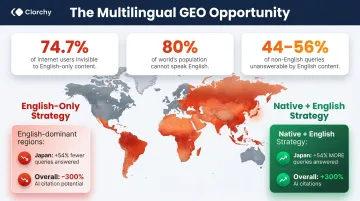
- English-only content is invisible to 74.7% of the world's internet users within AI search environments
- 80% of the world's population cannot speak English
- English-only content leaves AI systems unable to adequately answer between 44% and 56% of non-English queries
In Japan, adding native-language content allowed AI to satisfactorily answer 54% more queries than English content alone. Germany and Spain showed similar failure rates for English-only content.
How Global Teams Are Responding
Leading brands are applying GEO principles to localized content:
- Structured headings — Clear H2/H3 hierarchies in local languages
- Local E-E-A-T signals — Citations from region-specific authoritative sources
- Market-specific schema — Markup tailored to local search behaviors
- Locally-cited third-party sources — Building citation presence in regional publications
One verifiable case: companies investing in localized AEO content saw a 300% increase in AI citations across all major AI engines. A combined native-language and English content strategy outperforms English-only content by as much as 54%.
Why This Is Becoming Urgent
Those results matter more urgently than most teams realise — because AI search adoption is already global, not just Western. India leads global AI adoption rankings with 92% of workers using AI tools several times per week. Brands that build localized AI visibility now will accumulate an early lead that compounds over time. Competition in local languages is currently so low that brands are ranking "instantly" or within one month — but that window narrows as more teams catch on.
AI Search Attribution and ROI Measurement Capabilities Mature
As AI search becomes a meaningful traffic and revenue source, global marketing teams are moving beyond vanity metrics toward rigorous attribution models that connect AI visibility to website sessions, leads, and conversions.
Platform Evolution Driving Measurement
Tools like Goodie and Profound now track citations, sentiment, and competitive share across 10+ AI engines including ChatGPT, Gemini, Llama, Perplexity, and DeepSeek. Advanced platforms integrate with GA4 and CRM systems to connect AI search presence to funnel outcomes.
The two platforms address distinct needs:
- Goodie — answer optimization workflows, misinformation detection, brand accuracy tracking, and content gap analysis
- Profound — prompt volume tracking (the AI equivalent of keyword search volume), crawler analytics, and API access for custom analytics stack integrations
Conversion Rate Benchmarks by Platform
Not all AI platforms deliver equal conversion rates:
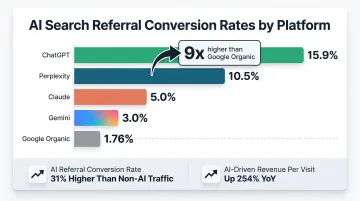
- ChatGPT referral conversion rate: 15.9% — nearly 9x the rate of Google organic (1.76%)
- Perplexity: 10.5%
- Claude: 5.0%
- Gemini: 3.0%
Overall, AI referral conversion rate is 31% higher than non-AI traffic, and AI-driven revenue per visit is up 254% YoY.
These conversion advantages are accelerating enterprise-level commitment to GEO measurement.
Enterprise Investment and Impact
Senior marketing leaders are responding to the data:
- 97% of 250+ surveyed CMOs, VPs, and Senior Directors reported a positive impact from AEO in 2025
- 94% plan to increase AEO investments in 2026
- Nearly 70% of businesses report higher ROI from incorporating AI into their SEO/GEO strategy
Brands see a 40-60% increase in citation rates after 90 days of GEO optimization — a timeline short enough to demonstrate ROI within a single quarter.
Why Measurement Maturity Matters
Without proper attribution, global teams struggle to justify GEO investment to leadership, optimize across regions, or benchmark AI search against paid and organic channels. The teams seeing the strongest returns treat measurement infrastructure as a prerequisite — not an afterthought — before scaling AI search strategies.
What's Driving These AI Search Optimization Trends
Three forces are pushing global marketing teams toward AI search optimization simultaneously: accelerating LLM adoption, measurable shifts in user behavior, and mounting pressure to consolidate tools.
Technology Acceleration and LLM Proliferation
ChatGPT reached 900 million weekly active users in February 2026, up from 400 million one year earlier. The rapid improvement and adoption of large language models — combined with their integration into search, browsers, and enterprise tools — has fundamentally altered how information is discovered and consumed.
Total AI chatbot traffic reached 55.2 billion visits in 2025, an 81% YoY increase. Teams that assumed a two-to-three-year window to adapt are now working on months.
Shifting User Behavior and Competitive Pressure
Users increasingly trust and prefer AI-synthesized answers. Google processes 417 billion searches per month vs. ChatGPT processing 72 billion messages per month, showing that AI search is capturing meaningful query volume.
Early-mover brands that have invested in GEO are already gaining disproportionate AI visibility. Between 40% and 60% of cited sources change month-to-month across Google AI Mode and ChatGPT, creating urgency for competitors to respond or lose share of voice.
Demand for Efficiency and Consolidation
Enterprise adoption has accelerated sharply:
- Worker access to AI rose by 50% in 2025
- 34% of enterprise marketing teams run at least one autonomous agent in production, up from 14% in Q4 2025
For teams managing multi-region, multi-language content at scale, the priority has shifted: reduce tool sprawl, cut operational overhead, and consolidate GEO readiness, content production, and performance analytics into fewer systems — ideally one.
How These Trends Are Impacting Global Marketing Teams
Across industries — from media and publishing to financial services and healthcare — these AI search trends are producing concrete operational, strategic, and workforce changes.
Operational Impact
Teams are adding new content review steps for GEO readiness:
- Schema validation to ensure structured data is present and correct
- AI crawler permissions management via robots.txt for GPTBot, ClaudeBot, and PerplexityBot
- Structured formatting audits to verify heading hierarchies and content organisation
This checklist signals a broader infrastructure shift — away from bolt-on SEO fixes and toward platforms built to satisfy both traditional search and AI crawler requirements from the ground up. Publive, for example, achieves 98% Core Web Vitals pass rates while publishing AI-optimised content, handling both requirements within a single platform.
Business Impact
Organisations are shifting budget from purely traditional SEO tooling toward GEO/AEO platforms and AI visibility measurement infrastructure. 54% of marketers are planning GEO implementation within 3-6 months.
KPIs are being revised to include:
- AI share-of-voice across multiple platforms
- Citation frequency in AI answers
- AI-attributable revenue alongside organic traffic metrics
Workforce Impact
Global teams are developing new capabilities:
- GEO strategy and content architecture planning
- AI content optimisation and structured markup implementation
- Multi-engine visibility analysis and competitive tracking
Organisations are upskilling existing content and SEO roles or hiring specialists. Agencies are building AEO service offerings to address client demand.
Future Signals for AI Search Optimization in Global Marketing
AI search is still in an early, fast-moving phase. The trends accelerating today are likely to intensify significantly over the next 1-3 years.
Agentic AI Will Bypass Brand Websites Entirely
The agentic AI market was valued at $608–634 billion in 2025 and is projected to grow to $11.6–16.3 trillion by 2034. Gartner forecasts that by 2028, 15% of day-to-day work decisions will be made autonomously through agentic AI.
At that scale, agentic AI will increasingly route purchase decisions and service recommendations without ever visiting a brand's website. For global marketing teams, being cited by AI becomes the primary point of contact with buyers — not a supplementary channel. Teams that are not citation-ready by 2025–2026 will face real competitive disadvantage as agentic commerce scales.
Regional AI Platforms Will Fragment the Landscape Further
Regional AI platforms and local-language LLMs — particularly across South Asia, Southeast Asia, the Middle East, and Latin America — will create new market-specific GEO requirements.
Named regional LLMs in active development include:
- Jais and Falcon (Middle East/Arabic)
- SeaLLM (Southeast Asia, including non-Latin scripts like Lao and Khmer)
- tzusumi (Japan)
- Latam-GPT (Latin America)
- InkubaLM (Africa, supporting English, French, Hausa, Swahili, IsiXhosa, IsiZulu, Yoruba)
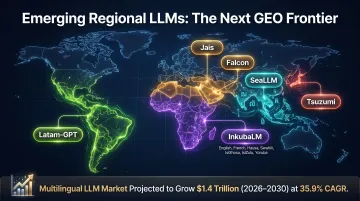
The multilingual LLM market is expected to grow by $1.4 trillion from 2026–2030, at a CAGR of 35.9%. Each of these platforms will have distinct training data, citation logic, and content preferences — making localized GEO strategy far more complex than straightforward translation.
Measurement Standards Will Converge
Right now, AI search performance is largely unmeasured or inconsistently tracked. As platforms like Profound, Goodie, and others mature, that changes. Three metrics are emerging as the likely industry benchmarks:
- Share of voice — how often your brand appears in AI-generated responses vs. competitors
- Citation rate — the percentage of relevant queries where your content is referenced
- Sentiment score — how AI models characterise your brand when cited
Once standardised, these metrics will make AI search performance as reportable and comparable as organic and paid channels are today.
Only 23% of marketers are currently investing in GEO measurement — a number that will climb sharply as AI attribution tools move from experimental to essential.
Conclusion
AI search optimization is not a future concern for global marketing teams — it is a present competitive reality. The five trends covered here reflect a structural shift in how brand visibility is earned, measured, and defended across global markets, platforms, and languages.
Teams that start adapting now — restructuring content infrastructure, building multilingual pipelines, and implementing AI attribution — will build a visibility lead that late movers will struggle to close. The window for early positioning is open, but it won't stay that way. GEO-ready platforms, structured content, and accurate attribution are no longer optional investments. They are the baseline for showing up in AI-generated answers at all.
Frequently Asked Questions
What is the difference between GEO and SEO for global marketing teams?
SEO optimises content to rank in traditional search result pages, while GEO focuses on getting a brand cited inside AI-generated answers from platforms like ChatGPT, Perplexity, and Google AI Mode. Global teams need both, with overlapping but distinct tactics.
Which AI search platforms matter most for a global marketing strategy?
The most impactful platforms currently are Google AI Mode, ChatGPT, Perplexity, Gemini, and Microsoft Copilot. Platform dominance varies by region and use case, so multi-engine tracking is essential for global teams.
How can global marketing teams optimise content for multiple languages in AI search?
Multi-language GEO means applying structured content principles — clear headings, schema, Q&A formats, local E-E-A-T signals — consistently across localised pages. Pair this with third-party citation building in each target market and track AI visibility per region and language separately.
How do you measure AI search visibility and attribute it to business outcomes?
Purpose-built GEO tools like Profound, Goodie, and Semrush One now track brand citations, sentiment, and share of voice across AI engines. The more advanced options integrate with GA4 and CRM systems — connecting AI search presence directly to traffic, leads, and revenue.
How quickly can AI search optimisation show results for global brands?
Brands with strong technical infrastructure and solid E-E-A-T signals can see improvements in AI citation frequency within weeks. Building the topical authority behind durable AI visibility, though, takes months of consistent content investment.