Introduction
AI-powered search tools have reshaped how people find information online. ChatGPT now serves 700 million weekly active users, while Google AI Overviews appear for roughly 15% of searches across millions of keywords. These platforms don't just supplement traditional search—they often replace it entirely, delivering synthesized answers instead of blue links.
This shift creates a serious problem for publishers and brands. Even when your content ranks #1 on Google, AI Overviews can intercept the click. Research from Ahrefs shows a 58% reduction in click-through rate for top-ranking content when AI Overviews appear—dropping from 7.3% CTR to just 1.6%. Ranking is no longer enough—you also need to be the source AI engines choose to cite.
That's where Generative Engine Optimization (GEO) comes in. This article covers what GEO is, how it differs from traditional SEO, why it matters right now, and the five core principles you need to start optimizing for AI discovery.
TL;DR
- GEO structures content so AI systems — ChatGPT, Perplexity, Google AI Mode — can extract and cite it in generated answers
- Unlike SEO which targets rankings, GEO targets citations and recommendations inside AI responses
- Start with your existing SEO fundamentals — GEO builds on them, not around them
- Practical tactics cover structured, extractable content, clear entity signals, and tracking where AI systems cite you
- For publishers and media companies, GEO protects organic reach as users shift from clicking search results to reading AI-generated answers
What Is Generative Engine Optimization?
Generative Engine Optimization is the practice of optimising your digital content and brand presence so AI-powered answer engines can accurately discover, understand, and cite your content in their outputs.
Unlike traditional search engines that return ranked lists of links, generative engines use large language models (LLMs) to retrieve relevant passages from across the web, synthesise them into conversational answers, and attribute sources inline. The goal of GEO is to become the source that AI systems retrieve and cite.
GEO is a structural shift in how content gets found — not a bolt-on tactic. For media houses, publishers, and brands that depend on organic discovery, it determines whether your content appears in an AI-generated answer or gets bypassed entirely.
GEO vs. SEO: Key Differences Every Publisher Should Know
GEO Builds on Your SEO Foundation
Most strong SEO practices remain foundational to GEO performance. Quality content, technical accessibility, E-E-A-T signals (Experience, Expertise, Authoritativeness, Trust), and authoritative backlinks matter for both. A solid SEO foundation covers roughly half the work GEO requires.
The Primary Goal Shifts
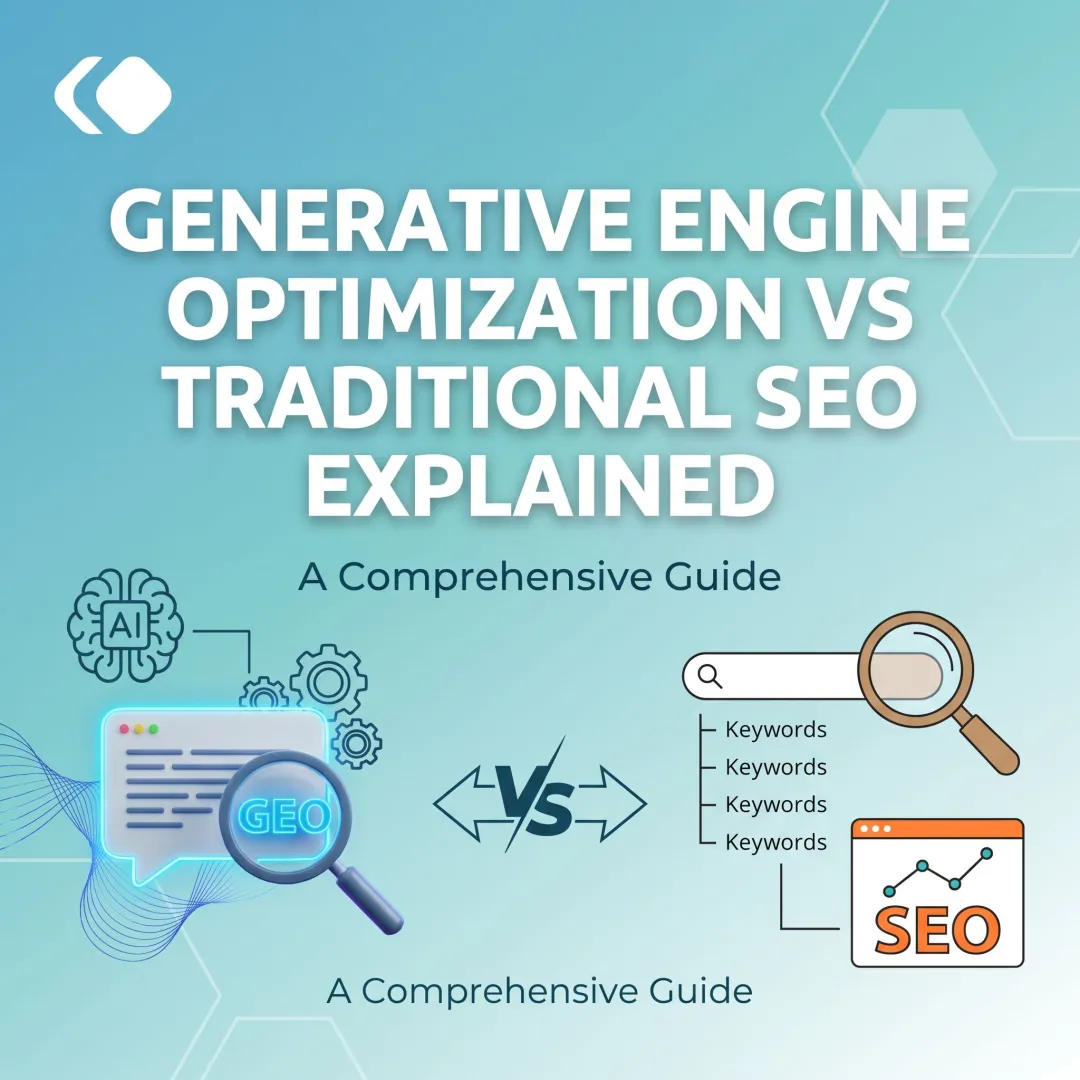
SEO optimises for rankings and clicks in traditional search results pages (SERPs). GEO optimises for mentions, citations, and recommendations inside AI-generated answers. The success metric shifts from "Where do I rank?" to "Am I being cited?" That shift in metric has a direct impact on how your content needs to be written and structured.
How Content Structure Requirements Change
Traditional SEO often rewards long-form comprehensive coverage. GEO rewards content that AI can extract easily:
- Self-contained paragraphs that make sense out of context
- Front-loaded answers at the start of each section
- Concrete facts, statistics, and definitions rather than vague generalities
- Clear headings, FAQ sections, comparison tables, and numbered lists
Where You Need to Be Seen
SEO primarily targets Google and Bing. GEO requires presence across a broader ecosystem including ChatGPT, Perplexity, Google AI Mode, and the third-party platforms AI tools draw from—Reddit, YouTube, industry publications, and review sites.
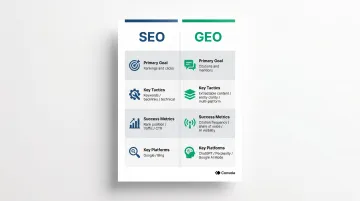
| Dimension | SEO | GEO |
|---|---|---|
| Primary Goal | Rankings and clicks in SERPs | Citations and mentions in AI answers |
| Key Tactics | Keywords, backlinks, technical optimisation | Extractable content, entity clarity, multi-platform presence |
| Success Metrics | Rank position, organic traffic, CTR | Citation frequency, share of voice, AI visibility |
| Key Platforms | Google, Bing | ChatGPT, Perplexity, Google AI Mode, third-party sources |
Why GEO Matters for Your Content Strategy Right Now
User Behaviour Is Shifting to AI Search
People increasingly turn to AI tools for direct answers rather than browsing search results. AI-driven traffic to U.S. retail sites grew 393% year-over-year in Q1 2026, with March 2026 alone showing 269% growth. This isn't a future trend—it's happening at scale right now.
Even more telling: 39% of consumers have used AI for shopping, 85% say it improved their experience, and 66% trust AI accuracy.
Publishers Face Specific Risk
AI Overviews and generative answers intercept traffic that used to flow to content sites. When your articles provide the answer AI is summarising but you're not cited, you bear the cost (AI trained on your content) without the benefit (the visit, the ad impression, the reader relationship).
Research from Seer Interactive shows a 61% drop in organic CTR for informational queries featuring AI Overviews, measured across 25.1 million organic impressions. However, brands cited inside the AI Overview earned 35% more organic clicks than those not cited—proving that citation visibility drives traffic even when AI answers dominate the page.
The Opportunity for Early Movers
Brands and publishers investing in GEO now can:
- Gain organic visibility in AI responses without paying for ads
- Build authority as a trusted source AI systems consistently cite
- Future-proof content as AI search becomes the dominant discovery channel
The performance data backs this up. In March 2025, AI traffic converted 38% worse than non-AI channels. By March 2026, it converted 42% better—with 12% higher engagement, 48% more time on site, and 13% more pages per visit.
Competitive Urgency Is Real
Gartner predicts traditional search engine volume will drop 25% by 2026 due to AI chatbots and virtual agents. For niche publishers and specialised media brands, that timeline is already compressing—early movers who build AI-citation authority now will be significantly harder to displace once the shift accelerates.
The 5 Core Principles of Generative Engine Optimization
GEO success rests on five connected principles — not one-time fixes, but ongoing disciplines that signal to AI systems your content is worth surfacing. Specific tactics will shift as AI evolves; these principles won't.
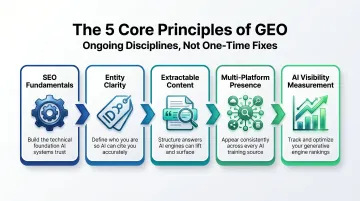
1. SEO Fundamentals Are the Starting Point
Technical accessibility, page performance, and E-E-A-T signals remain as important for GEO as they are for traditional SEO. AI crawlers need to access and render your content.
One critical issue: heavy JavaScript or client-side rendering can make content invisible to AI systems. Google's official guidance confirms that AI Overviews and AI Mode rely on core Search systems—there's no separate AIO crawler, and Googlebot powers these features.
Publishers should ensure:
- Author credentials are clear and well-attributed
- Content is technically accessible (not blocked by rendering issues)
- Page performance meets Core Web Vitals standards
For publishers on Publive, Core Web Vitals optimization and technical SEO are handled at the platform level — removing a common barrier to both traditional search ranking and AI discoverability.
2. Entity Clarity Helps AI Understand Who You Are
AI systems need to unambiguously understand what your brand is, what category it belongs to, and what topics it has authority over. Consistent descriptions across your website, social profiles, directories, and industry publications help AI confidently map your brand to the right topics.
Schema markup reinforces this in machine-readable format. But research from Kurt Fischman shows ranking position is still the primary driver — attribute-rich schema correlated with a 61.7% citation rate versus 41.6% without it, yet Position 1 was cited in 43% of queries while Position 7 dropped to just 5%.
Entity clarity starts with clear, consistent language in visible content — schema amplifies it, but doesn't replace it.
3. Write Content That Is Easy to Extract
AI systems retrieve specific passages, not entire pages, when assembling answers. Write paragraphs that express one complete idea and make sense without surrounding context.
- Citing sources: +40% visibility lift
- Adding quotations: +31% lift
- Including statistics: +27% lift
Structured formats improve extractability:
- FAQ sections with clear question-answer pairs
- Comparison tables for product or service features
- Numbered lists for step-by-step processes
- Clear headings that summarise section content
- Front-loaded answers at the start of each section
4. Build Presence Beyond Your Own Website
AI tools don't just pull from your website. They synthesise from YouTube, Reddit, review platforms, industry publications, and social channels.
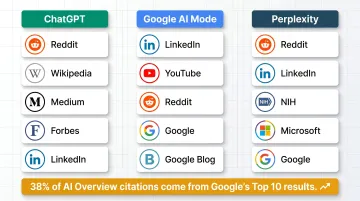
- ChatGPT most frequently cites Reddit, Wikipedia, Medium, Forbes, and LinkedIn
- Google AI Mode favours LinkedIn, YouTube, Reddit, Google, and Google Blog (LinkedIn appears in ~15% of responses)
- Perplexity draws from Reddit, LinkedIn, NIH, Microsoft, and Google with more stable sourcing
38% of AI Overview citations pull from pages ranking in Google's Top 10, and YouTube is the most-cited domain in AI Overviews overall — making video a higher-leverage channel than most publishers treat it.
Two types of presence matter here. Owned presence — your YouTube channel, LinkedIn articles, podcast appearances, expert quotes in press — gives AI more source material to draw from. Earned mentions — customer reviews, journalist citations, forum recommendations — signal credibility that owned content alone can't manufacture.
5. Measure AI Visibility as a Distinct Metric
Traditional analytics (GA4, Google Search Console) can't capture GEO impact because AI mentions may drive brand awareness and later conversions without a direct click.
New metrics needed include:
- Citation frequency – How often AI cites your brand
- Share of voice – Your mention rate vs. competitors
- Context/prompt tracking – Which topics trigger your brand mentions
- Sentiment – Whether mentions are positive or negative
These metrics won't replace your existing SEO dashboard — they extend it. Without them, AI-driven brand discovery stays invisible in your reporting.
How to Measure Your GEO Performance
The Visibility Blind Spot
GEO creates an attribution gap in traditional analytics. Users may discover your brand through an AI answer, then visit your site directly or via a branded search later. The link between AI citation and conversion is hard to trace in standard dashboards, but it can still be tracked with the right tools.
58% of marketplace consumers now use AI tools to research products, creating significant "dark traffic" that doesn't show clear referral paths in GA4. That invisible traffic is exactly what the metrics below are designed to surface.
Key GEO Metrics to Monitor
Track these metrics over time to reveal where you have AI authority and where competitors own the AI narrative:
- Citation frequency – How often you appear in AI-generated answers for relevant prompts
- Share of voice – Your mention rate compared to competitors
- Sentiment of mentions – Positive, neutral, or negative framing
- Topic/query triggers – Which questions or prompts surface your brand
Dedicated GEO Visibility Tools
Several platforms now help brands and publishers monitor AI mentions and benchmark against competitors:
- Semrush AI Visibility Toolkit – Tracks brand mentions across ChatGPT, Gemini, and Google AI Overviews; covers prompt discovery, competitive benchmarking, and daily visibility scores
- SE Ranking AI Overviews Tracker – Monitors your brand's position inside Google AI Overviews snippets, citation frequency, and how AI rankings compare to traditional search results
- Profound – Enterprise platform covering 10+ AI engines including ChatGPT, Claude, Perplexity, and Gemini; measures share-of-answer, sentiment, and prompt volumes at scale
Start with one tool, establish a baseline, and expand tracking as your GEO strategy matures.
Frequently Asked Questions
Will generative engine optimization (GEO) replace SEO?
No. GEO builds on SEO rather than replacing it. Both work together: SEO creates the technical foundation and content quality signals that AI systems rely on, while GEO extends that foundation to optimise for being cited and recommended in AI-generated answers.
What are the 5 pillars of generative engine optimization?
The five core principles are: (1) strong SEO fundamentals, (2) entity clarity, (3) content extractability, (4) multi-platform presence, and (5) AI visibility measurement. These work together to improve AI citation performance.
How do AI systems decide which content to cite and reference?
AI systems favour content that is technically accessible, clearly attributed to a credible author or brand, and written in self-contained extractable passages. Corroboration across multiple trusted third-party sources, strong ranking position, and schema richness also correlate with higher citation rates.
What types of content perform best in AI-generated answers?
Direct answers to specific questions, concrete definitions, fact-based comparisons, FAQ sections, and content containing verifiable statistics and expert quotes perform well. These formats are easy for AI to extract, reuse, and attribute accurately.
Is GEO especially important for media companies and publishers?
Yes. AI Overviews can intercept publisher traffic while summarising content without attribution — a direct threat to both visibility and authority. GEO gives publishers a path to being credited as the source as AI search continues to grow.