Introduction
AI-powered platforms have transformed content discovery at staggering scale. ChatGPT processes over 2 billion daily queries, while Google AI Overviews now appear on 15.69% of all searches by November 2025. For media publishers and content-driven brands, this shift represents both disruption and opportunity.
The urgency is clear: Gartner forecasts traditional search volume will drop 25% by 2026 as AI chatbots and virtual agents capture market share. When AI engines pull answers directly from source content, traditional rankings become secondary—visibility depends on being cited, not merely ranked.
Answer Engine Optimization (AEO) is how publishers adapt to this reality. This guide covers the strategies that matter most: structuring content for AI citation, building E-E-A-T signals that AI models trust, matching query intent with precision, and implementing structured data that makes your content machine-readable.
TL;DR
- AEO optimises content for citation by AI answer engines (ChatGPT, Perplexity, Google AI Overviews), not just search rankings
- Core strategies: structured data, answer-centric formatting, E-E-A-T signals, content freshness, AI crawler access
- AEO builds on SEO foundations; domain authority and technical SEO remain prerequisites
- Fresh, structured content earns more AI citations — publishers with strong domain authority are best positioned to benefit
- Begin by auditing AI crawler access and current citation performance before creating new content
What Is AEO and Why Does It Matter Now?
AEO optimises content to be selected as the direct answer AI engines deliver in response to conversational queries. Unlike SEO, which targets blue-link rankings, AEO structures content for AI parsing and citation.
The urgency has intensified as AI platforms reshape search behaviour. Semrush's analysis of 10M+ keywords found AI Overviews peaked at 24.61% of queries mid-2025, settling at 15.69% by November. More concerning for publishers: informational query coverage dropped from 91.3% to 57.1% as AI Overviews expanded into commercial and transactional territory, putting revenue-generating content directly at risk.
For media publishers and content-rich brands, AEO represents a strategic opportunity. AI engines need authoritative sources to cite. Publishers with structured, accurate, technically accessible content become the trusted sources these systems rely upon—but only when content is structured in ways AI systems can reliably parse and cite.
Best AEO Strategies for AI-Driven Platforms
These strategies reflect how AI engines actually process and cite content, combining technical requirements with content and authority-building tactics.
Strategy 1: Implement Structured Data and Schema Markup
Structured data tells AI engines exactly what type of content your page contains, making extraction and citation easier. Schema markup formats like FAQPage, Article, and Speakable enable AI systems to identify question-answer pairs, editorial content, and voice-surfaced passages.
Priority schema types for publishers:
- Article/NewsArticle — Editorial content requiring timestamps, authors, and publisher information
- FAQPage — Question-answer content ideal for direct citation
- Speakable — Passages optimised for voice assistants and AI-surfaced responses
- Organization — Brand identity for knowledge panels and entity recognition
Research reveals a nuanced impact. Schema App reported a 19.72% increase in AI Overview visibility after implementing connected schema with entity linking. However, OtterlyAI's controlled experiment found 6 of 7 AI platforms couldn't directly interpret schema when prompted — only Gemini retrieved correct JSON-LD.
The resolution: schema helps indirectly. It improves Google's content understanding, which increases visibility when AI systems query Google's index. For high-volume publishers, platforms that automate schema deployment at scale eliminate manual implementation overhead.
Strategy 2: Format Content for Direct Answer Extraction
AI engines prefer content structured for extraction. Answer-centric formatting places clear question-based headings followed by concise 40–60 word direct answers, then supporting context — not keyword-stuffed introductions.
Effective formatting tactics:
- Question-based H2/H3 headings — Phrase subheadings as actual user queries
- Direct definitional answers — Open sections with the core answer first
- Structured lists — Use bullets and numbered steps for multi-part content
- Dedicated FAQ blocks — Group common questions at page end
The data supports this approach. Pages previously selected for featured snippets are cited in AI Overviews at roughly 2x the rate of non-snippet pages. Winning list featured snippets yields a 75% higher chance of primary citation in AI-generated summaries, according to StackMatix research.
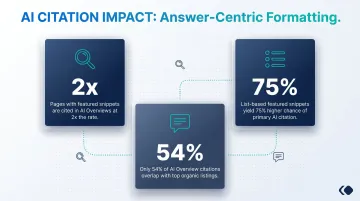
Only 54% of Google AI Overview citations overlap with top organic listings — meaning AI draws from a broader source set than traditional rankings. Answer-centric formatting increases your chances of inclusion in that expanded set.
Strategy 3: Build E-E-A-T Signals AI Engines Can Verify
E-E-A-T (Experience, Expertise, Authoritativeness, Trustworthiness) determines whether AI engines consider your content credible enough to cite. Trust is the most important component — the others contribute to its overall assessment.
Actionable E-E-A-T steps:
- Structured author profiles — Add Person schema with credentials and bylines linking to author pages
- Authoritative citations — Earn mentions in industry publications and trusted directories
- Complete organisational pages — Maintain accurate About/Contact pages with Organization schema
- Verifiable claims — Support factual statements with primary sources
For media houses and YMYL (Your Money or Your Life) content in finance and healthcare, AI engines apply stricter trust filters. Google's official documentation confirms YMYL topics receive "even more weight" on E-E-A-T signals before citation.
Google's VP of Product Robby Stein confirmed that traditional authority signals remain "extremely valid and extremely useful" for AI search. AI systems use query fan-out, issuing conventional Google searches behind the scenes, which means your established domain authority still matters.
Strategy 4: Prioritise Content Freshness and Recency
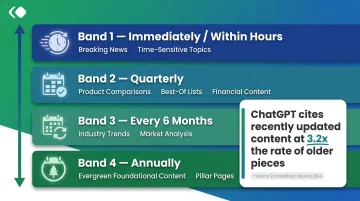
AI engines actively prioritise recently updated content for time-sensitive queries. Quattr's research found content updated within 30 days dominates AI citations, with ChatGPT citing recently updated content at 3.2x the rate of older pieces. AI-cited content is 25.7% fresher than traditional organic results.
Recommended refresh cadence:
- Quarterly — Product comparisons, "best of" lists, financial/regulatory content
- Every 6 months — Industry trends and analysis
- Annually — Evergreen foundational content
- Immediate — Breaking news and time-sensitive topics (within hours)
When refreshing content, update statistics, add FAQs that reflect emerging queries, and republish with timestamps that reflect genuine changes. Google's Query Deserves Freshness (QDF) algorithm requires 20-30% of textual content to be updated before recognising a revision as meaningful.
Changing publish dates without substantive edits triggers negative quality signals — so make updates count.
High-frequency publishers producing news, business, or financial content gain a natural AEO advantage through continuous fresh content — but only when structured and technically accessible.
Strategy 5: Ensure Technical Accessibility for AI Crawlers
AEO fails if AI crawlers cannot access or render your content. Technical accessibility requires allowing major AI bots and ensuring they can read all page content.
Critical technical requirements:
- Verify robots.txt — Confirm GPTBot, ClaudeBot, PerplexityBot, and other AI crawlers have explicit access
- Render content server-side — JavaScript-heavy pages must be pre-rendered; client-side rendering is invisible to most AI bots
- Fix crawl errors — Broken pages and redirect chains prevent full indexation by both AI and traditional crawlers
- Pass Core Web Vitals — Loading speed, interactivity, and visual stability are proxy signals for content reliability
Major AI crawler user agents to permit:
| Bot Name | Operator | Purpose |
|---|---|---|
| GPTBot | OpenAI | Training data and model improvement |
| OAI-SearchBot | OpenAI | ChatGPT search results surfacing |
| ClaudeBot | Anthropic | Real-time citations in Claude conversations |
| PerplexityBot | Perplexity | Index building for Perplexity search |
| Google-Extended | Gemini AI training data |
Core Web Vitals compliance signals content quality and reliability. Platforms optimised for these metrics — particularly those achieving high pass rates — provide technical foundations for AI discoverability alongside traditional SEO benefits.
Strategy 6: Build Omnichannel Entity Authority
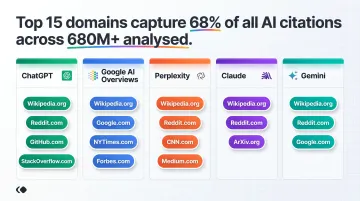
AI engines synthesise answers from multiple platforms beyond your website. The AI Platform Citation Source Index 2026, analysing 680M+ citations, found extreme concentration: the top 15 domains capture 68% of all AI citations, with Reddit alone accounting for approximately 40% citation frequency overall.
Platform-specific citation preferences:
- ChatGPT — Wikipedia (26-48% of top-10 share), Reddit, Amazon, Forbes
- Google AI Overviews — Reddit (21%), YouTube (19%), Quora, Wikipedia
- Perplexity — Reddit (6.6%), LinkedIn, NIH/PubMed, Microsoft, Britannica
- Claude — NYT, The Atlantic, The New Yorker, The Economist, Guardian
- Gemini — Reuters, Forbes, Financial Times, Time, Axios
Practical omnichannel steps:
- Complete Google Business Profile — Full Organisation schema and accurate information
- Publish expert content on high-citation platforms — LinkedIn articles, Quora answers, relevant Reddit communities
- Pursue digital PR placements — Contribute to publications AI systems treat as authoritative sources
- Maintain consistent entity presence — Ensure your brand appears across multiple trusted channels
Citation shares can shift 80% within a single month. For publishers and financial institutions relying on AI-driven traffic, that volatility is material — which is why presence across Reddit, Wikipedia, YouTube, LinkedIn, and authoritative news outlets is a hedge, not an optional extra.
AEO vs SEO: Key Differences Content Teams Must Understand
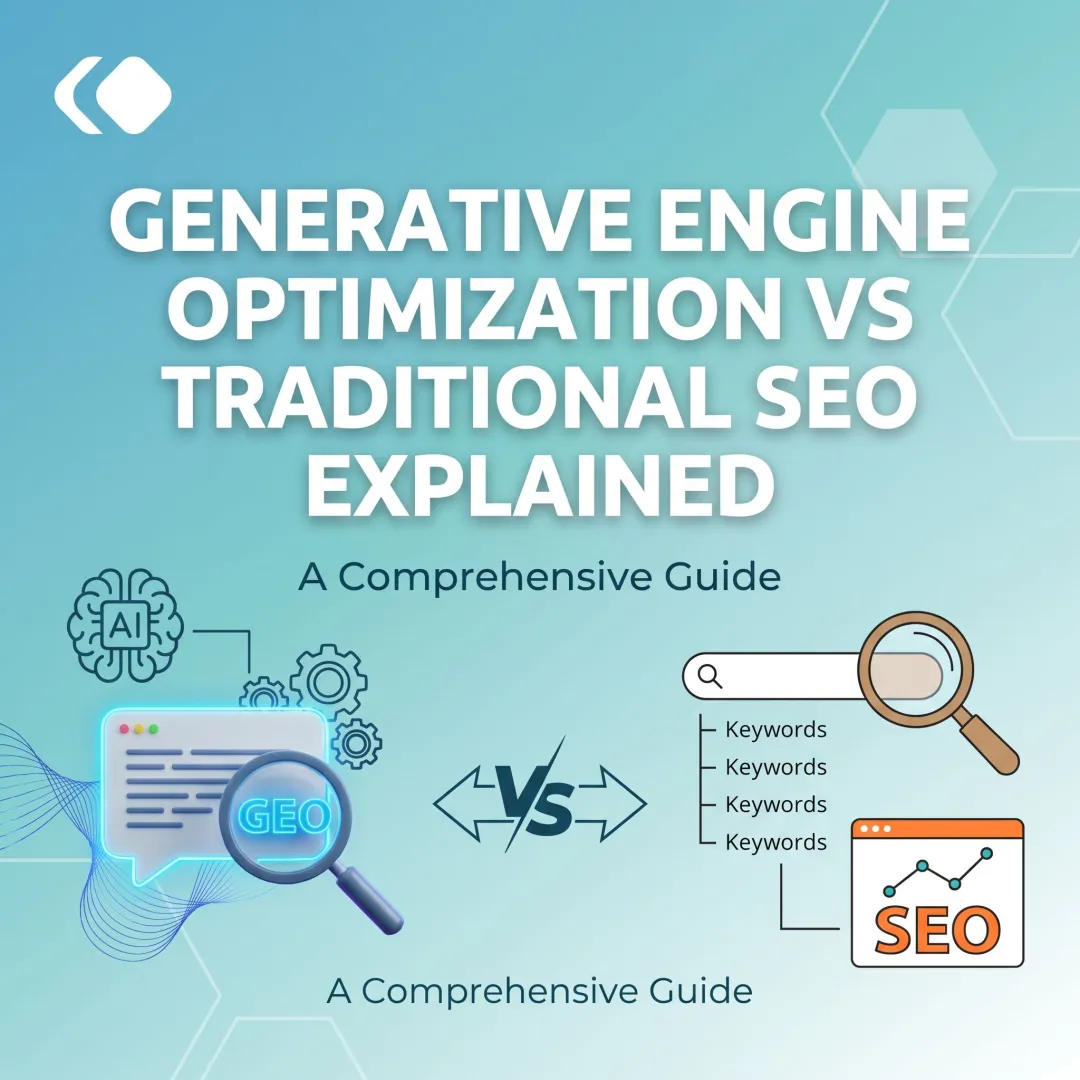
AEO and SEO serve different objectives, and understanding the gap shapes how content teams allocate effort and measure results. SEO optimizes for ranking position and click-through to your page; AEO optimizes for being selected as the synthesized answer—where success is citation frequency and brand visibility in AI responses, not organic sessions.
| Dimension | Traditional SEO | Answer Engine Optimisation (AEO) |
|---|---|---|
| Intent Parsing | Keyword-based matching | Conversational/question-based understanding |
| Result Format | Ranked links on SERP | Direct synthesised answers |
| Key Signals | Backlinks + keyword density | Structured data + trust + topicality |
| Content Format | Long-form keyword-optimised | Chunked Q&A answer modules |
| Success Metrics | Rankings + CTR | AI citations + answer share of voice |
AEO does not replace SEO. Google, Microsoft, and Moz all confirm traditional SEO signals—domain authority, quality backlinks, technical foundations—remain prerequisites for AEO success. Strong SEO creates the authority base AI systems require before citing content.
Treat AEO as an additional strategic layer. Add AEO-specific monitoring—citation share, prompt testing, multi-platform presence—to existing SEO workflows without overhauling the team structure you already have.
How to Prioritise Your AEO Strategy: Common Mistakes to Avoid
Content teams often make three critical mistakes when starting AEO: attempting to optimise everything simultaneously, ignoring technical accessibility (the fastest-impact fix), or producing new content when existing high-authority pages simply need restructuring.
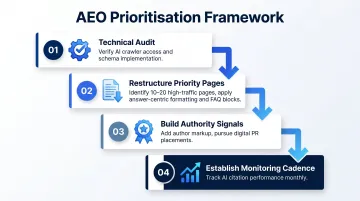
Prioritisation framework:
- Start with technical audit — Verify AI crawlers can access your site and schema is implemented
- Identify 10–20 high-traffic pages — Restructure with answer-centric formatting and FAQ blocks
- Build authority signals — Add author markup, pursue digital PR placements
- Establish monitoring cadence — Track AI citation performance monthly
Once your prioritisation order is set, the platform you build on determines how quickly you can execute each step. Evaluate tools against these criteria before committing:
- Built-in schema support and automation at scale
- AI-first content architecture designed for parsing
- Performance optimisation for Core Web Vitals
- Analytics surfacing content discoverability signals
The right infrastructure removes the manual overhead from steps 1–4 above — schema deployment, crawl access, and performance tuning become platform defaults rather than one-off fixes.
Conclusion
AEO is not a future trend—it's a present competitive necessity. Brands and publishers structuring content for AI citation today compound their visibility advantage as AI-driven search grows. With Semrush concluding "AI search traffic has the potential to overtake traditional organic search traffic within the next two to four years," delay creates permanent disadvantage.
Start with the highest-leverage fixes: verify AI crawler access, implement schema markup, then restructure priority pages with answer-centric formatting. AEO requires continuous investment — content freshness, authority building, and omnichannel presence don't hold on a fixed timeline.
Publive's platform is built for exactly this — with content architecture, schema infrastructure, and crawler access controls optimised for both traditional search engines and AI-powered discovery platforms. See how Publive enables content-led growth in the AI search era.
Frequently Asked Questions
What are the best options for answer engine optimisation in AI?
The most effective approaches combine structured data implementation (Article, FAQPage, Speakable schema), answer-centric content formatting with question-based headings, and E-E-A-T authority building through author profiles and trusted citations. Platforms built with AEO discoverability in mind automate schema deployment and handle technical foundations automatically.
What is the difference between AEO and SEO?
SEO targets ranked positions in traditional search results; AEO targets citation in AI-synthesised answers. They require different content structures, signals, and success metrics — SEO optimises for rankings and CTR, while AEO optimises for structured data, trust signals, and answer share of voice.
How does structured data help with answer engine optimisation?
Schema markup (FAQPage, Article, Speakable) tells AI engines what type of content a page contains and identifies direct answers to questions. This explicit structure makes content significantly easier for AI systems to extract and cite in responses, particularly when schema connects entities through Organisation and Person markup.
Which AI platforms should I optimise my content for?
Prioritise Google AI Overviews and AI Mode, ChatGPT, Perplexity, Bing Copilot, and Gemini. Content built on structured data, clear formatting, and strong E-E-A-T signals performs across all these platforms — though Claude favours long-form editorial content and Perplexity weights academic sources.
How do I know if my AEO strategy is working?
Track brand citation frequency in AI responses using monitoring tools like Profound or OtterlyAI. Monitor changes in branded search volume and direct traffic as secondary indicators. Audit competitor appearances in AI answers for your target topics to benchmark relative visibility and identify citation gaps.
Does AEO replace traditional SEO?
No. AEO builds on SEO foundations — strong domain authority, quality backlinks, and technical SEO remain prerequisites. Google's systems use query fan-out, meaning AI searches query traditional Google behind the scenes. Treat AEO as an additional strategic layer for content that already has solid SEO foundations.