This article explains what AI share of voice is, how it differs from traditional SOV, the exact steps to measure it across platforms, the metrics that matter most, and how to systematically improve it.
TL;DR
- AI share of voice (SOV) measures how often your brand appears in AI-generated answers compared to competitors
- Unlike traditional SEO, AI SOV is zero-click — being cited in the answer is the outcome, not a step toward one
- Measurement means defining target queries, running them across AI platforms, and logging position and sentiment
- Structured, authoritative content and third-party citations are the primary levers for improving AI SOV
- Consistent tracking and content iteration are essential as AI model behaviours shift over time
What Is AI Share of Voice — and Why It's Different from Traditional SOV
AI share of voice is the percentage of AI-generated answers in which your brand is mentioned compared to competitors, across a defined set of relevant queries. The simplified formula: (Your Brand Mentions ÷ Total Mentions Across All Brands) × 100.
How AI SOV Differs from Traditional Share of Voice
| Dimension | Traditional SOV | AI SOV |
|---|---|---|
| What it tracks | Ad spend, rankings, impressions | Brand mentions in AI-generated answers |
| Positions | Ranked (1st, 3rd, 5th…) | Binary — mentioned or not |
| Paid slots | Available | None |
| Click behaviour | CTR varies by rank | No guaranteed click at any mention |
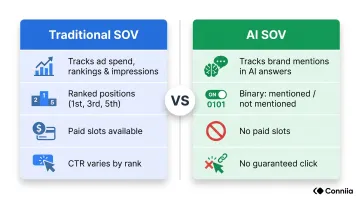
In conventional search, ranking position 3 versus position 5 represents a measurable difference in click-through rate. In AI search, only mention versus non-mention matters. That binary nature is what makes AI SOV a distinct metric — not just a variation of what you already track.
Why AI SOV Is a Leading Indicator of Brand Relevance
The numbers tell a compelling story. ChatGPT reached approximately 700 million monthly active users by early 2025, while Google Gemini hit approximately 750 million users by the end of 2025. AI Overviews now appear in approximately 55% of all Google searches.
Buyer behaviour is shifting just as fast. A March 2026 G2 survey of 1,076 B2B buyers found that 51% now start research with an AI chatbot more often than with Google — up from 29% just a year earlier. Overall, 71% rely on AI chatbots at some point during the research process.
That means a buyer may form a shortlist before they ever visit your website. If your brand doesn't appear in the AI answers they read first, you're not losing ground in search rankings — you're absent from the conversation entirely.
How to Track Your Brand's Share of Voice in AI-Driven Search
Tracking AI SOV requires a structured, repeatable methodology because AI outputs are dynamic. The same query can return different results across platforms, sessions, and time. Consistency in approach is what makes the data actionable.
Step 1: Define Your Target Query Set
Identify 15–25 high-intent queries that reflect how your target audience actually searches on AI platforms. Prioritize four query types:
- High-intent recommendation queries — "best platform for X" or "which tool should I use for Y"
- Category-definition queries — "what is the leading solution for X"
- Head-to-head comparison queries — "Brand A vs Brand B for [use case]"
- Problem-based queries — "how to solve X" or "what causes Y"
Avoid generic short-tail keywords that don't reflect conversational AI search behavior.
Step 2: Run Queries Across Multiple AI Platforms
Execute each query systematically across the major AI platforms your audience uses — at minimum: ChatGPT, Google AI Overviews, Gemini, and Perplexity.
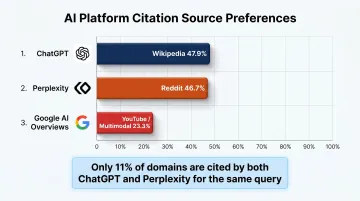
Each platform has different training data, citation logic, and response styles. Research analyzing 75,000 AI answers found that only 11% of domains are cited by both ChatGPT and Perplexity for the same query, while 71% of cited sources appear on only one platform.
Platform-specific citation preferences include:
- ChatGPT favors Wikipedia (47.9% of top citations)
- Perplexity favors Reddit (46.7% of top citations)
- Google AI Overviews favor YouTube and multimodal content (23.3% share)
That cross-platform divergence makes repeated testing essential. Run each query multiple times to account for response variability — only 30% of brands remain visible from one AI answer to the next, and only 20% remain present across five consecutive runs of the same query.
Step 3: Document Brand Mentions with Structured Logging
For each query-platform combination, record:
- Whether your brand appears (yes/no)
- How many times it is mentioned
- Where in the response it appears (first mention, mid-response, or buried in a list)
- The context in which it is described (recommended, compared, or criticized)
- Which external sources the AI cites in support of its answer
Step 4: Benchmark Against Competitors
AI SOV is inherently comparative. Identify 3–5 direct competitors and track the same metrics for them across the same queries. Calculate each brand's share as a percentage of total mentions across all tracked brands.
Note which competitors appear in queries where your brand is absent. These gaps reveal the most actionable optimization opportunities. A brand with 30% coverage but zero overlap with a competitor's top queries has a different problem than one with 30% coverage and heavy overlap.
Step 5: Establish a Measurement Cadence and Baseline
Those coverage gaps only become clear over time — which is why a regular tracking cadence matters. AI model outputs shift with updates, new training data, and content changes. Establish a consistent rhythm:
- Weekly for competitive or fast-moving industries
- Monthly for stable markets
Build a baseline over the first 4–6 weeks before drawing strategic conclusions. Publive's GA4 and GSC connectors give content teams the data infrastructure to connect AI visibility signals directly with on-site content performance, so baseline data and trend tracking live in one place rather than scattered across tools.
Key Metrics That Define AI Share of Voice Performance
Raw mention count is just the starting point. Four additional metrics tell you where your brand truly stands — and where it's losing ground.
Mention Frequency and Prompt Coverage
How often your brand appears in AI responses, and across what percentage of your tracked query set. A brand appearing in 60% of relevant prompts has stronger coverage than one with high word count in a narrow slice of queries.
Given that only 20% of brands remain visible across five consecutive runs of the same query, consistent appearance across a majority of your target queries represents differentiated performance.
Position Within the Answer
Where your brand appears in a response carries real weight — a first mention outperforms a buried list entry by a meaningful margin.
Position-weighted scoring assigns different values based on placement:
- First mention = highest weight
- Mid-response mention = medium weight
- List-only inclusion = lower weight
This approach gives a sharper competitive picture than binary presence/absence tracking. Brands that earn both a mention and a citation are 40% more likely to reappear in subsequent answers, yet only 28% of answers currently include brands with this dual visibility.
Sentiment and Context Quality
AI systems don't just mention brands — they frame them. Monitor whether your brand is described positively, neutrally, or negatively, and in what use-case context.
Is your brand associated with ease of use, pricing, reliability, or innovation? Negative mentions or weak context associations can be more damaging than no mention at all.
The buyer-behaviour data from G2 Research shows just how much framing matters:
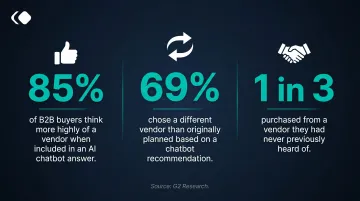
- 85% of B2B buyers think more highly of a vendor when an AI chatbot includes them in an answer
- 69% chose a different vendor than originally planned based on a chatbot's recommendation
- 1 in 3 purchased from a vendor they had never previously heard of
Competitive Share and Query Coverage Gap
Calculate the percentage of target queries where your brand appears versus where competitors appear without you. This "coverage gap" is the primary driver for content prioritisation.
A brand with 30% coverage but 0% overlap with a competitor's top queries has a different problem than one with 30% coverage and heavy overlap. The first needs broader content; the second needs stronger positioning within topics it already owns.
How to Optimize Your Brand's AI Share of Voice
Improving AI SOV comes down to one thing: making your brand the most credible, consistently referenced answer to the questions your audience is already asking. There's no shortcut — only substance.
Create Structured, Answer-First Content Targeting Your Defined Query Set
AI models are built to surface clear, direct answers. Publish content that explicitly addresses your high-intent queries with:
- Well-structured headings that mirror how people ask questions
- Concise definitions in the first paragraph
- Comparison sections with tables when evaluating alternatives
- Decision-stage language that helps users choose
Research analysing 75,000 AI answers containing 1,056,727 citations found that specific content formats dominate AI citations:
| Content Type | Share of Citations | Strongest Intent |
|---|---|---|
| Listicles | 21.9% | Commercial |
| Articles | 16.7% | Informational |
| Product pages | 13.7% | Transactional |
| How-to guides | 6.2% | Informational |
80.9% of listicle citations come from third-party (neutral) sites — only 19.1% come from brand-owned content. Focus on creating genuinely helpful comparison content, not promotional material disguised as guidance.
Build Topical Authority Through Consistent Publishing Velocity
AI models favour brands that appear as consistent, credible sources across a range of related topics. Publish regularly across the subtopics that surround your core queries.
Pages not updated at least quarterly are 3x more likely to lose their citations in AI search. Freshness matters: Perplexity shows an 82% citation rate for content updated within the last 30 days versus 37% for content over one year old — a 45-percentage-point premium for fresh content.
Publive's AI-powered content creation tools help media brands and publishers produce and repurpose content up to 60% faster, making it practical to maintain the publishing velocity needed to sustain and grow AI SOV over time.
Earn Citations on the Third-Party Sources AI Models Trust
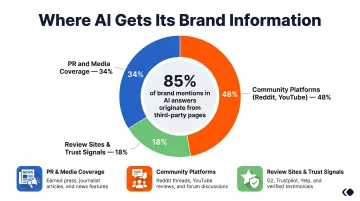
85% of brand mentions in AI answers originate from third-party pages rather than the brand's own domain. This makes earned media a primary lever for AI SOV.
Identify which third-party sources are cited most often in AI responses for your target queries:
- PR and media coverage accounts for 34% of AI citations
- Community platforms like Reddit and YouTube account for 48% of citations
- Review sites are the top trust signal that increases buyer confidence in AI chatbot answers
For B2B queries specifically, ChatGPT gives 47.6% citation share to GetApp and 84.5% to Clutch for agency queries. Develop a targeted strategy to appear on the platforms AI models already trust.
Optimise for AI Crawlability and Structured Data
Ensure your content is technically accessible to AI crawlers:
- Use schema markup for products, reviews, FAQs, and articles
- Maintain clear heading hierarchies (H2, H3 structure)
- Include descriptive metadata
- Build well-structured internal linking
- Maintain strong Core Web Vitals performance
Research from Princeton's GEO paper found that these optimisation strategies produced measurable visibility improvements:
- Citing sources within content
- Adding statistics with source attribution
- Including quotations from credible authorities
Combined, these strategies boosted visibility by up to 40% in generative engine responses.
Act on Citation Gap Analysis to Close Competitive SOV Gaps
Once your technical foundation is in place, gap analysis tells you exactly where to focus next. For each query where a competitor appears and your brand doesn't, trace back to the specific sources the AI cited in that response. Update or create content that directly addresses those sources' positioning, then work to earn new citations from them.
This systematic gap-closing approach targets the highest-value opportunities first: queries where competitors have won visibility but you haven't.
Common Mistakes That Undercut AI Share of Voice
Tracking Volume Without Weighting for Sentiment or Position
Many teams celebrate a rise in mention count without checking whether those mentions are positive, neutral, or buried at the bottom of a list. A brand mentioned frequently in negative or irrelevant contexts may actually be worse off than a brand with fewer but authoritative, well-positioned mentions.
Treating AI SOV as a One-Time Audit Rather Than an Ongoing Signal
AI model outputs shift continuously as models update, new content is indexed, and competitors make content changes. BrightEdge data shows AI search referral traffic experiencing dramatic month-over-month swings, with individual platforms doubling traffic in single months.
Teams that run a single SOV snapshot and don't build a regular tracking cadence will consistently act on stale data.
Optimizing Only for Traditional SEO Signals While Ignoring GEO-Specific Requirements
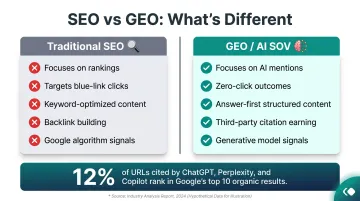
High organic rankings don't guarantee AI mentions. Only 12% of URLs cited by ChatGPT, Perplexity, and Copilot rank in Google's top 10 organic results. More striking: 28.3% of ChatGPT's most-cited pages have zero organic visibility.
AI models prioritise content that is structured, authoritative, and widely cited — qualities that demand a distinct strategy beyond conventional SEO. Brands that treat the two as interchangeable tend to underinvest in the answer-first formats and third-party citation building that actually move AI SOV.
Frequently Asked Questions
Frequently Asked Questions
How do I measure my brand's share of voice in ChatGPT and Google AI Overviews?
Measurement involves defining a set of high-intent target queries, running them systematically across platforms, and recording mention frequency, position, and sentiment for your brand versus competitors. Consistency across sessions is critical due to response variability — run each query multiple times and average results.
How do brands increase their share of voice?
Increasing AI SOV requires publishing structured, answer-first content targeting the queries where your brand is absent, earning citations on third-party sources that AI models already trust, and maintaining publishing consistency to build topical authority over time.
What is brand voice in AI?
Brand voice in AI can refer to two things. First, how AI models describe and position your brand in generated answers (the tone, context, and associations used). Second, AI share of voice as a metric: how often and how prominently your brand appears relative to competitors in AI-generated responses.
What is a good AI share of voice percentage?
Appearing in more than 50–60% of your target queries is a strong baseline, though benchmarks vary by industry. Focus on your improvement trend and coverage gap versus competitors rather than any single absolute number.
How often should I track my brand's AI share of voice?
Track weekly for competitive or rapidly evolving industries and monthly for more stable markets. Because AI outputs are probabilistic and shift with model updates, averaging results across multiple query runs is necessary to reduce noise and identify genuine trends.
Does improving AI share of voice replace traditional SEO?
AI SOV optimisation complements rather than replaces traditional SEO. Strong technical SEO, Core Web Vitals performance, and quality content creation remain foundational. However, AI SOV requires additional focus on structured content formats, third-party citations, and GEO-specific signals that traditional SEO alone does not address.