Traditional SEO built the digital marketing rulebook for over two decades, but the landscape is shifting. With ChatGPT processing over 2 billion daily queries, Perplexity handling 780 million searches in 2025, and Google's AI Overviews appearing in 13% of all searches, the rules of visibility are being rewritten. Publishers, media houses, and brands can't afford to ignore this shift.
TL;DR
- GEO optimises content to appear inside AI-generated answers; traditional SEO ranks pages in search results
- SEO drives traffic through clicks; GEO builds authority through AI citations, reaching audiences who never visit your site
- Core difference: SEO targets search rankings; GEO targets selection as the AI's definitive answer
- Both are complementary, not competing — integrated strategies dominate digital visibility in 2025
- Different metrics: SEO tracks rankings and CTR; GEO tracks brand citations and share of voice in AI responses
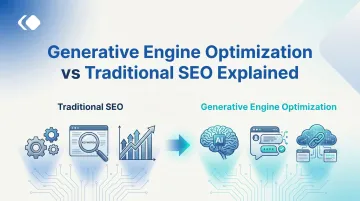
GEO vs. Traditional SEO: At a Glance
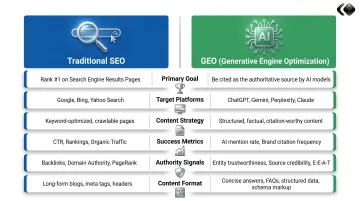
The table below maps out where the two approaches diverge — from goals and platforms to the metrics that actually tell you if it's working:
| Dimension | Traditional SEO | Generative Engine Optimization (GEO) |
|---|---|---|
| Primary Goal | Rank pages on Google/Bing SERPs | Appear in AI-generated answers (ChatGPT, Gemini, Perplexity, AI Overviews) |
| Target Platforms | Google, Bing search engines | ChatGPT, Gemini, Claude, Perplexity, Google AI Overviews |
| Content Strategy | Keyword-focused, backlink building | Semantic clarity, structured authority content, conversational depth |
| Success Metrics | Rankings, CTR, organic sessions, conversions | AI citation frequency, brand mention rate, share of voice in AI responses |
| Authority Signals | Domain authority, backlinks, PageRank | E-E-A-T signals, multi-platform presence, entity density, citation transitivity |
| Content Format | Long-form keyword-rich articles | FAQs, definitions, numbered steps, structured data, comparison tables |
What is Traditional SEO?
Traditional SEO is the practice of optimising websites to earn organic visibility on search engines like Google and Bing. The goal: rank for relevant keywords, attract clicks, and convert visitors. For roughly 20 years, it's been the dominant digital visibility strategy.
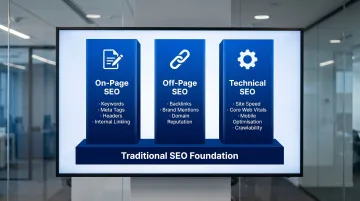
Three Core Pillars:
- On-Page SEO — keyword placement, meta tags, content quality, headers, and internal linking
- Off-Page SEO — backlinks, digital authority signals, brand mentions, and domain reputation
- Technical SEO — site speed, Core Web Vitals, mobile optimisation, crawlability, and structured data
Each pillar impacts operational outcomes. Faster load times reduce bounce rates, which improves rankings. Clean URL structures help crawlers index content efficiently. Strong backlink profiles signal trustworthiness to search algorithms.
How Success is Measured:
- Keyword rankings in SERPs
- Organic traffic volume
- Click-through rate (CTR)
- Conversion rate from organic visitors
Organic search drives 53.3% of all website traffic, making it the single largest traffic channel for most businesses. With AI-driven search tools gaining ground, organic traffic still declined only 2.5% year-over-year as of January 2026 — far smaller a shift than most forecasts anticipated.
That resilience matters for publishers and content teams: traditional SEO continues to deliver measurable returns, particularly for transactional and navigational queries where users still click through to source pages.
What is Generative Engine Optimization (GEO)?
Generative Engine Optimization (GEO) is the practice of optimising content to be referenced, cited, or surfaced inside AI-generated answers — not just ranked on SERPs. The goal shifts from earning a click to being the trusted source an AI chooses when synthesising a response.
How Generative Engines Work Differently
Generative engines like ChatGPT, Perplexity, and Google AI Overviews don't return ranked lists of links. Instead, they:
- Synthesise information from multiple sources into a single conversational response
- Evaluate trustworthiness differently than Google's ranking algorithm
- Don't primarily send traffic to external sites
That changes what "winning" means. Your brand, data, or framework appearing in a Perplexity or Google AI Overview response still delivers real commercial value — awareness, trust, and brand recall — even when users never visit your site. Research shows LLM click-throughs convert at 4.4x the rate of traditional organic search traffic.
What Content Characteristics GEO Rewards
So how do you earn that visibility? The Princeton GEO paper formally defined the field and showed that adding citations, quotations, and statistics boosts AI visibility by up to 40%. Content with these properties gets extracted most readily:
- Structured formatting: headers, bullet points, FAQs, tables, numbered steps
- Fact-rich and citation-worthy: original data, statistics, and quotable insights
- Clear definitions: direct answers to "what is X?" queries
- Conversational query depth: content addressing complex, scenario-based questions
- Strong E-E-A-T signals: expert author credentials, recognised industry citations, cross-platform presence
Publive's CMS is built with these standards in mind — helping media publishers and content teams structure content for GEO discoverability while maintaining the Core Web Vitals performance that traditional SEO still requires.
GEO vs. Traditional SEO: 5 Key Differences
1. Target Platforms
Traditional SEO targets search engines that return ranked lists of links. Google holds 90.02% global search market share, processing 16.4 billion searches daily. Bing accounts for 5.14%. These platforms evaluate websites based on authority, relevance, and user experience signals.
GEO targets generative AI platforms that return synthesised text responses:
- ChatGPT: 400 million+ monthly active users, 2 billion+ daily queries
- Gemini: 750 million monthly active users
- Perplexity: 30-45 million monthly active users, 780 million annual queries
- Google AI Overviews: now appearing on 13% of all queries globally
Content now needs to work in both environments at once. That means optimising for crawlability and keyword relevance while also structuring content so AI systems can extract and cite it accurately.
2. Authority Signals
Traditional SEO builds authority through:
- Backlinks from trusted domains
- Domain age and PageRank
- Engagement metrics (time on page, bounce rate)
- E-E-A-T (Experience, Expertise, Authoritativeness, Trustworthiness)
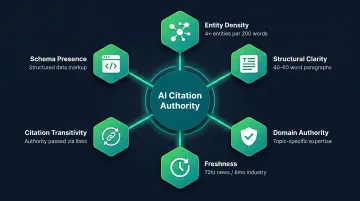
GEO infers authority differently. A March 2026 study identified six measurable factors:
- Entity density — above 4 named entities per 200 words is the critical threshold
- Structural clarity — content chunked into 40-60 word paragraphs for easy extraction
- Topic-specific domain authority — evaluated at the intersection of domain and topic, not domain-level
- Freshness — 72-hour window for news, 6 months for tech/industry content
- Citation transitivity — "sources that cite get cited"
- Schema presence — rated "Very High" for Gemini/Google AI Overviews
Traditional backlinks show a weak or neutral correlation with AI citations. Brand search volume is the strongest predictor instead, with a 0.334 correlation — outweighing both backlinks and domain authority.
The implication: building AI visibility requires consistent expert presence, named authorship, and being cited by sources that AI systems already trust — not just accumulating backlinks.
3. Content Strategy and Query Format
Traditional SEO content targets short keyword phrases. The average Google search query is just 3.5 words.
GEO content must anticipate conversational, long-form prompts. The average ChatGPT prompt is 23 words — nearly 7x longer. Research shows 65-85% of ChatGPT prompts don't match traditional search keywords.
Example transformation:
- SEO query: "best CMS for publishers" (4 words)
- GEO prompt: "What's the best CMS for a regional news publisher managing 200+ articles per month with a 10-person content team?" (20 words)
The GEO version includes context, scale, and specific constraints. Content optimised for GEO needs to address scenarios, not just keywords.
4. Success Metrics
SEO success is measured by:
- Organic sessions and traffic volume
- SERP rank position
- Click-through rate (CTR)
- Conversions from organic visitors
GEO success is measured by:
- AI citation frequency (how often your brand/content is referenced)
- Brand mention rate in generative responses
- Accuracy of brand representation in AI answers
- Competitive share of voice in AI outputs
Here's the challenge: GEO may reduce direct clicks but increase brand trust and recall. Zero-click Google searches grew from 56% to 69% between May 2024 and May 2025. For every 1,000 US searches, only 360 clicks now go to the open web.
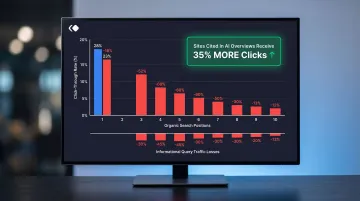
When AI Overviews appear, click-through rates fall sharply across the board:
- Position 1 CTR drops 18% (from 28% to 23%)
- Positions 3-10 see 50-70% CTR declines
- Informational queries (definitions, how-to, health/science) lose 30-45% of traffic
However, sites cited within AI Overviews receive 35% more organic clicks than non-cited sites in the same SERP position — showing that AI citation visibility has real commercial value.
5. Content Format Preferences
Search engines reward comprehensive long-form content optimised for crawlability — typically 1,500-3,000+ words with strategic keyword placement and internal linking.
Generative AI rewards structured, self-contained content blocks that are easy to extract and cite:
- FAQs with clear question-answer pairs
- Definitions and glossary blocks
- Numbered steps and ordered lists
- Comparison tables
- Content chunked into 40-60 word paragraphs
Wikipedia accounts for 22% of major LLM training data by influence weight, representing 7.8% of all ChatGPT citations and 47.9% of its top-10 cited domains. The reason comes down to structure: infoboxes, standardised headings, citation references, and category hierarchies make content trivially easy to extract. 72.4% of Wikipedia pages cited by ChatGPT feature a question heading followed by a short, direct answer.
The lesson for publishers: adopt consistent formatting. Content with added statistics, citations, and quotations outperforms keyword-stuffed content. Optimal length for AI citation is 1,200-2,500 words — beyond that, citation probability declines due to passage fragmentation.
Why Content Publishers and Brands Need Both
Traditional SEO still drives meaningful web traffic and underpins discoverability. GEO builds the authority and brand presence that shapes demand before users even reach a search bar. These aren't competing strategies — they operate at different stages of the user journey, which is exactly why publishers need both running in parallel.
The Hybrid Content Strategy
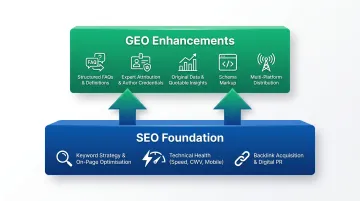
For media brands and publishers, the practical approach is this:
Maintain strong SEO foundations:
- Keyword strategy and on-page optimisation
- Technical health (site speed, Core Web Vitals, mobile-first design)
- Backlink acquisition and digital PR
On top of that foundation, layer GEO enhancements:
- Structured FAQs and definition blocks
- Expert attribution and author credentials
- Original data, statistics, and quotable insights
- Schema markup (Article, FAQPage, HowTo)
- Multi-platform content distribution — LinkedIn, industry forums, podcast transcripts, contributed articles
Topical Authority Drives AI Citation
GEO rewards consistency and topical authority over time. Fan-out coverage shows a 0.77 Spearman correlation with AI citation — the strongest known predictor. Brands that invest in becoming the recognised voice on specific topics get cited more frequently as AI models update.
The content depth advantage is significant: entity-rich content achieves 267% more AI citations than keyword-optimised content. Publishing 20+ deeply focused articles on a single topic cluster within 6 months produces measurable authority gains — one case study tracked a new site with no backlinks going from 0 to 40% AI citation rate purely through topical focus.
Executing this at scale requires infrastructure that supports both GEO and SEO simultaneously. Publive's platform is built for exactly this — combining AI-powered content creation and repurposing tools with an analytics dashboard that tracks traditional SEO signals (via GA4/GSC connectors) alongside content performance trends.
Decision Framework: When to Prioritise SEO vs. GEO
Prioritise SEO when:
- The goal is immediate traffic and conversion
- You're targeting transactional queries (product pages, service bookings)
- You need direct attribution and revenue tracking
- Your audience uses traditional search for discovery
Prioritise GEO when:
- The goal is brand authority and top-of-funnel awareness
- You're creating informational/educational content
- You want to shape trust and recall before the purchase decision
- Your audience increasingly uses AI tools for research
For most media publishers and enterprise brands, the answer is both running in parallel. Outbound referral traffic from ChatGPT to the web grew 206% in 2025, and over 21% of ChatGPT outbound traffic goes directly to Google — users discover via AI, then validate through traditional search. Each channel feeds the other's effectiveness.
Conclusion
Traditional SEO and GEO serve different but overlapping objectives. SEO gets you indexed and ranked; GEO gets you referenced and cited. Neither is sufficient alone.
For media houses, financial content publishers, and healthcare brands, being cited in an AI-generated answer isn't just a vanity metric. It shapes which sources readers trust, which brands get recalled during purchase decisions, and which publishers become the default reference in their vertical.
Every month without a GEO strategy is a month where AI engines are learning to cite competitors instead. The publishers and brands building durable digital visibility through 2026 are those running SEO and GEO in parallel — not choosing between them.
Frequently Asked Questions
Is GEO replacing traditional SEO?
No. GEO and SEO serve different functions — SEO drives direct traffic through search rankings, while GEO drives brand presence in AI-generated answers. The most effective strategy integrates both.
How do I know if my content is being cited by AI tools like ChatGPT or Perplexity?
Emerging tools like Otterly.ai, Gauge, and Semrush's AI Visibility Toolkit track brand mentions and citations across AI platforms. You can also manually test key industry queries across ChatGPT, Perplexity, and Google AI Overviews to see if your brand appears.
What type of content performs best in GEO?
Structured formats perform best — FAQs, numbered guides, comparison tables, clear definitions, and content with original data or expert attribution. AI systems extract and cite these formats most readily.
How does GEO affect organic traffic and website visits?
GEO can reduce direct CTR since AI answers may satisfy queries without a site visit. However, it increases brand recall, trust, and top-of-funnel awareness. 58.5% of US searches ended without a click in 2024 — a trend playing out across global markets — making AI citation visibility critical for long-term brand presence.
Does GEO require a completely different content team or skill set?
GEO builds on existing content skills but requires a shift in content structuring, greater emphasis on E-E-A-T signals, and new measurement frameworks. Most teams can adapt with the right tools and editorial guidelines rather than a full restructure.
Can smaller publishers compete with large media brands in GEO?
Yes. GEO creates an opening for niche publishers with deep topical authority. AI systems favor trusted expertise in specific domains over broad coverage, meaning focused regional news publishers or vertical media brands can outperform larger generalist outlets in relevant AI citations.