Introduction
SEO professionals are watching organic traffic patterns shift in ways traditional rank tracking cannot explain. Only 360 out of every 1,000 Google searches now produce a click to the open web — meaning 58.5% of searches end without any website visit. Meanwhile, Google AI Overviews, ChatGPT search, and Perplexity are answering questions directly, with users never clicking through to a source.
The core question has shifted from "how do we rank first?" to "how do we get referenced at all?" When AI engines synthesise answers and present them as complete responses, visibility changes fundamentally.
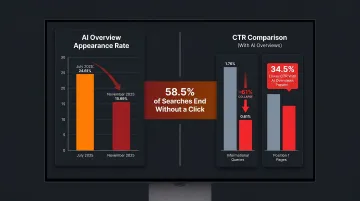
The numbers are stark: organic CTR fell 61% on queries where AI Overviews appear. Publishers who built their traffic on informational content are now absorbing those losses directly.
What follows covers how generative AI reshaped search, what GEO (Generative Engine Optimisation) requires in practice, and which content strategies hold up when AI answers replace blue links.
TLDR
- Google AI Overviews, ChatGPT, and Perplexity now act as "answer engines" — synthesising information directly instead of returning link lists
- This shift created GEO (Generative Engine Optimisation) — optimising content to be cited by AI engines, not just ranked on SERPs
- 58.5% of searches now end without a click; traditional SEO remains the prerequisite for GEO success
- AI-referred traffic converts at 4.4x the rate of traditional organic visitors, making citation a revenue driver despite lower volume
- Winning in this environment means moving beyond keyword-first strategies toward topical authority, E-E-A-T signals, and structured content AI can parse
How Generative AI Changed the Search Landscape
Traditional search engines returned ranked lists of links for users to evaluate. Generative AI search engines analyse multiple sources, synthesise them, and produce a single contextual answer. This architectural shift matters because visibility is no longer guaranteed by a high SERP position alone.
The key platforms reshaping discovery include Google AI Overviews (formerly SGE), Bing Copilot, ChatGPT search, and Perplexity. These tools don't surface content from identical signals, creating strategic complexity. Google maintains its 90.02% global search market share, while Perplexity processes 600 million queries monthly — up 140% from mid-2024 to early 2025.
The traffic impact is measurable. Research tracking 3,119 search terms found that organic CTR for informational queries with AI Overviews fell from 1.76% to 0.61% between June 2024 and September 2025, a 61% collapse. Even queries without AI Overviews saw CTR drop 41%.
A separate study confirmed the pattern: AI Overviews correlate with 34.5% lower average CTR for Position 1 pages compared to similar keywords without an AI summary.
AI Overviews now appear in approximately 15.69% of searches as of November 2025, down from a July peak of 24.61% but still representing millions of queries daily. Nearly 60% of keywords triggering AI Overviews have 100 or fewer monthly searches, indicating Google targets long-tail, specific queries where synthesised answers add the most value.
Changing User Behaviour
User search behaviour shifted from entering keywords to asking full, conversational questions. Short queries (1-2 words) dropped from 42% to 31% of total impressions between January and June 2025, following Google's AI Mode launch. Users migrated toward natural-language queries of 3-4 words that better match how they speak.
Search intent became the primary optimisation signal. Users no longer want to find a page; they want an answer. This has devalued keyword density as a tactic and elevated contextual relevance and comprehensiveness. Voice search reinforces the shift: an estimated 154.3 million Americans use voice assistants in 2025, with 57% using voice commands daily.
These behaviour shifts carry direct commercial consequences. Short keywords accounted for 76% of conversions in January 2025 but dropped to 50% by June. Mid-length queries (3-4 words) doubled their conversion share from 20% to 40% in the same period, as users moved toward more specific, intent-rich searches.
The E-E-A-T Imperative
Google reinforced E-E-A-T (Experience, Expertise, Authoritativeness, Trustworthiness) when it added "Experience" to the framework in December 2022. AI engines are trained to favour and cite sources demonstrating real-world expertise and verifiable authority ; generic, keyword-stuffed content is increasingly filtered out.
Research shows 76% of AI Overview citations come from the top-10 organic results, meaning AI answers inherit traditional E-E-A-T ranking signals. The strongest correlations for being mentioned in AI Overviews are off-site authority signals:
- Branded web mentions: 0.664 correlation
- Branded anchors: 0.527 correlation
- Branded search volume: 0.392 correlation
For media publishers and content-led brands, E-E-A-T is both a trust signal for search engines and a competitive differentiator. Original reporting, first-person expertise, and credited authors carry more weight than ever.
Notably, 81.9% of content ranking in the top 20 search results includes some AI-generated material, confirming Google rewards quality regardless of production method.
The Rise of GEO: Optimising to Be Cited, Not Just Ranked
GEO (Generative Engine Optimisation) is the practice of structuring and positioning content so generative AI engines select it as a cited source when constructing answers. The goal is not to win a ranking position but to become the trusted source an AI references.
GEO does not replace SEO — it is built on top of it. A site that isn't well-indexed, crawlable, and authoritative in the traditional sense cannot expect to appear in AI-generated answers. SEO creates the foundation; GEO builds the visibility layer.
The academic foundation for GEO comes from research published at KDD 2024 by Princeton University and IIT Delhi, cited over 113 times. The study tested nine optimisation strategies across 10,000 queries and found:
- Quotation Addition: Over 40% visibility improvement
- Statistics Addition: 30-40% visibility improvement
- Cite Sources: 30-40% visibility improvement; websites ranked 5th saw a 115.1% increase in visibility
- Keyword Stuffing: Provided little to no improvement and sometimes performed worse than baseline
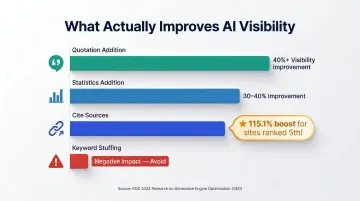
When validated on Perplexity.ai, quotation addition delivered 22% improvement, statistics addition delivered 37% improvement, and keyword stuffing performed 10% worse than baseline.
What AI Engines Look for When Selecting Sources
Generative AI engines prioritise sources that demonstrate:
- Topical depth — comprehensive, interconnected coverage of a subject area, not isolated how-to articles
- Clear source attribution — claims tied to named studies, data, or expert statements
- Factual consistency — no contradictions across a site's content
- Structured presentation — content that is easy for AI to parse and extract
Brand authority matters too. AI engines draw from both training data and real-time web indexing. Brands consistently referenced across credible third-party sources — publications, forums, industry citations — are more likely to be surfaced in generated answers.
This points to a strategic shift: from single-page keyword optimisation to topical cluster ownership. Publishers that build authoritative coverage across related subtopics give AI engines more signal to cite them — repeatedly.
GEO in Practice: What Content Needs to Look Like
Content structured for GEO needs to be explicit about claims, attributions, and expertise signals. This includes:
- Byline credibility with author bios featuring credentials
- Internal consistency across the site
- Clear definitions of key concepts
- Natural language mirroring how users ask questions
- Statistics with clear attribution to primary sources
- Quoted expert statements where appropriate
One structural rule applies across all of these: answer the user's question within the first 40-60 words. AI engines extract answers from content quickly — leading with the response, not the preamble, is what gets cited.
What the Zero-Click Era Means for Your Organic Traffic
Zero-click searches occur when a generative AI engine or featured snippet answers the query directly in the interface. The user receives a satisfactory answer without visiting a source website. As of early 2024, 58.5% of US Google searches and 59.7% of EU searches ended this way — only 360 out of every 1,000 US searches produced an open-web click.
Informational queries are most vulnerable: 48% of zero-click searches involve informational queries, followed by 27% navigational and 25% local searches. Lifestyle and utility content (weather, TV guides, horoscopes) face the greatest traffic loss, while hard news queries remain more insulated.
The publisher impact is measurable. According to Search Engine Land, global organic Google search traffic to publishers dropped significantly between November 2024 and November 2025:
- Global publisher search traffic fell 33% year-over-year
- US publishers saw a steeper 38% decline
- News executives project a further 43% drop within three years
- 20% of respondents expect to lose 75% or more of search traffic
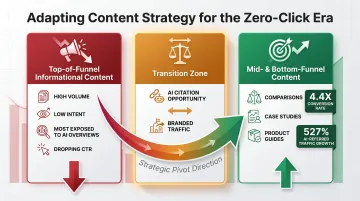
Informational, top-of-funnel content that Google can answer directly in an AI Overview is most exposed. Audit your keyword portfolio now to identify where your traffic is at risk.
The Opportunity Hidden Inside the Decline
While raw traffic volume may decrease for some content types, the traffic that does arrive is demonstrably higher intent. Users who click through from an AI-generated answer have already been pre-qualified by the AI's summary — they're looking for depth, product information, or a specific action.
Research confirms that AI search visitors convert at 4.4x the rate of traditional organic search visitors. AI-referred traffic grew 527% year-over-year between January and May 2025. When a brand is cited within an AI Overview, organic CTR is 35% higher compared to queries where the brand isn't cited.
Publishers who optimise for AI citation may see lower volume but higher revenue per visit. That shift in quality over quantity points to a clear content strategy:
- Prioritise mid- and bottom-funnel content — comparisons, case studies, and product-adjacent guides that AI engines surface for decision-stage queries
- Reduce dependence on top-of-funnel informational content as a primary traffic driver, especially if your model relies on page views
- Track AI citation rates alongside traditional organic metrics to get a complete picture of search visibility
Practical Strategies to Optimise Content for the AI Search Era
Move from keyword-first to entity and topic-based optimisation. Instead of building content around individual search terms, build comprehensive topic clusters where each piece reinforces the brand's authority in a subject area. AI engines are trained to recognise and favour brands with broad, consistent topical ownership.
Structure content as topical hubs:
- One pillar page covering the subject comprehensively
- Multiple supporting articles diving deep into subtopics
- Clear internal linking connecting related pieces
- Consistent terminology and definitions across all content
Use structured data and schema markup as a machine-readable credibility layer. When content is annotated with structured schema — FAQ schema, Article schema, HowTo schema, Organisation schema — AI engines and search algorithms can parse context, extract answers, and attribute the source.
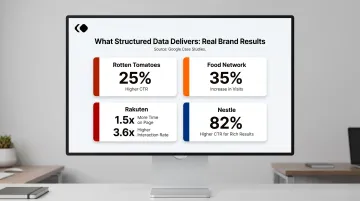
Google's own case studies show structured data implementation delivering measurable results:
- Rotten Tomatoes: pages with structured data saw a 25% higher CTR
- Food Network: visits increased 35% after converting 80% of pages to enable search features
- Rakuten: Users spend 1.5x more time on structured data pages and show a 3.6x higher interaction rate on AMP pages
- Nestle: Pages showing as rich results had 82% higher CTR
Three schema types matter most for zero-click and AI visibility:
- FAQPage Schema — for People Also Ask and AI Overviews
- HowTo Schema — for featured snippets and AI-generated step lists
- LocalBusiness Schema — for knowledge panels and local packs
For media houses and brands managing high content volumes, implementation is where most strategies stall. Publive's platform is built for GEO discoverability from the ground up — structured content architecture, native schema support, and AI-powered content workflows that help teams produce the topic depth AI engines favour. The result: broader coverage without a proportional increase in editorial overhead.
Why Technical SEO Remains the Foundation
No GEO strategy can compensate for poor technical health. AI search engines cannot cite what they cannot crawl and index reliably. Core technical requirements — fast page load speeds, clean site architecture, mobile optimisation, and accurate XML sitemaps — are the prerequisite for any visibility in generative search results.
Core Web Vitals carry direct ranking weight. Pages with poor loading, interactivity, and visual stability scores get suppressed before they can even be evaluated for AI citation. Only approximately 47% of websites pass Core Web Vitals assessments — which means publishers who optimise hold a measurable edge over the majority.
AI crawlers operate with strict compute budgets and tight timeouts of 1-5 seconds compared to traditional crawlers. Recommended targets:
- TTFB under 200ms
- HTML payloads under 1MB
- LCP under 2.5 seconds
- CLS under 0.1
Fast sites get crawled deeper and cited more often by AI systems. For context, Publive achieves a 98% Core Web Vitals pass rate, the highest among leading DXPs, which translates directly to stronger performance in both traditional and AI-era search.
Internal linking and site architecture function as authority distribution mechanisms. A well-structured site passes authority signals between related content, reinforcing the topical cluster strategies that GEO depends on.
Clear hierarchical navigation, descriptive anchor text, and strategic cross-linking help AI engines map content relationships and establish topical ownership — making structure as important as the content itself.
Measuring SEO Success in an AI-First Search World
Traditional rank tracking is no longer a sufficient measure of search visibility. Marketers must supplement position tracking with new signals:
- Branded search volume trends — monitoring branded search spikes in Google Search Console can serve as a proxy indicator for AI mention activity (0.392 correlation with AI citation frequency)
- Direct traffic from AI-referred sources — requires custom GA4 configuration to separate AI referrers (chatgpt.com, perplexity.ai) from "Direct" traffic
- Share of voice in AI-generated summaries — percentage of citations in a category vs. competitors
- Brand mention monitoring — tracking whether content is being cited in AI answers across the web
A critical measurement gap exists: clicks to links in Google's AI Mode are currently not being recorded in Google Search Console. Clicks from AI Mode don't send a referrer value. GA4 misattributes AI-referred visits as "Direct" traffic without custom configuration.
Dedicated GEO measurement tools are emerging specifically to close this gap:
| Tool | Function | Pricing |
|---|---|---|
| Otterly.ai | Brand Visibility Index, automated link citation tracking | $29–$999/mo |
| Promptmonitor | Multi-model prompt tracking (ChatGPT, Claude, Gemini) | $29–$129/mo |
| Semrush AI Toolkit | Brand sentiment analysis, up to 50 competitors | $99/mo add-on |
| Profound AI | Hallucination detection, SOC 2 compliance | $499+/mo |
Five emerging GEO metrics replacing traditional ranking-focused measurement:
- Citation Frequency — how often your brand appears in AI responses (aim for 30%+ in your category)
- Brand Visibility Score (BVS) — composite metric weighting citation placement, link presence, and sentiment
- AI Share of Voice (AI SOV) — your brand's citation share relative to competitors; track weekly to catch ranking shifts before they show up in GSC
- Sentiment Analysis — whether AI describes your brand positively, neutrally, or negatively
- LLM Conversion Rate — conversion rate of visitors arriving from AI referrers vs. traditional organic search
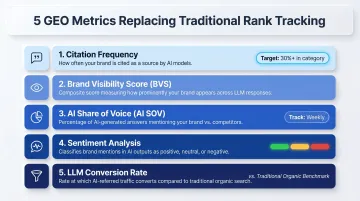
Setting up even one of these tracking layers — starting with GA4 referrer segmentation — gives you a measurable baseline before your competitors do.
Frequently Asked Questions
What is Generative Engine Optimisation (GEO) and how is it different from SEO?
GEO is the practice of optimising content to appear in AI-generated answers and citations. It complements traditional SEO rather than replacing it — think of GEO as the layer built on top of a strong organic foundation.
Is traditional SEO still relevant now that AI answers so many queries directly?
Yes. AI engines can only cite content they can crawl, index, and evaluate for quality — making technical SEO, site authority, and E-E-A-T signals the foundation on which GEO is built.
How do AI Overviews and SGE affect organic website traffic?
AI Overviews most significantly impact informational, top-of-funnel queries, potentially reducing click-through rates by 34.5–61%. However, traffic that does arrive tends to be higher intent (4.4x higher conversion rate), making content strategy and conversion optimisation more important than volume alone.
What is E-E-A-T and why does it matter more in the AI era?
E-E-A-T (Experience, Expertise, Authoritativeness, Trustworthiness) is how search and AI engines judge source credibility. Generative AI models specifically favour well-attributed, expert-authored content — 76% of AI citations come from top-10 organic results.
How can I optimise content to be cited in AI-generated answers?
Build topical authority through comprehensive content clusters, use structured data/schema markup to make content machine-readable, demonstrate E-E-A-T signals clearly with author credentials and source attribution, and write in natural conversational language that mirrors how users ask questions.
What metrics should marketers track to measure performance in an AI-first search environment?
Track traditional signals (GSC impressions, CWV scores, domain authority) alongside emerging indicators: branded search volume, AI-referred traffic in GA4 (with custom configuration), citation frequency in AI-generated summaries, brand mention sentiment, and conversion rates from AI referrer traffic vs. traditional organic.