
Content teams in media, publishing, and brand marketing face a dual challenge: producing content faster while structuring it to be cited by AI engines. Generative AI tools are now the primary lever for solving both problems simultaneously. This guide evaluates the top solutions for optimizing website content using generative AI in 2026, covering the criteria that matter for publishers and brand marketers.
TL;DR
- Generative AI content optimization tools now serve two roles: accelerating production AND structuring content for AI citation (GEO)
- Top platforms unify content creation, on-page optimization, AI visibility tracking, and publishing in one workflow
- Key evaluation criteria include GEO/AEO readiness, content output speed, integrations, analytics depth, and pricing
- Platforms built for media houses and brands offer advantages over standalone SEO tools by integrating the full content lifecycle
- Your best fit depends on team size, publishing volume, and whether you need a full CMS or a focused point solution
What Is Generative AI Content Optimization — And Why It Matters in 2026
Optimizing website content using generative AI means using AI to speed up content creation, improve content structure for both human readers and AI search engines, and ensure content is discoverable — cited — by platforms like ChatGPT, Perplexity, and Google AI Overviews. This practice is increasingly called Generative Engine Optimization (GEO).
The scale of this shift is hard to ignore:
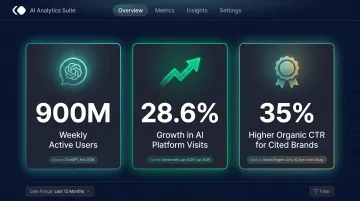
- ChatGPT hit ~900 million weekly active users by February 2026 — more than double the 400 million it had in February 2025
- AI platform visits grew 28.6% between January 2025 and January 2026
- Brands cited in AI Overviews earn 35% higher organic CTR and 91% higher paid CTR compared to uncited competitors
Being cited in an AI answer delivers a kind of brand authority that no traditional organic listing can match.
The tools covered here are the leading solutions for teams that need to compete on both fronts: faster content production and genuine GEO discoverability.
Top Solutions for Optimizing Website Content Using Generative AI in 2026
Five platforms made this list, each evaluated on AI content creation quality, GEO/AEO readiness, integration with publishing workflows, analytics depth, and track record with media and enterprise clients.
Publive
Built specifically for media houses, brands, financial institutions, and healthcare organisations, Publive consolidates AI-powered content creation, repurposing, and GEO-ready publishing into one unified system. Clients include Indian Express, News Nation, and Sambad.
The platform delivers 60% faster content output with AI, and 98% of sites pass Core Web Vitals — the highest pass-rate among leading DXPs. Content is structured for AI citation from the outset, addressing GEO discoverability at the infrastructure level rather than retrofitting it later.
Key platform consolidations include:
- CMS with GA4 and GSC connectors, plus Golden Signals Dashboard analytics
- Push notifications and social distribution built in
- 50% lower Total Cost of Ownership vs. fragmented technology stacks
| Feature Category | Details |
|---|---|
| Key Features | AI content generation, repurposing & experimentation; GEO discoverability architecture; 98% Core Web Vitals pass rate; enterprise analytics with GA4/GSC connectors; WCAG compliant + DPDP ready implementation |
| Best For | Media houses, publishers, brands, financial institutions, and healthcare organisations needing an all-in-one AI-first CMS with GEO-ready publishing |
| Commercial Model | Custom pricing with usage-based billing; contact required for enterprise quotes |
Surfer SEO
Surfer SEO reverse-engineers search results using NLP analysis, serving content writers, SEO professionals, and agencies. AI Visibility Tracking is included natively (not a separate add-on), showing brand performance across multiple AI search engines.
Surfer's Content Editor scores content in real time against top-ranking pages, and the Humanizer feature ensures AI-generated content retains quality. AI Visibility Tracking starts at the Pro plan, covering ChatGPT, Perplexity, Google AI Mode, Google AI Overviews, and Gemini with daily refresh. The Standard plan tracks ChatGPT only with weekly updates.
| Feature Category | Details |
|---|---|
| Key Features | Real-time Content Editor with NLP scoring; AI Visibility Tracking (multi-engine on Pro+); Surfy AI writing assistant; Humanizer; cannibalization reports and rank drop detection |
| Best For | SEO professionals and content teams needing data-driven on-page optimization with built-in AI visibility tracking |
| Starting Price | $99/month (annual billing) for Standard plan; Pro plan at $182/month (annual) includes 5-platform AI tracking with daily refresh |
Writesonic
For content marketers and agencies looking to consolidate tools, Writesonic combines AI content writing, SEO research, GEO tracking, and site audits under a single login. The platform tracks AI search performance across eight platforms — ChatGPT, Perplexity, Google AI Overviews, Gemini, Claude, Copilot, Grok, and DeepSeek — with full coverage on the Enterprise plan.
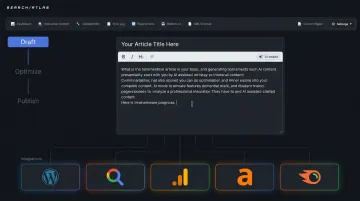
The Action Centre delivers specific optimization tasks (citation opportunities, missing prompts, technical fixes), while AI Article Writer 6.0 handles deep research and E-E-A-T compliance. The platform integrates with WordPress, Google Search Console, Google Analytics, Ahrefs, and Semrush — making it a strong option for teams looking to replace multiple tools with one interface.
| Feature Category | Details |
|---|---|
| Key Features | AI Article Writer 6.0 with E-E-A-T compliance; GEO tracking across 6+ AI platforms (8 at Enterprise); Action Centre; SEO Site Audit; WordPress and GSC integrations |
| Best For | Content marketers and agencies wanting AI writing combined with GEO tracking in a single platform |
| Starting Price | $99/month (monthly billing) or $79/month (annual billing) for Starter plan; full 8-platform tracking requires Enterprise plan |
Clearscope
Clearscope focuses on helping content perform across both traditional search and AI platforms like ChatGPT and Gemini, using what the platform calls Answer Engine Optimization (AEO). It prioritizes quality over volume and is trusted by in-house content teams and agencies.
Clearscope's Query Fan-out Awareness identifies how topics expand into related questions (critical for GEO coverage). All plans include unlimited users and unlimited projects with no per-seat pricing, and Content Portability allows unlimited sharing and export — avoiding platform lock-in. Best positioned for teams where content quality and authority are the primary levers.
| Feature Category | Details |
|---|---|
| Key Features | Topic Exploration and content clustering; Query Fan-out Awareness; Search Intent Recommendations; AI Drafts; Content Inventory for published pages; prompt tracking across ChatGPT and Gemini |
| Best For | Content teams and agencies prioritizing depth, authority, and AEO-readiness over high-volume production |
| Starting Price | $129/month for Essentials plan with unlimited users and projects |
Frase
Frase takes a research-to-publish approach, built around the Frase Agent: an AI copilot with 80+ skills that analyses a site, identifies content gaps, and recommends what to create next. AI visibility tracking is available across multiple platforms starting from entry-level plans.
Frase is differentiated by its explicit focus on getting content cited by AI systems rather than just ranked. Auto internal linking, brand voice profiles, and a content calendar make it particularly valuable for small teams and agencies managing multiple client domains without dedicated SEO resources. The Starter plan at $39/month (annual) includes AI visibility tracking across two platforms — the only platform in this comparison offering multi-platform AI tracking at its lowest tier.
| Feature Category | Details |
|---|---|
| Key Features | Frase Agent with 80+ skills; AI visibility tracking (multiple platforms); auto internal linking; brand voice profiles; content calendar; API & MCP access |
| Best For | Agencies, small businesses, and teams wanting a strategic AI copilot to surface content gaps and optimise for both traditional and AI search citation |
| Starting Price | $39/month on annual billing ($49/month monthly) for Starter plan with 2-platform AI tracking |
How We Chose the Best Generative AI Content Optimization Solutions
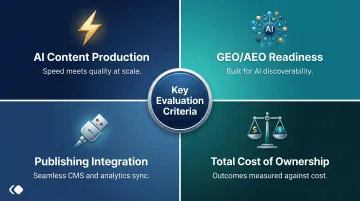
The tools above were assessed against four core criteria:
- AI content production capability — Speed, quality, brand voice consistency
- GEO/AEO readiness — How well the platform structures content to be retrieved and cited by AI engines
- Publishing and workflow integration — CMS compatibility, analytics connectors, automation depth
- Total cost of ownership relative to outcomes — Whether fragmented stacks inflate operational costs and introduce inconsistency
Academic research from Princeton and IIT Delhi found that adding cited sources improved AI visibility by up to 40%, while statistics and quotations delivered 15-30% gains. The most effective GEO strategies centre on evidence-backed, citation-rich content — not generic schema markup.
Research by Fischman (2026) reinforces this: generic JSON-LD schema does not independently predict AI citation, but Product/Review schema with concrete data attributes showed citation rates of 61.7% vs 41.6%.
Avoid selecting a tool based on feature count alone. The more relevant question is whether it fits your team's content velocity and existing tech stack. Enterprise and media-scale teams are better served by platforms that consolidate the full content lifecycle — creation, optimization, distribution, and measurement — rather than patching together multiple point solutions.
Conclusion
In 2026, optimizing website content with generative AI means ensuring every piece is structured to be retrieved and cited by AI engines, distributed across channels, and measured against both traditional and AI search KPIs. The right platform choice should align with operational scale, publishing workflows, and GEO readiness requirements — not just brand reputation.
Evaluate each tool against your content velocity, team size, and scalability needs before committing.
For media houses, brands, and publishers looking for an AI-first platform that handles the full content lifecycle — from AI-assisted writing to GEO-ready publishing and enterprise analytics — explore how Publive's consolidated platform can replace multiple vendors while delivering faster content output and higher AI search discoverability.
Frequently Asked Questions
What is the difference between SEO and GEO in content optimization?
SEO focuses on ranking pages in a list of links to earn clicks, while GEO (Generative Engine Optimization) focuses on structuring content so AI engines like ChatGPT, Perplexity, and Google AI Overviews cite your brand when generating synthesized answers. The primary KPI shifts from rankings and CTR to citation frequency and share of AI voice.
How does generative AI help with website content optimization?
Generative AI speeds up content workflows and improves discoverability across AI-powered search. Specifically, it helps teams:
- Accelerate creation through drafting, repurposing, and rewriting
- Structure content for machine ingestion — answer-first formatting, modular sections, FAQ schema
- Identify gaps relative to what AI engines already cite, reducing production time
Do I need to replace my existing CMS to use AI content optimization tools?
Most standalone tools (Surfer, Clearscope, Frase, Writesonic) integrate with existing CMS platforms via plugins or APIs, while AI-first CMS platforms like Publive offer deeper GEO-native publishing as an all-in-one replacement. The right choice depends on whether a team needs a point solution or a full platform migration.
How do I measure whether my content is performing in AI-generated search results?
Track four new KPIs: AI citation frequency, share of AI voice (your citations vs. competitors), citation sentiment, and AI-referred traffic via GA4. Standard rank-tracking tools don't capture any of these — purpose-built GEO platforms are required.
What content formats are most likely to be cited by AI search engines?
AI engines favour content with clear answer-first structure, modular H2/H3 sections that stand alone as passages, and explicit Q&A pairs. Strong E-E-A-T signals — author bios, original data, third-party citations — also matter. FAQPage schema and structured data markup further improve retrieval probability.
Can small media teams realistically use these AI content optimization tools?
Yes. Most platforms offer entry-level plans suitable for small teams (Frase from $39/month USD, Writesonic from $79/month USD, Surfer from $99/month USD). Consolidated platforms reduce the per-seat overhead of managing multiple tools. The key is prioritising tools that fit existing publishing workflows rather than adding complexity to an already lean operation.