This post explains what AI agents are in the context of newsletter distribution, the specific use cases where they deliver value, the tools available, and what publishers and content teams concretely gain. This is a practical guide for media, publishing, and brand content teams—not a developer tutorial—focused on understanding and implementing AI-driven newsletter automation.
TLDR
- AI agents autonomously handle content curation, writing, personalisation, scheduling, and performance analysis
- Multi-agent workflows assign specialised roles (researcher, writer, editor, distributor) that execute independently
- Publishers gain speed, personalisation at scale, and reduced manual overhead
- Tools range from no-code platforms (Make.com, Zapier) to AI-first publishing platforms purpose-built for media teams
What Are AI Agents for Newsletter Distribution?
AI agents are software systems that perceive inputs (RSS feeds, CMS data, subscriber behaviour), reason about them, and take autonomous action — no human sign-off required at each step. McKinsey defines an AI agent as "a software component that has the agency to act on behalf of a user or a system to perform tasks." Key characteristics include:
- Autonomy — acts independently within defined parameters
- Planning — breaks complex workflows into manageable subtasks
- Tool use — operates across browsers, APIs, and third-party software
- Multi-agent collaboration — coordinates with specialised sibling agents
- Memory structures — learns iteratively from past interactions
This differs fundamentally from traditional email marketing automation. Rule-based systems trigger actions based on pre-set conditions—if a user opens an email, send a follow-up—but they break down when facing situations the rules' designers didn't anticipate. AI agents, by contrast, handle a wide variety of scenarios for a given use case through contextual decision-making, dynamic content generation, and adaptive scheduling based on engagement data.
"Newsletter distribution" here means the full pipeline — not just the delivery act. AI agents manage each stage end-to-end:
- Content selection — sourcing and prioritising stories from feeds or CMS
- Copy generation — drafting subject lines, summaries, and body content
- Audience segmentation — grouping subscribers by behaviour and interest
- Send-time optimisation — scheduling based on individual engagement patterns
- Post-send analytics — interpreting results and adjusting future sends
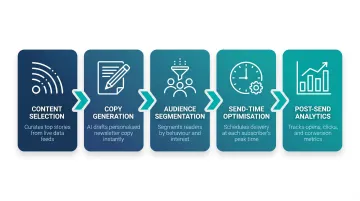
This is the scope where AI agents make editorial and strategic decisions that rule-based automation simply cannot.
Key Use Cases: Where AI Agents Make the Biggest Difference
Automated Content Curation and Summarisation
AI agents scan designated sources—RSS feeds, CMS libraries, news wires, web pages—and select, filter, and summarise content relevant to each newsletter edition, replacing hours of manual research.
For news publishers specifically, agents pull from a publication's own article archive, flag trending stories based on engagement signals, and auto-generate digest-style summaries for morning briefings or weekly roundups. Reuters publishes over 1,000 automated business updates monthly using in-house AI systems for earnings coverage and tagging. The New York Times uses an internal tool called "Echo" for summarising long reports and background documents within the newsroom.
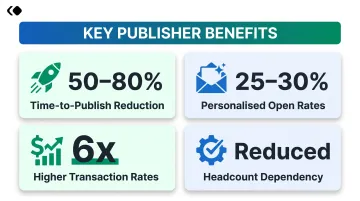
Lookout Local (Santa Cruz and Eugene) uses AI agents to assemble hyperlocal neighbourhood newsletters by pulling public data—permits, roadwork, crime reports, weather, events—enabling small teams to cover multiple neighbourhoods at a scale otherwise unaffordable. For routine content, this model cuts time-to-publish by 50-80%.
Hyper-Personalisation at Subscriber Scale
AI agents analyse subscriber behaviour—open history, click patterns, content categories engaged with—to dynamically assemble different versions of the same newsletter for different audience segments without manually building multiple templates.
For media companies managing multiple niche verticals or regional editions, a single agent can generate tailored editions for finance readers, tech readers, or health readers from a shared content pool. The agent handles the segmentation logic automatically:
- Reads each subscriber's engagement history to determine content preferences
- Selects relevant articles from the shared pool for each segment
- Assembles edition variants without duplicating editorial effort
- Routes the correct version to the correct audience at send time
Personalised/segmented emails achieve open rates of 25-30% compared to approximately 20% for generic sends, and click-to-open rates (CTOR) of 15-18% vs. 10-12%. Metro UK launched daily personalised newsletters—Horoscopes, Football, TV—using Sailthru's personalisation engine. Results: 24-50% CTR on personalised editions, with zero added editorial lift through automation.
Send-Time and Frequency Optimisation
AI agents use historical engagement data to determine the optimal send time for individual subscribers or cohorts—moving beyond blanket "Tuesday at 10am" scheduling toward truly individualised delivery timing.
In a head-to-head test of 100,000 subscribers, AI-powered smart send time achieved a 26.8% open rate vs. 21.4% for traditional manual scheduling—a 25% relative increase. The AI variant also generated 32% more revenue per email.
Send-time optimisation is one side of the equation. The other is what subscribers see the moment the email lands: the subject line.
Automated A/B Testing and Subject Line Optimisation
AI agents generate multiple subject line variants, test them on a sample segment, evaluate open rate performance in real time, and deploy the winning version to the remaining list—all without manual intervention.
JOANN achieved a 10% increase in email open rates using Phrasee's AI-generated subject lines. Virgin Holidays saw a 2% increase in open rates—described as worth millions in new revenue. Time required to create and test subject lines dropped from weeks to seconds.
Persado's research indicates that experienced marketers fail to select the highest-performing copy approximately 70% of the time. Over 60% of email recipients decide whether to open based on the subject line alone.
List Management and Subscriber Health Maintenance
AI agents handle ongoing list hygiene automatically, freeing teams from the operational drag of manual database upkeep. Core tasks include:
- Processing unsubscribes and bounce removals in real time
- Flagging disengaged subscribers for automated re-engagement flows
- Enriching subscriber profiles with CRM or behavioural data
- Maintaining segmentation accuracy as audience behaviour shifts over time
The result: deliverability stays high and subscriber data stays current without anyone having to manage it manually.
How a Multi-Agent Newsletter Workflow Works
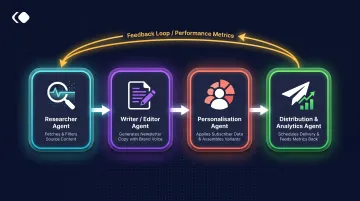
Rather than one AI doing everything, modern workflows assign distinct tasks to distinct agents—improving output quality and making each step easier to audit. Role-specialised agents work in sequence, each contributing expertise to the overall process.
The Researcher Agent
This agent fetches and filters source content from URLs, CMS archives, RSS feeds, or web scraping tools based on defined topic parameters. Its output is raw, structured content ready for the next stage. It doesn't write a word—it gathers, validates, and organises, so the next agent starts with clean inputs rather than noise.
The Writer/Editor Agent
This agent takes the researcher's output and generates newsletter-ready copy: headline, intro, section summaries, and CTA. Brand voice parameters and editorial standards are applied at this stage, so every draft already matches the publication's tone before any human review.
The Personalisation Agent
This agent applies subscriber data to dynamically adjust content blocks, swap stories based on segment preferences, and assign subject lines. A finance publication, for example, might serve one version to retail investors and a different one to institutional readers—both generated from the same base draft, with no manual effort per variant.
The Distribution and Analytics Agent
The final stage: scheduling the send based on optimisation signals, triggering delivery via the connected email platform, and collecting post-send metrics—opens, clicks, unsubscribes. Those metrics feed directly back into the researcher and personalisation agents, so subject line choices and segment splits improve with each send cycle.
Top Tools for Automating Newsletter Distribution
Tools fall into three main categories: no-code workflow automation platforms, AI agent orchestration frameworks, and AI-native publishing platforms.
No-Code Workflow Automation Platforms
| Platform | AI/LLM Capabilities | Newsletter Features | Key Differentiator |
|---|---|---|---|
| Zapier | Integrates with 9,000+ apps; AI actions for content generation and summarisation | End-to-end newsletter automation: content collection, formatting, personalisation, distribution | Largest integration ecosystem; accessible to non-technical teams |
| Make.com | 400+ AI app integrations (OpenAI, Anthropic Claude, Google Vertex/Gemini, Mistral, Perplexity); dedicated AI Agents feature | Content generation, summarisation, data enrichment, multi-channel distribution | Visual canvas builder; agentic automation with step-by-step reasoning logs |
| n8n | Native AI nodes supporting multiple LLMs; pre-built templates (e.g., "Automatic news summarisation & email digest with GPT-4") | Full newsletter workflow templates including RSS fetch, AI summarisation, and email send | Self-hostable (open source, 185k+ GitHub stars); full execution transparency |
These platforms offer flexibility and low technical barriers, but they require manual assembly — you design the workflow logic yourself and connect each tool. That trade-off matters when comparing them to more developer-oriented frameworks.
AI Agent Orchestration Frameworks
| Framework | Description | Content Workflow Fit |
|---|---|---|
| CrewAI | Open-source multi-agent framework; agents are autonomous units that perform tasks, make role-based decisions, use tools, and collaborate. Enterprise edition includes Visual Agent Builder. | Role-based agents (e.g., Researcher, Writer, Editor) map directly to editorial workflows. |
| AutoGen (Microsoft) | Open-source framework for building AI agents and facilitating multi-agent cooperation. Supports sequential and dynamic workflow patterns. | Multi-agent conversation patterns for content research, drafting, and review pipelines. |
| LangChain | Framework for building LLM-powered applications with prompt templates, chains, and retrieval-augmented generation. | Content pipelines: fetch sources, summarise, generate newsletter copy using prompt templates. |
These frameworks require developer resources—Python proficiency—and are best suited to teams with engineering capacity or access to technical partners.
AI-Native Publishing/Newsletter Platforms
| Platform | AI Features | Publisher Focus |
|---|---|---|
| Echobox Email | Multi-algorithm approach: AI-driven content selection, ordering, layout optimisation, and send-time optimisation. Generates a "perfect newsletter" in 10 seconds. | Built specifically for publishers; used by 1,000+ leading publishers globally. Removes need for in-house data science. |
| Sailthru by Marigold | AI/ML for unified customer profiles, predictive segmentation, custom recommendation algorithms, and individual content curation per recipient. Claims up to 100% uplift in conversion rates and 50+ hours saved in campaign builds. | Built for media/publishing and retail. Named clients include Metro UK. |
Purpose-built platforms offer tighter integration between content management, distribution, and analytics, though they carry subscription costs. For media organisations managing high-volume publishing, this trade-off often makes sense: Publive, which serves publishers including Indian Express and Dataquest, takes a similar integrated approach — combining content creation, AI-driven distribution, and audience analytics in a single platform rather than requiring teams to stitch together separate tools.
What Media Publishers and Content Teams Stand to Gain
AI agents reduce the hours editorial and marketing staff spend on newsletter production tasks, freeing them for audience strategy, investigative content, and creative work. Among B2B marketers using generative AI, 51% report fewer tedious tasks, 45% see more efficient workflows, and 42% experience faster content creation.
Personalised, well-timed newsletters consistently outperform generic sends. Personalised emails generate six times higher transaction rates and revenue per email than non-personalised emails. For high-performing companies, segmentation-driven personalisation consistently ranks among the highest-ROI activities in the email marketing mix.
For publishers, these gains translate directly into operational advantages:
- Faster content output without expanding the editorial headcount
- Reduced dependence on freelancers or agencies for newsletter formatting
- Richer subscriber data informing smarter editorial decisions
- Lower total content operations costs over time
McKinsey estimates generative AI could generate $2.6 trillion to $4.4 trillion in annual value across industries — with marketing and sales identified as the function where the impact lands hardest.
Frequently Asked Questions
What exactly does an AI agent do in a newsletter workflow?
AI agents autonomously execute specific tasks—such as sourcing content, writing copy, personalising sections, and scheduling sends—within a defined workflow, reducing the need for human input at each step. They make contextual decisions based on data, not just follow rules.
How is AI newsletter automation different from tools like Mailchimp or HubSpot?
Traditional email platforms automate delivery based on pre-set rules and static templates, while AI agents dynamically generate content, make contextual decisions, and adapt based on real-time subscriber behaviour — without needing new instructions for every scenario.
Can AI agents fully replace human editors in newsletter creation?
AI agents handle repetitive, data-intensive tasks well, but human editors remain essential for editorial judgement, brand voice calibration, and quality control. In practice, agents handle volume; editors handle standards.
How do AI agents personalise newsletters for large subscriber lists?
Agents analyse behavioural data—past opens, clicks, content category preferences—to segment subscribers and dynamically assemble content variants (different story selections, subject lines, or CTAs) for each segment at scale without manual work.
What technical setup is needed to use AI agents for newsletter distribution?
It depends on the tool. No-code platforms like Make.com need minimal technical skill, while API-based frameworks require developer involvement. AI-native publishing platforms offer the least friction for editorial teams, with pre-built workflows ready to deploy.
How do AI agents improve newsletter open rates and engagement over time?
Agents continuously learn from post-send performance data—refining send timing, subject line patterns, and content selection — so each edition is calibrated on what actually drove opens and clicks in the last one.