Introduction
Enterprise content teams are stretched thin. They manage content across multiple platforms, regions, and channels while legacy CMS infrastructure drains developer bandwidth, slows publishing cycles, and fragments toolsets across a dozen disconnected vendors. At the same time, CFOs demand measurable returns on every technology investment — and "we need a better CMS" rarely survives a budget review without hard numbers.
The architectural conversation around headless CMS—APIs, decoupling, microservices—matters less to enterprise leaders than the business outcomes it unlocks: measurable cost reduction, faster time-to-market, and scalability that doesn't demand proportional infrastructure spend. A Forrester Total Economic Impact study found that enterprises adopting headless CMS achieved 295% ROI over three years, with $507,000 in productivity savings and $2 million in publishing process savings.
This article breaks down where that ROI actually comes from — developer time reclaimed, publishing cycles compressed, infrastructure costs reduced — and what enterprises in media, BFSI, and content-heavy industries stand to lose by staying on legacy systems.
TL;DR
- A headless CMS decouples content from presentation, delivering content to any channel via APIs without backend rebuilds
- Primary ROI drivers: lower total cost of ownership, faster publishing cycles, and channel scalability without proportional cost growth
- Legacy CMS hidden costs (developer dependency, maintenance overhead, re-platforming cycles) routinely exceed the cost of switching
- Track ROI through KPIs: time-to-publish, infrastructure spend, development hours saved, content reuse rates
- Treating headless CMS as strategic infrastructure compounds returns — each new channel, AI workflow, and automation adds value without rebuilding from scratch
What Is a Headless CMS?
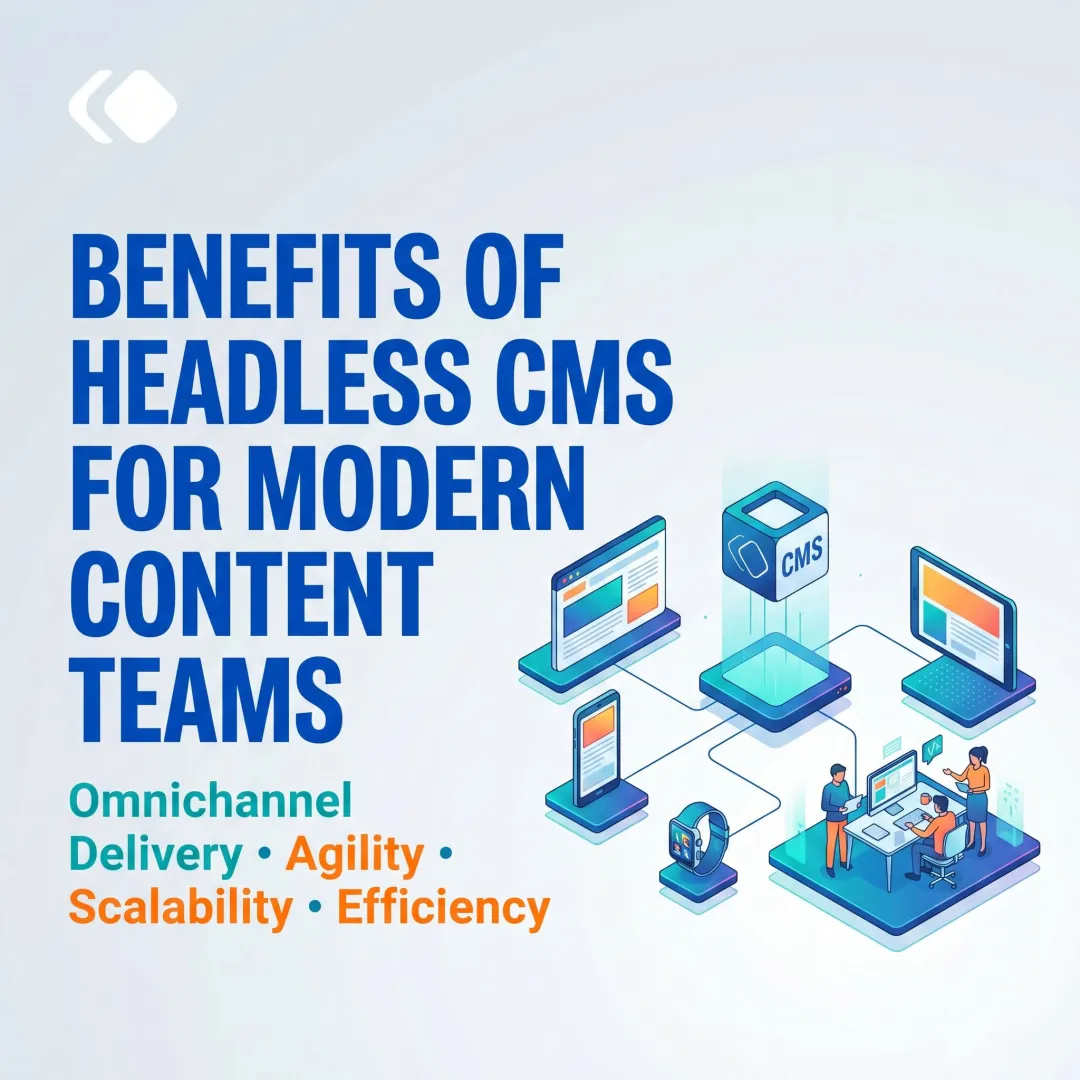
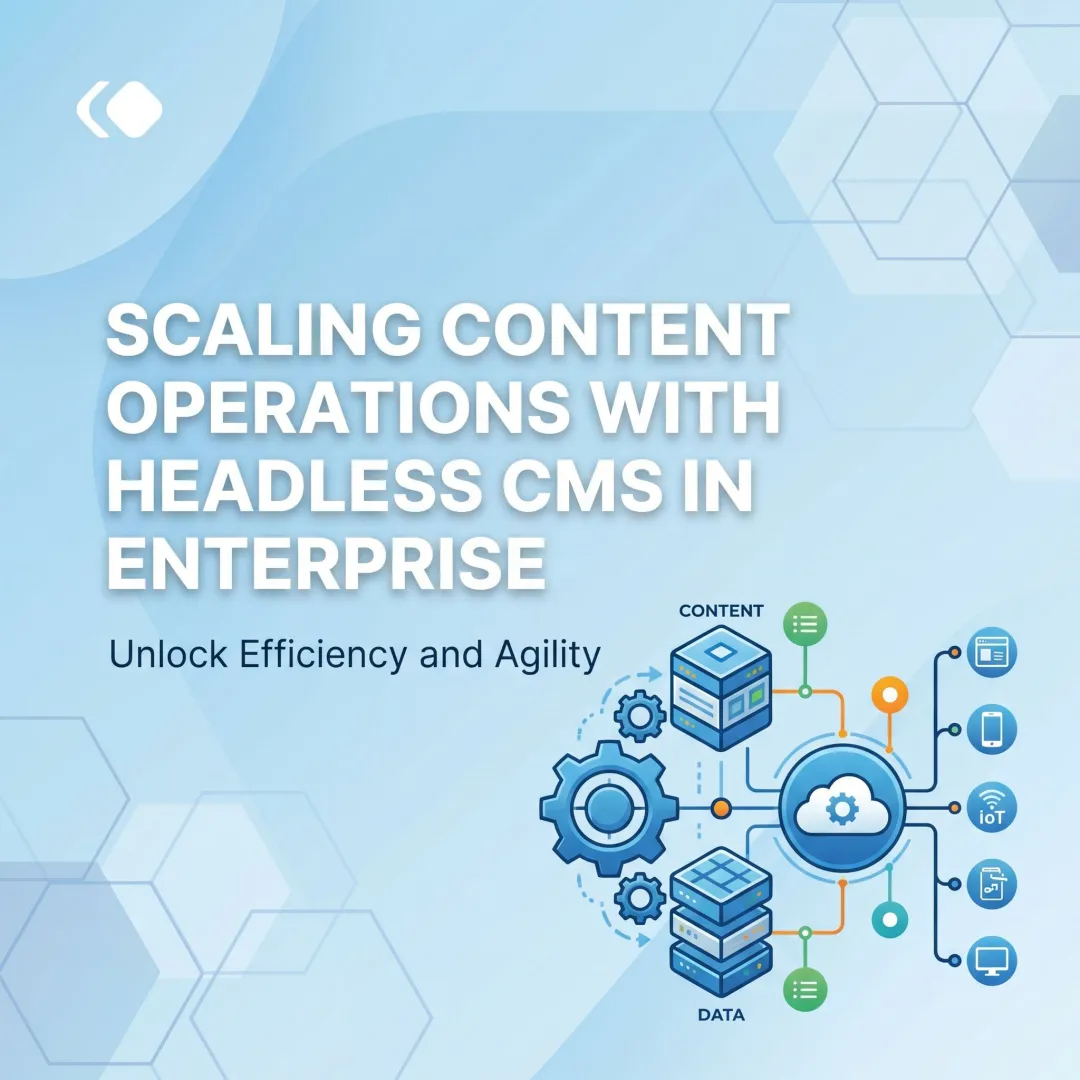
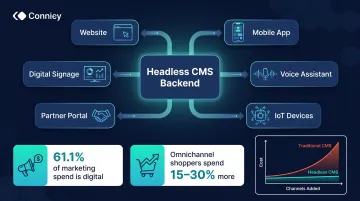
A headless CMS is a content management backend that stores and delivers content via APIs, completely decoupled from how or where that content is displayed—whether on a website, mobile app, digital signage, or voice assistant.
Headless CMS adoption is most common among organisations managing high content volumes across multiple platforms, brands, languages, or geographies. That includes:
- Media companies and digital news publishers
- Financial institutions and BFSI organisations
- Hospital networks and healthcare systems
- Large consumer brands with multi-channel content operations
73% of businesses now use headless architecture, and over 80% of large enterprises plan to adopt headless or composable CMS by 2026.
Headless CMS is the infrastructure that makes content reuse, omnichannel delivery, and continuous iteration possible at enterprise scale—without requiring development resources for every new channel or content update.
Key Advantages of a Headless CMS for Enterprise ROI
The advantages below are evaluated through measurable, operational impact—costs avoided, time saved, revenue enabled—rather than theoretical capability. Each ties directly to KPIs that enterprise finance and technology leaders track.
Lower Total Cost of Ownership (TCO)
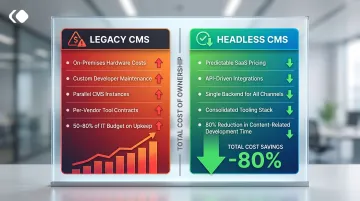
TCO for a CMS goes far beyond the license fee. It includes hosting infrastructure, developer time for maintenance and upgrades, integration costs, downtime costs, and the compounding expense of scaling a monolithic system.
How headless CMS reduces TCO in practice:
- SaaS-based pricing eliminates on-premises hardware and maintenance
- API-driven integrations reduce custom development
- A single content backend serving multiple channels removes the need for parallel CMS instances
- Consolidated tooling eliminates per-vendor costs for analytics, SEO, push notifications, and asset management
The hidden cost driver: Software maintenance consumes 50-80% of total cost of ownership over a system's lifetime (Gartner, IEEE). Organisations spend 55-80% of IT budgets maintaining existing systems. For financial services, this rises to 70-80%; for healthcare, 65-80%.
Forrester documented an 80% reduction in content-related development time for headless CMS adopters—the largest single cost driver. That means developer time shifts from maintenance to growth initiatives.
KPIs impacted:
- Infrastructure spend
- Developer hours per content update
- Number of third-party vendor contracts
- Cost per content asset published
- Annual platform maintenance cost
Best fit for: Organisations running legacy monolithic CMS platforms with large, developer-dependent teams; enterprises managing content across multiple properties or brands; companies approaching a re-platforming decision point.
Faster Content Velocity and Time-to-Market
For enterprise teams in media, finance, and e-commerce, the ability to publish, update, and distribute content quickly is a direct revenue lever. Delays in publishing product updates, regulatory notices, news content, or campaign materials translate into lost opportunity.
How headless CMS creates speed in practice:
- Content editors work in a stable, always-available backend
- Structured content models and reusable components reduce per-piece production time
- AI-assisted creation and repurposing compress the content cycle
- Approval workflows streamline within a single platform rather than across disconnected tools
Forrester documented a 90% reduction in time to publish for headless CMS adopters. Real-world outcomes include Hartlauer's 30% revenue increase and 50% traffic growth after moving to headless, and MoneyLion reducing time to launch new content to 15 minutes—without developer support.
Organisations using AI-integrated CMS workflows achieve 2.1x higher content output and 2.4x faster delivery speed (Optimizely benchmark report).
KPIs impacted:
- Average time-to-publish per content type
- Number of content assets published per sprint
- Campaign activation lead time
- Content team output per headcount
- Editorial throughput
When this advantage matters most: News and media organisations where publishing delays are competitively damaging; financial institutions needing to update product pages, rates, or compliance content on short notice; enterprises running high-frequency marketing campaigns across multiple regions.
Omnichannel Scalability Without Proportional Cost Growth
Traditional CMS platforms require significant rework (or entirely separate implementations) when adding new digital touchpoints: mobile apps, connected devices, partner portals, or localised regional sites. Headless architecture eliminates this constraint because the content layer is already decoupled from presentation.
How headless CMS creates scalability in practice:
Once content is structured in the headless backend, it pushes to new channels via API—no re-entry, reformatting, or rebuilding required. New markets, languages, or platforms need only frontend development work; the content infrastructure stays intact.
Digital channels now account for 61.1% of total marketing spend (Gartner 2025 CMO Spend Survey), with 7 out of 10 industries dedicating over 60% of budgets to online channels. Meanwhile, connected IoT devices reached 18.5 billion in 2024 and are forecast to hit 21.1 billion in 2025—each representing a potential content endpoint.
Every new touchpoint added to a traditional CMS compounds cost and complexity. With a headless architecture, that cost curve flattens significantly. Research shows omnichannel shoppers demonstrate 15-30% higher spending levels compared to single-channel customers—making the scalability argument both operational and commercial.
KPIs impacted:
- Time to launch new channel or regional property
- Number of active channels served from a single content backend
- Content reuse rate across channels
- Cost per incremental channel addition
Particularly valuable for: Enterprises expanding into new markets or languages; media companies operating multiple publications from one content team; healthcare networks and financial institutions serving both web and mobile audiences with compliance-sensitive content.
What Happens When Enterprises Avoid Going Headless
The operational cost of staying on a monolithic CMS compounds quietly, then all at once. Three patterns repeat across enterprises that delay the move:
- Maintenance overhead grows with every customization layered onto the platform
- Development teams spend disproportionate time managing infrastructure instead of building features
- Content teams stay bottlenecked by slow publishing cycles and developer dependencies for even minor updates
Traditional CMS platforms do not scale gracefully. Organizations end up paying for multiple platform licences, managing integration debt between siloed tools, and facing re-platforming crises every 3–5 years. After 8–10 years, most large organisations are maintaining 8 to 12 different technological platforms — sometimes exceeding 30 CMS platforms within a single company.
The financial exposure is direct:
- 32% of the world's largest enterprise websites suffer a CMS security or data breach every week, with Forrester estimating mitigation costs of ₹25–₹29 crore per incident
- 90% of firms report one hour of downtime costs over ₹2.5 crore, with 41% reporting hourly costs between ₹8.3 crore and ₹41.6 crore
- Enterprise CMS migration projects cost ₹7 crore to ₹16.6 crore, with hidden costs inflating final budgets by 30–50%
In content-intensive industries like media, fintech, and healthcare, the ability to publish faster, personalise at scale, and maintain consistent digital performance is a direct competitive advantage. Every quarter spent on a legacy system is a quarter of compounding migration debt — and the longer the delay, the higher the eventual cost to escape it.
How to Maximize Your Headless CMS ROI
Headless CMS ROI builds over time — but only when the platform is used strategically. Organizations that see the highest returns treat it as a content operations platform: structured content modelling from day one, clear workflow ownership, and quarterly performance reviews tied to KPIs.
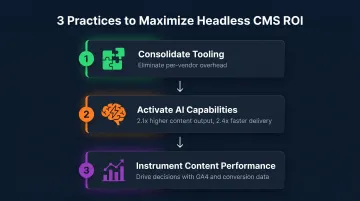
Three concrete practices that amplify ROI:
- Consolidate tooling – Replace standalone SEO tools, analytics platforms, push notification services, and asset management systems with an integrated platform to eliminate per-vendor overhead
- Activate AI capabilities – Use AI built into or integrated with the CMS to reduce content production time and increase output without proportional headcount growth. Organisations using AI-integrated CMS workflows achieve 2.1x higher content output and 2.4x faster delivery speed
- Instrument content performance from the start – Connect the CMS to analytics (GA4, GSC, or equivalent) so content decisions are driven by engagement and conversion data, not intuition
Platform choice shapes how quickly these practices take hold. Publive, for instance, combines headless CMS infrastructure with built-in AI content creation, Core Web Vitals optimisation, and an enterprise analytics dashboard in a single platform — enabling customers to act on all three practices without stitching together separate tools. Its customers have reported 50% lower TCO as a result.
To keep returns compounding: review outcomes quarterly, audit integrations for efficiency, and track content reuse rates as a leading indicator of how well the platform is actually being used.
Conclusion
A headless CMS reduces the total cost of owning and operating content infrastructure, accelerates the speed at which content reaches audiences, and enables channel expansion without the cost curve of traditional platforms—and each of these advantages compounds as the organisation grows.
Going headless is a long-term investment in content operations efficiency, not a one-off migration. Enterprises that measure outcomes, act on data, and keep optimising their workflows see returns that extend well beyond the initial platform switch.
With 295% ROI over three years and measurable reductions in development time, infrastructure costs, and time-to-market, the numbers make the case. The question for most organisations is no longer whether to adopt headless—it's how quickly they can start capturing those gains.
Frequently Asked Questions
How is headless CMS ROI different from traditional CMS ROI?
Traditional CMS ROI is often measured by feature availability, while headless CMS ROI is driven by operational metrics—reduced infrastructure cost, faster publishing cycles, and content reuse across channels—making returns more directly attributable to business outcomes like developer time savings and revenue acceleration.
How long does it typically take to see ROI after adopting a headless CMS?
Initial returns—developer time savings and reduced hosting costs—typically appear within the first few months. Compound ROI from faster content velocity and channel expansion usually materialises over 12–24 months, depending on implementation maturity and how strategically the platform is used.
What are the biggest hidden costs of a traditional CMS that headless eliminates?
The largest hidden costs are developer dependency for routine content updates, redundant vendor contracts for tools the headless platform consolidates, and recurring re-platforming expenses driven by monolithic architecture limitations—cycles that typically repeat every 3–5 years.
How do enterprises measure the ROI of a headless CMS?
Core KPIs include infrastructure and licensing cost reduction, developer hours saved per month, time-to-publish per content type, content reuse rate across channels, and revenue metrics tied to content-driven campaigns or faster time-to-market.
Is a headless CMS worth the investment for organisations with smaller content teams?
Headless CMS ROI scales with content volume and channel complexity. For smaller teams with simple needs, the initial setup investment may outweigh early returns, but organisations expecting growth, multi-channel expansion, or high publishing frequency benefit even at modest team sizes.
How does AI integration amplify the ROI of a headless CMS?
AI capabilities built into a headless CMS reduce content production time, enable automated repurposing across channels, and surface performance data for faster optimisation. The result: higher output per team member without proportional cost increases.