Introduction
Enterprise content teams face mounting pressure. They manage dozens of digital channels, publish in multiple languages, and coordinate hundreds of articles daily through complex approval workflows. Yet many still run on legacy monolithic CMS platforms built for a simpler era.
Back then, a company's digital presence meant one website. Now it means a web property, mobile app, push notification system, email platform, and digital signage network—all operating in parallel.
The gap between content demand and operational capacity is widening. McKinsey research cited by Mole Street finds that technical debt consumes up to 40% of IT capacity in large organisations, draining resources that could drive innovation. Meanwhile, 31% of B2C marketers cite slow execution as their top barrier to personalised campaigns—rising to 61.4% in financial services, where regulatory complexity compounds the technical challenge.
This article breaks down how headless CMS architecture enables enterprises to scale content operations effectively. Here's what we cover:
- Infrastructure principles that support elastic growth
- Workflow and governance requirements at scale
- How AI shifts from content creation aid to operations engine
- What decision-makers must evaluate before migration
TLDR
- Headless CMS decouples content from presentation via APIs, enabling multi-channel publishing from a single content source
- Enterprise scaling demands more than speed—it requires structured workflows, role-based access, and governance at scale
- AI is evolving from a content creation tool to an operations engine—automating bulk updates, enforcing consistency, and handling distribution at scale
- Platform evaluation must weigh API performance, uptime SLAs, localisation support, and total cost of ownership
When Enterprise Content Operations Break Down
Content operations typically break at predictable inflection points. The warning signs are consistent across organizations:
- Regional teams edit the same content simultaneously, with no coordination
- Brand messaging fragments across web, app, and social channels
- Publishing delays cascade as sequential approval chains bottleneck high-priority launches
- Infrastructure costs climb as teams bolt on tools to patch gaps the core CMS cannot fill
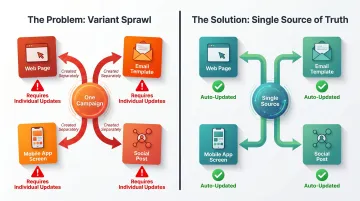
The "variant sprawl" problem emerges when the same campaign exists in four versions across platforms with no single source of truth. A product launch lives as a web page, mobile app screen, email template, and social post — all created separately, all slightly different, all requiring individual updates when details change.
For regulated industries, this creates direct compliance exposure. Which version reflects the approved legal language? Which asset was live when the customer complaint occurred?
The critical question decision-makers must ask: Is this a people and process problem, or is the underlying architecture fundamentally unable to support scale? Headless CMS addresses the latter. No amount of workflow training fixes a platform that cannot deliver content to multiple channels from one source, or scale infrastructure during traffic spikes without manual intervention.
That architecture problem has a real cost. A typical Adobe Experience Manager deployment runs approximately ₹3.7 crore annually before customization, with three-year total cost of ownership reaching ₹20–21 crore.
The operational drag compounds this. Simple updates that should take minutes — creating pages, building forms, launching tests — routinely take days or weeks because marketers depend entirely on engineering resources to execute them.
How Headless CMS Architecture Powers Enterprise-Scale Content Delivery
The Core Architectural Principle
Headless CMS decouples the content repository (back-end) from the presentation layer (front-end), delivering content to any channel via APIs. This separation means a single piece of structured content can feed a website, mobile app, push notification, digital signage, and voice assistant simultaneously—without duplication or reformatting.
API-First Design in Practice
Content is stored as structured, channel-agnostic data accessed by any front-end through REST or GraphQL APIs. For enterprises running multiple digital properties simultaneously, the payoff is immediate: update a product specification once, and it propagates to every property automatically. No versioning conflicts, no manual republishing.
Elastic, Cloud-Native Infrastructure
Headless CMS platforms built on cloud infrastructure auto-scale compute resources during traffic spikes. News publishers know this pressure firsthand. Traffic can surge 10x to 100x baseline volume within minutes during elections, major announcements, or breaking news — and top-tier publishers have handled over 2 million concurrent users during peak events, a load that collapses most monolithic systems.
The financial stakes are real. For ad-revenue-dependent publishers, CMS downtime translates directly to lost advertising revenue — estimates place losses in the range of ₹77 lakh per hour, with enterprise-wide averages reaching ₹11.6 lakh per minute. When uptime equals revenue, infrastructure decisions aren't discretionary.
Global CDN and Edge Caching
Content served from edge nodes nearest to users reduces latency and ensures performance under global load. This directly affects uptime SLAs and Core Web Vitals scores, both of which influence search visibility and user retention. Google's Core Web Vitals are confirmed ranking signals: LCP under 2.5 seconds, INP under 200 milliseconds, CLS under 0.1.
Sites optimised for Core Web Vitals report 20–50% SEO lifts. One documented case saw organic traffic increase 35% after Vitals optimisation. Performance affects revenue: a 1-second page load delay results in 7% fewer conversions, and 40% of users abandon sites taking more than 3 seconds to load.
Independent Scaling Advantage
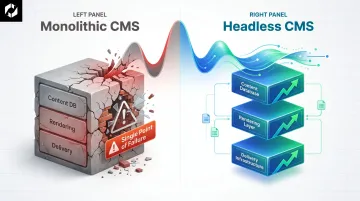
With headless architecture, the content database, rendering layer, and delivery infrastructure scale independently. A bottleneck in one layer doesn't crash the entire system—unlike monolithic CMS where everything shares the same infrastructure. During a traffic spike, the delivery layer scales while the editorial back-end maintains steady performance for the publishing team.
The Five Pillars of Scalable Content Operations
Structured, Reusable Content Modeling
Content stored as modular components rather than static pages can be reused across channels, campaigns, and regions without reformatting. A single "article" content type powers a web page, app card, email snippet, and AMP page simultaneously. This eliminates duplication and maintains consistency—when the source updates, all presentations reflect the change.
For enterprises managing thousands of content items, this architectural decision compounds over time. Traditional page-based CMS requires creating and maintaining separate versions for each channel. Component-based systems maintain one source that feeds many destinations.
Multi-Team Workflow Governance
Approval chains, role-based access control (RBAC), and granular permissions allow large editorial teams to work in parallel without overwriting each other's work or bypassing compliance checks. For regulated industries, audit logs move from a nice-to-have to a hard operational requirement.
Indian BFSI and healthcare organisations face specific mandates here:
- SEBI's cybersecurity framework requires regulated entities to maintain detailed audit trails of system activity and access
- India's DPDP Act mandates data accountability and breach traceability across content operations
- Healthcare organisations must demonstrate access segregation and record retention under applicable data fiduciary obligations
CMS platforms serving these sectors need comprehensive audit capabilities, role-based access with segregation of duties, and documented compliance controls.
Localization and Multi-Market Management
Running the same content across 10+ markets with different legal requirements, languages, and product variations creates architectural complexity. 90% of businesses plan to enter new-language markets within five years, yet over 50% have lost business due to inadequate localization.
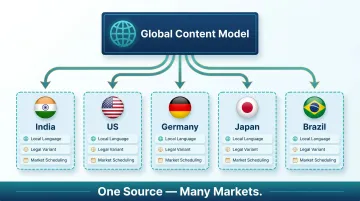
A headless CMS allows teams to manage a global content model while enabling regional overrides, translation workflows, and market-specific scheduling—without fragmenting the content architecture. The same product description exists in one place, with localized variations for each market managed as extensions rather than duplicates.
Omnichannel Publishing and Scheduling
Enterprise content teams need to schedule releases across channels simultaneously—ensuring the website, app, and social push all launch in sync. Preview environments that reflect real rendering across formats before publish become critical when coordinating multi-channel campaigns.
51.6% of B2C marketers identify seamlessly executing omnichannel communication as a top challenge. Strategy rarely holds teams back. Legacy infrastructure does — most older systems simply weren't built to orchestrate simultaneous multi-channel releases from a single source.
Performance Monitoring and Uptime Reliability
Enterprise content operations require real-time visibility into CMS health, API response times, and publishing success rates. SLA-backed uptime guarantees are non-negotiable for enterprises where CMS downtime means lost revenue or regulatory exposure.
Industry-standard SLAs offer 99.9% uptime (8.76 hours downtime annually); enterprise-grade services commit to 99.99% (52.56 minutes annually). Mission-critical systems target 99.999% (5.26 minutes annually)—a meaningful operational difference for publishers during peak events.
AI in Content Operations: Beyond Writing to Managing at Scale
The early promise of AI in CMS focused on faster content writing. At enterprise scale, the real bottleneck isn't creation—it's managing, updating, and maintaining consistency across thousands of content items.
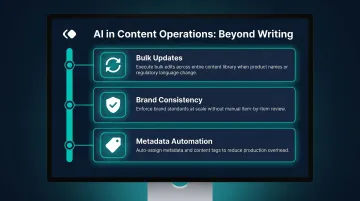
Modern AI-powered CMS platforms handle the operational layer that editorial teams can't scale manually:
- Execute bulk updates when product names or regulatory language change across the entire content library
- Enforce brand consistency at scale without manual review of individual items
- Automate metadata assignment and content tagging to reduce production overhead
AI-Powered Distribution Workflows
Automated social media sharing, push notification scheduling, and content syndication reduce manual effort for media and brand publishing teams. 79% of marketers now use GenAI for content tasks—the highest adoption rate of any martech category. Beyond copy generation, adoption spans content optimisation (49%), image/video ideation (44%), and production (36%).
AI-Assisted SEO and Content Discoverability
Metadata auto-generation, structured data optimisation, and GEO (Generative Engine Optimisation) readiness are increasingly important as AI search engines reshape content discovery. Zero-click searches increased from 56% to 69% in one year, reshaping how users find content.
Enterprises need CMS platforms purpose-built for AI search discoverability—platforms that generate structured data, optimise for featured snippets, and format content for generative AI platforms like ChatGPT, Gemini, and Claude.
That's where platforms built from the ground up for AI discoverability make the difference. Publive's AI-first headless platform delivers 60% faster content output with built-in tools for generation, repurposing, and distribution—without stitching together separate vendors.
Organisations like Indian Express and News Nation use Publive to handle high-volume, time-sensitive publishing at scale. Indian Express Tamil achieved a 3x surge in page views within 45 days; News Nation saw a 7.3x increase in monthly page views alongside 5.2x growth in active users.
What to Look for in an Enterprise Headless CMS
Six evaluation criteria matter most at enterprise scale:
- API performance under load — Can it handle concurrent requests during traffic spikes? Infrastructure must auto-scale without performance degradation.
- Uptime SLA and support terms — What uptime does the vendor guarantee contractually? Enterprise operations require commitments, not best-effort promises. Confirm whether 24/7 support is included or separately priced.
- Governance depth — Role-based access control, audit trails, approval workflows, and field-level permissions are compliance requirements for regulated industries, not optional features. Verify SOC 2, ISO 27001, WCAG, and regional data protection compliance.
- Localisation and multi-site management — Can the platform manage content across multiple markets and languages without duplicating the entire content architecture? 87% of businesses confirm localisation directly contributes to expansion success.
- Total cost of ownership — Evaluate licensing, infrastructure, integrations, and vendor sprawl together. Gartner reports 85% of DXP effort and cost goes to integrations. By 2026, 70% of organisations are expected to adopt composable over monolithic DXP architectures.
- AI-readiness — The martech landscape reached 15,384 solutions in 2025, with 77% of new products AI-native. Platforms must go beyond AI-assisted writing to AI-powered operations automation.
The Consolidation Imperative
Enterprises are moving away from assembling 6-8 separate tools (CMS + DAM + analytics + push + SEO + social) toward consolidated platforms that reduce operational overhead and integration maintenance cost. Only 17.3% of platforms rate as having "great" API coverage — a significant barrier to composable strategies.
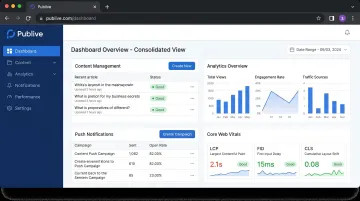
That consolidation pressure is exactly what purpose-built platforms are designed to address. Publive, for instance, serves media houses, financial institutions, and large brands by bringing content management, AI-powered creation, push notifications, analytics, and Core Web Vitals optimisation into a single platform. With 99.995% uptime on AWS, 50% lower TCO compared to multi-vendor stacks, and 98% of client sites passing Core Web Vitals — the highest pass-rate among leading DXPs — it addresses the performance and cost requirements that fragmented stacks consistently fail to meet.
Frequently Asked Questions
What is the difference between a headless CMS and a traditional CMS for enterprise use?
A headless CMS decouples content from presentation via APIs, enabling multi-channel delivery from one source. Traditional CMS locks content to a single front-end, limiting scalability and requiring duplicate content creation for each channel.
When should an enterprise migrate from its current CMS to a headless CMS?
Migrate when you experience content duplication across channels, sequential publishing bottlenecks, inability to serve multiple digital properties from one source, or rising infrastructure costs from patching a legacy system that fundamentally cannot scale.
How does a headless CMS support omnichannel content publishing at scale?
Structured content stored as API-accessible data can be simultaneously delivered to websites, mobile apps, push notifications, digital signage, and other channels without reformatting or duplicating content. One update propagates everywhere automatically.
What governance features should an enterprise headless CMS include?
For regulated industries, non-negotiable features include:
- Role-based access control and granular field-level permissions
- Multi-step approval workflows and full audit logs
- Compliance certifications (SOC 2, ISO 27001, WCAG) with segregation of duties
Platforms without built-in compliance reporting are a liability, not just a gap.
How does AI improve content operations in a headless CMS beyond content writing?
Advanced AI automates bulk content updates, metadata tagging, translation workflows, and publishing distribution—reducing manual operations overhead as content volume scales. At enterprise scale, AI stops being a writing tool and starts running the operations layer: scheduling, routing, and distributing content with minimal human intervention.
What is the total cost of ownership impact of switching to a headless CMS?
Setup costs are real, but the long-term savings are significant. Enterprises consolidate multiple point tools into one platform, cut infrastructure overhead, and reduce developer dependency for routine content tasks. Organisations migrating from monolithic CMS platforms have documented TCO reductions of 50% or more.