While "headless CMS" is widely discussed in technical circles, its real value for content teams isn't in the architecture itself—it's in what that architecture makes possible day-to-day: faster publishing, fewer bottlenecks, and content that works everywhere without manual reformatting.
This article explains the practical, measurable advantages of headless CMS for content teams, backed by industry data and real-world case studies. You'll see exactly how this approach eliminates operational friction and why organisations from Televisa to WebMD have made the switch.
TL;DR
- A headless CMS separates content management from presentation, delivering content to any channel via APIs
- Content teams publish faster through parallel workflows, eliminating the "wait for IT" bottleneck
- Structured content powers AI workflows and improves discoverability in ChatGPT, Gemini, and AI search
- 61% of teams use two or more CMSes because monolithic platforms can't handle omnichannel demands
- Content structured today stays reusable as new channels emerge, so the advantages build over time
What Is a Headless CMS?
A headless CMS is a content management system that stores and manages content separately from how that content is displayed—content is published to any channel via APIs, rather than being locked to a single website template.
Where it's applied:
- Media publishers distributing articles to web, apps, and aggregators
- Brands pushing content to websites, kiosks, and smart devices
- Editorial teams managing multilingual and multi-platform content from one backend
- Financial institutions delivering product information to portals, mobile apps, and CRM systems
What matters across all these use cases is operational control. Content teams need the ability to publish consistently across a growing number of channels without restructuring workflows for each new one.
According to Forrester Principal Analyst Chuck Gahun, "essentially all" evaluated CMS vendors now deliver experiences via APIs, marking the end of monolithic architectures. Globally, the headless CMS market is projected to grow from $3.94B in 2025 to $22.28B by 2034, a 22.6% CAGR driven by rapidly expanding digital touchpoints.
Key Advantages of a Headless CMS for Content Teams
The three advantages below are chosen specifically for their operational impact on content teams—not developer convenience. Each ties directly to outcomes teams actively track: publishing speed, content efficiency, audience reach, and cost.
Omnichannel Publishing Without Rebuilding Every Time
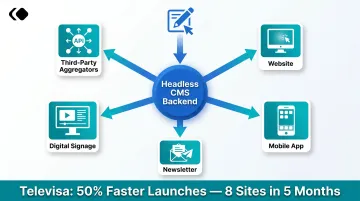
With a headless CMS, content is created once in a structured format and delivered to multiple channels—website, mobile app, newsletter, digital signage, third-party aggregators—through APIs, without re-entering or reformatting the content for each platform.
In practice:
Content teams write and manage everything from a single backend. The CMS handles delivery to each channel based on how the front-end is configured—meaning no copy-pasting between platforms, no duplicate CMS logins, and no waiting for developers to "push" content to a new channel.
The operational impact:
This directly eliminates one of the biggest productivity drains for content teams—the manual effort of repurposing and re-publishing the same content across multiple platforms. 61% of content teams currently use two or more CMSes to manage content across regions, departments, or platforms, with 44% using multiple systems specifically to support omnichannel experiences. That fragmentation creates duplicated effort and inconsistency risk.
The operational savings are measurable. When Mexican media giant Televisa consolidated from 9 disparate CMS platforms to 1 headless system, they achieved a 50% decrease in launch times and deployed 8 sites in just 5 months.
When the same structured content auto-populates across channels, teams maintain a single source of truth and reduce the risk of outdated or conflicting versions appearing across touchpoints. For aviation manufacturer Gulfstream, this meant publishing single structured documentation to four distinct endpoints—FAA regulators, pilots, ground crew, and in-flight displays—from one content model.
KPIs impacted:
- Content publishing frequency
- Cross-channel coverage rate
- Time spent on content reformatting
- Error/inconsistency rate across channels
Best fit for: Media houses managing high-volume content across web and app; brands expanding into new markets or launching new digital channels; any content team where channel growth has outpaced headcount growth.
Faster Content Output and Shorter Time-to-Market
Headless CMS decouples content creation from front-end development, which means editorial and marketing teams can create, edit, and publish content without waiting on developer cycles—and developers can simultaneously work on front-end features without blocking content operations.
How parallel workflows change the day-to-day:
In a traditional CMS, a new campaign page, content type, or template change often requires a developer to modify the CMS theme or backend before content can be published. In a headless setup, content is structured independently of the presentation layer, so editors can work in parallel with the development team and publish to existing channels immediately.
The speed gains, in numbers:
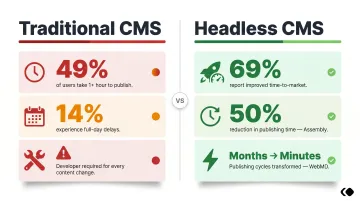
This parallel workflow removes the "waiting for IT" bottleneck that content teams consistently cite as a top productivity constraint. 49% of WordPress users report it takes over one hour to publish content, with 14% experiencing full-day delays. Meanwhile, 69% of headless CMS users report improved time-to-market.
Real-world results back this up. Assembly achieved a 50% reduction in publishing time after switching to a headless platform. WebMD Ignite compressed publishing cycles from months to minutes. One digital coupon publisher eliminated engineering dependency entirely—their Product Operations team took full ownership of content updates.
Fewer developer hours spent on routine content work means engineering capacity shifts to higher-value projects. IDC research reports a 42% improvement in IT efficiency and a 17% gain in technical writing productivity for organisations adopting structured content management systems.
KPIs impacted:
- Time-to-publish
- Developer ticket volume for content-related requests
- Content team throughput (pieces per week/month)
- Campaign launch lead time
Best fit for: Fast-moving editorial teams covering live news or product launches; marketing teams running multiple simultaneous campaigns; organisations where content volume consistently outstrips developer bandwidth.
Structured Content and AI-Readiness
A headless CMS stores content as discrete, structured data fields—headline, body, metadata, tags—rather than HTML blobs locked to a page template. That architecture makes content machine-readable and compatible with AI-powered workflows: automated tagging, content repurposing, SEO optimisation, and AI search discoverability.
How this changes content operations:
In a traditional CMS, content is often stored as formatted HTML tied to a page template, making it difficult to extract, analyse, or feed into AI tools. In a headless architecture, each content element is a discrete, queryable data field—which makes it compatible with AI content generation tools, analytics pipelines, and emerging AI search engines.
Why structured content is now table stakes:
Structured content is the foundation for AI-augmented workflows—automated summarisation, intelligent recommendations, faster repurposing across formats. 88% of organisations now use AI regularly (up from 78% in 2024), and 44% of CMS users rank AI-powered content creation as their top requested feature.
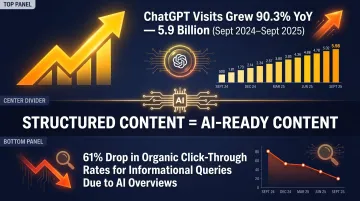
The urgency extends to discoverability. ChatGPT visits grew 90.3% year-over-year to 5.9 billion between September 2024 and September 2025. AI Overviews in Google Search drove a 61% drop in organic click-through rates for informational queries. Content that isn't structured for AI extraction is simply less visible.
EY uses structured content (DITA XML) to feed LLMs for internal AI-powered search and chat, supporting hundreds of content producers and tens of thousands of audit practitioners globally. Kontent.ai notes that structured content is "a critical enabler for AI search tools to find, process, and reuse your content effectively."
Content structured in a headless CMS stays reusable and discoverable as AI-mediated interfaces and zero-click search behaviours become dominant—which means the investment compounds over time, not just today.
Publive's platform is built on headless architecture for exactly this reason: structured content management paired with AI-powered creation, repurposing, and GEO discoverability, so media houses and brands can scale output without scaling headcount.
KPIs impacted:
- Content discoverability in AI search
- Time spent on content repurposing
- AI tool integration success rate
- Organic traffic from AI-referred sources
Best fit for: Media publishers and content-heavy brands building AI workflows; teams managing large content libraries that need intelligent surfacing; organisations preparing for AI-mediated search as a primary discovery channel.
What Happens When Teams Stay With a Monolithic CMS
As channel and content demands grow, teams relying on traditional, tightly coupled CMS platforms experience predictable consequences:
- Content silos force re-entry and reformatting for every new platform, creating duplication and escalating maintenance overhead. 87% of employees struggle to manage content through its entire lifecycle, and 68% report being buried under disconnected tools.
- Developer bottlenecks stall publishing cycles, leaving content teams with backlogs and missed time-sensitive windows. One major digital coupon publisher required engineering involvement for any change to its digital experience, because content types were scattered across separate tooling, services, and stacks.
- Scaling content output means scaling headcount, since monolithic platforms don't decouple operational complexity from volume. 61% of teams use two or more CMSes precisely because no single monolithic platform covers all their needs.
- Modern tool integrations become difficult or impossible, as content locked inside a monolithic structure can't easily connect with analytics platforms, AI writing assistants, or personalisation engines built for API-driven workflows.
- Technical debt compounds over time, as patches and workarounds make the system fragile and costly. Forrester characterises monolithic CMS architectures as "a thing of the past" and flags technical debt as a primary risk for organisations that skip proper evaluation before committing to a platform.
How Content Teams Can Get the Most from a Headless CMS
A headless CMS delivers its strongest benefits when adoption is structured. Content models should be designed upfront with reuse in mind—defining clear content types, taxonomy, and field structures that allow the same content to serve multiple channels without rework.
The COPE principle (Create Once, Publish Everywhere), popularised by NPR over 15 years ago, remains the foundational content strategy for headless adoption. It involves breaking content into reusable "chunks" rather than monolithic "blobs."
Three operational practices separate teams that get full value from headless from those that don't:
- Track operations metrics regularly. Review publishing velocity, cross-channel coverage, and developer ticket volume on a set cadence to confirm the architecture is delivering efficiency gains and catch friction early. IDC research documents 287% three-year ROI and $32 million average annual benefit for organisations adopting structured content systems, with a 13.9-month payback period.
- Pair headless with AI capabilities. Headless architecture delivers more when the CMS includes built-in AI tools. Platforms like Publive combine headless delivery with AI for content creation, social distribution, and analytics—so teams gain structural flexibility and production speed without managing separate vendors.
- Build content engineering capacity. Forrester recommends creating dedicated "content engineer" roles to bridge developers and content strategists, ensuring content activates reliably across every channel and technology.
Conclusion
The real value of a headless CMS for content teams lies not in the technology itself, but in the operational control, publishing speed, and content adaptability it creates—advantages that directly affect how much content a team can produce, how consistently it reaches audiences, and how ready that content is for an AI-driven discovery landscape.
These benefits compound: a team that structures its content well, publishes across channels without bottlenecks, and feeds a clean content architecture into AI workflows today will operate with compounding efficiency gains as digital channels and AI tools continue to evolve.
Headless CMS adoption is an ongoing infrastructure decision, not a single migration event. The returns scale with how deliberately it is applied — which means teams that delay structured implementation continue losing ground each quarter.
With 90% of global technology decision-makers expecting increased budgets for consumer-facing digital products, the teams moving now are the ones shaping their content infrastructure before channel fragmentation and AI discovery make catch-up significantly harder.
Frequently Asked Questions
What are the benefits of a headless CMS?
Headless CMS enables omnichannel publishing from a single backend, faster content output through parallel workflows, structured content that integrates with modern AI tools, and improved site performance through API-driven delivery.
What is the difference between a headless CMS and a traditional CMS?
A traditional CMS tightly couples content with its presentation layer (one CMS, one website), while a headless CMS separates them: content is managed in one backend and delivered to any channel via APIs, giving teams the flexibility to publish anywhere without rebuilding their setup for each new platform.
Is a headless CMS suitable for beginners?
For non-technical content creators, a headless CMS can simplify day-to-day work—editors work in a clean backend focused on content rather than page templates. However, initial setup and front-end configuration typically require developer involvement, so it works best when technical support is available at launch.
Can a headless CMS improve content team efficiency?
Yes—by removing developer dependency for routine publishing tasks, enabling content reuse across channels, and integrating with AI tools, headless CMS directly reduces manual effort and accelerates publishing cycles for content teams.
What are the challenges of adopting a headless CMS?
Higher upfront setup effort, greater reliance on developers during implementation, and the need to design a thoughtful content model before launch.
How does a headless CMS support omnichannel content publishing?
Because content is stored as structured data and delivered via APIs, the same content can be automatically distributed to websites, mobile apps, newsletters, digital kiosks, and other channels from a single backend—eliminating the need to re-enter or reformat content for each platform.