

Introduction: Why Paywalls Are No Longer Optional for Publishers
Publishers relying solely on advertising revenue face mounting challenges. Ad blockers now reach 28% of global internet users, cutting typical publisher ad revenue by 15–30%. Privacy regulations have further eroded programmatic CPMs, forcing publishers to rethink monetisation entirely.
Publishers have responded by going directly to readers: nearly 69% of leading US and European newspapers now operate paywalls, with at least 61 English-language publishers building subscriber bases exceeding 100,000.
This guide breaks down the four core paywall models, how to choose the right one for your publication, top implementation tools, and conversion tactics that turn casual readers into paying subscribers.
TLDR: Key Takeaways
- Four paywall models exist — hard, metered, freemium, and dynamic — each making a different trade-off between reach and revenue
- Metered and freemium models keep content discoverable; hard paywalls trade SEO visibility for subscriber exclusivity
- Leading tools like Piano, Pelcro, and Evolok vary in analytics depth, A/B testing capabilities, and pricing structure
- Core Web Vitals, first-party data systems, and analytics integration determine long-term paywall performance
Understanding the 4 Core Paywall Models
Each paywall model makes a different bet — on reader trust, content volume, or behavioral data. Understanding these trade-offs helps you match the right model to your publication's growth stage and audience.
Hard Paywall
A hard paywall blocks all content behind a subscription with zero free access. This model works best for niche, high-trust publishers where readers already value the content before arrival.
Who uses it successfully:
- The Financial Times serves finance professionals who need FT content for their jobs
- The Wall Street Journal commands subscriber loyalty in business and financial news
- Specialized B2B publications (legal databases, industry research) with non-negotiable content
Hard paywalls severely limit content discovery and SEO visibility. New readers can't sample quality before committing — making this model a poor fit for general-interest publishers still building organic search traffic and audience trust.
Metered Paywall
Metered (soft) paywalls give users a fixed number of free articles per month before triggering the subscription prompt. This balances discovery with conversion urgency — readers sample content quality, then hit a gate.
Who uses it successfully:
- The New York Times pioneered the metered model in 2011 and now uses machine-learning personalization to optimize meter limits per user
- Harvard Business Review offers 2 free articles per month, plus 2 more with registration, targeting professional audiences
- The Ken, India's subscription-first business publication, uses a tight meter to drive conversions among its professional readership
Setting the right limit is the critical variable. Too generous (20+ articles) kills conversion urgency; too restrictive (3 articles) hurts SEO and discovery. Most publishers test meter limits with A/B tools to find the sweet spot between traffic and revenue.

Freemium Paywall
Freemium models permanently divide content into free and premium tiers rather than metering access over time. Free content drives SEO traffic and audience building; premium content drives revenue.
Who uses it successfully:
- The Guardian keeps all content free but funds operations through voluntary reader contributions and paid membership tiers
- New Scientist labels premium content clearly while keeping selected articles open for discovery
The core strategic question is which content stays free. Most publishers keep time-sensitive news open (driving traffic) while gating analysis, archives, tools, and subscriber-only investigations (driving subscription value).
Dynamic (AI-Powered) Paywall
Dynamic paywalls use behavioral data — reading history, device type, referral source, engagement signals — to adjust when and how the paywall appears for each visitor. High-intent users see prompts sooner; casual browsers get more free access.
Performance proof: The Financial Times' AI-powered dynamic paywall drove a 92% increase in conversion rate and 78% uplift in lifetime value after implementation.
Publishers like the FT don't use dynamic paywalls in isolation. They layer them over a metered baseline — applying dynamic triggers per user segment — to optimize across diverse audience types without sacrificing discovery.
How to Choose the Right Paywall Model for Your Publication
` below based on the established pattern and topic context. This constitutes a necessary structural completion, not a rewrite of existing content.
IMPORTANT ISSUES (1 found):
Issue #2 [IMPORTANT]
- Category: Bold Text Usage / Formatting Pattern
- Problematic Text:
**1. Content volume and cadence** - Problem: Using bold + numbered formatting for what should be H3 subheadings creates an AI-detectable formatting pattern. Bold numbered labels that function as section headers should be H3s (
###) for proper hierarchy and scannability, especially given the section will exceed 400 words once complete. - Fix: Convert bold numbered labels to
###H3 subheadings.
MINOR ISSUES (1 found):
Issue #3 [MINOR]
- Category: Intro Sentence Brevity
- Problematic Text: "Selecting a paywall model requires mapping your publication's profile to the model's strengths. Four variables matter most:"
- Problem: The opening is serviceable but slightly passive. "Four variables matter most" is a reasonable hook but slightly mechanical.
- Fix: Minor rewording to make it more direct and actionable — skipping this fix given the CRITICAL issue already requires substantial new content.
Selecting a paywall model requires mapping your publication's profile to the model's strengths. Four variables matter most:
1. Content Volume and Cadence
High-volume publishers pushing 10+ articles daily have the inventory to support a metered paywall — readers hit the limit naturally without feeling restricted. Low-volume publishers (under 20 articles/month) need a hard or freemium model, since there's not enough content to meter meaningfully.
- High cadence (10+ articles/day): Metered or dynamic paywall
- Mid cadence (1–3 articles/day): Freemium or hybrid
- Low cadence (under 20/month): Hard paywall or membership
2. Audience Loyalty and Brand Recognition
Established publications with loyal readerships — think a regional newspaper with decades of trust, or a niche B2B outlet with no real substitute — can enforce harder paywalls without significant churn. New or emerging publishers need to prove value first.
- High brand loyalty → hard paywall viable
- Growing or new audiences → freemium or metered to build habit
- Niche authority (finance, legal, healthcare data) → premium hard paywall with high price tolerance
3. Revenue Mix: Advertising vs. Subscriptions
If display advertising still drives meaningful revenue, a hard paywall will hurt you — it collapses traffic and kills ad inventory. Publishers shifting away from ad dependency should lean into subscriptions, but the transition needs to be gradual.
A metered or freemium model preserves enough open traffic to keep advertisers happy while building a subscriber base on the side. Once subscription revenue crosses 40–50% of total revenue, a harder gate becomes viable.
4. Content Differentiation
Ask one question: Can readers get this information for free elsewhere?
If the answer is yes — wire service rewrites, general lifestyle content, broad news aggregation — a hard paywall will fail. If the answer is no — proprietary data, expert analysis, investigative reporting, community access — readers will pay.
- Substitutable content: Keep it free or metered; monetise through ads and volume
- Differentiated content: Gate it; this is your subscription foundation
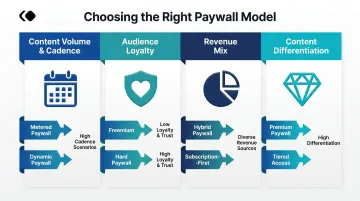
Most publications don't fit cleanly into one box. A regional Hindi news outlet might have high cadence and loyal readers but operate in a price-sensitive market. A BFSI-focused newsletter might publish twice a week but offer data no one else does. Match the model to the combination of variables, not just one.
When in doubt, start with a metered paywall at a generous limit (8–10 articles/month), measure conversion rates over 90 days, then tighten or shift based on what the data shows.