Introduction
Media and publishing decision-makers face a real infrastructure crossroads. Only 22% of audiences now access news directly through publisher websites or apps, down 10 percentage points since 2018.
Six social platforms each reach 10%+ of users for news. 72% of news video consumption happens on third-party platforms. The CMS that once powered a single website simply can't keep up.
50% of consumers now use AI-powered search, and organisations that don't adapt risk a 20-50% decline in traditional search traffic by 2028. Publishers must now deliver structured content to AI search engines, social feeds, mobile apps, push notifications, and voice interfaces — simultaneously.
That urgency makes the platform choice harder, not easier. The average enterprise migration loses $315,000 per project, and 57% of IT leaders spend over $1 million on migrations annually.
This guide breaks down both approaches — what each delivers, where each falls short, and how to decide which one fits your organisation's actual needs.
TL;DR
- A monolithic CMS couples front-end and back-end tightly, making deployment fast but multi-channel scaling difficult
- A composable DXP uses modular, API-connected tools that let teams assemble a tailored digital experience stack
- Monolithic systems suit smaller teams with stable, single-channel requirements
- Composable DXPs suit publishers scaling across web, app, and social channels with rapid expansion goals
- Your choice comes down to scale, budget, technical maturity, and where you plan to grow
Composable DXP vs Monolithic CMS: Quick Comparison
| Dimension | Composable DXP | Monolithic CMS |
|---|---|---|
| Architecture | Modular, API-first with independently deployable components | Tightly coupled front-end and back-end in a single platform |
| Flexibility | High — swap components without overhauling entire stack | Limited — changing one element often requires platform-wide changes |
| Time to Market | Moderate initial setup; faster iteration on new channels afterward | Faster initial deployment for single site |
| Total Cost of Ownership | Lower long-term TCO; organisations use only the modules they need | Higher long-term TCO; most organisations use only 20–30% of licensed features |
| Scalability | Highly scalable across channels and touchpoints | Limited scalability; adding channels requires re-platforming |
| Best Fit | Growing multi-channel enterprises with technical teams | Simple, single-channel use cases with limited technical resources |
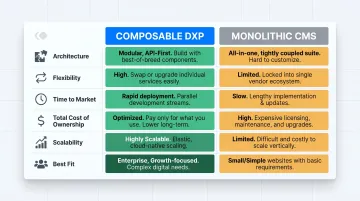
A word of caution: These categories overlap more than vendor marketing suggests. Many platforms call themselves "composable" while relying heavily on proprietary modules. Evaluate actual openness — API standards, framework flexibility, vendor lock-in risks — rather than taking vendor labels at face value.
What is a Composable DXP?
A composable DXP is a digital experience platform built on modular, independently deployable components connected via APIs. Rather than accepting a pre-bundled suite, organisations select best-of-breed tools for content management, personalisation, analytics, digital asset management (DAM), and commerce.
MACH Principles: The Architectural Foundation
The MACH Alliance defines the composable standard through four principles:
- Microservices — individual business functions developed, deployed, and managed independently
- API-first — all functionality exposed through APIs for reliable integration
- Cloud-native SaaS — software leveraging full cloud capabilities including elastic scaling and automatic updates
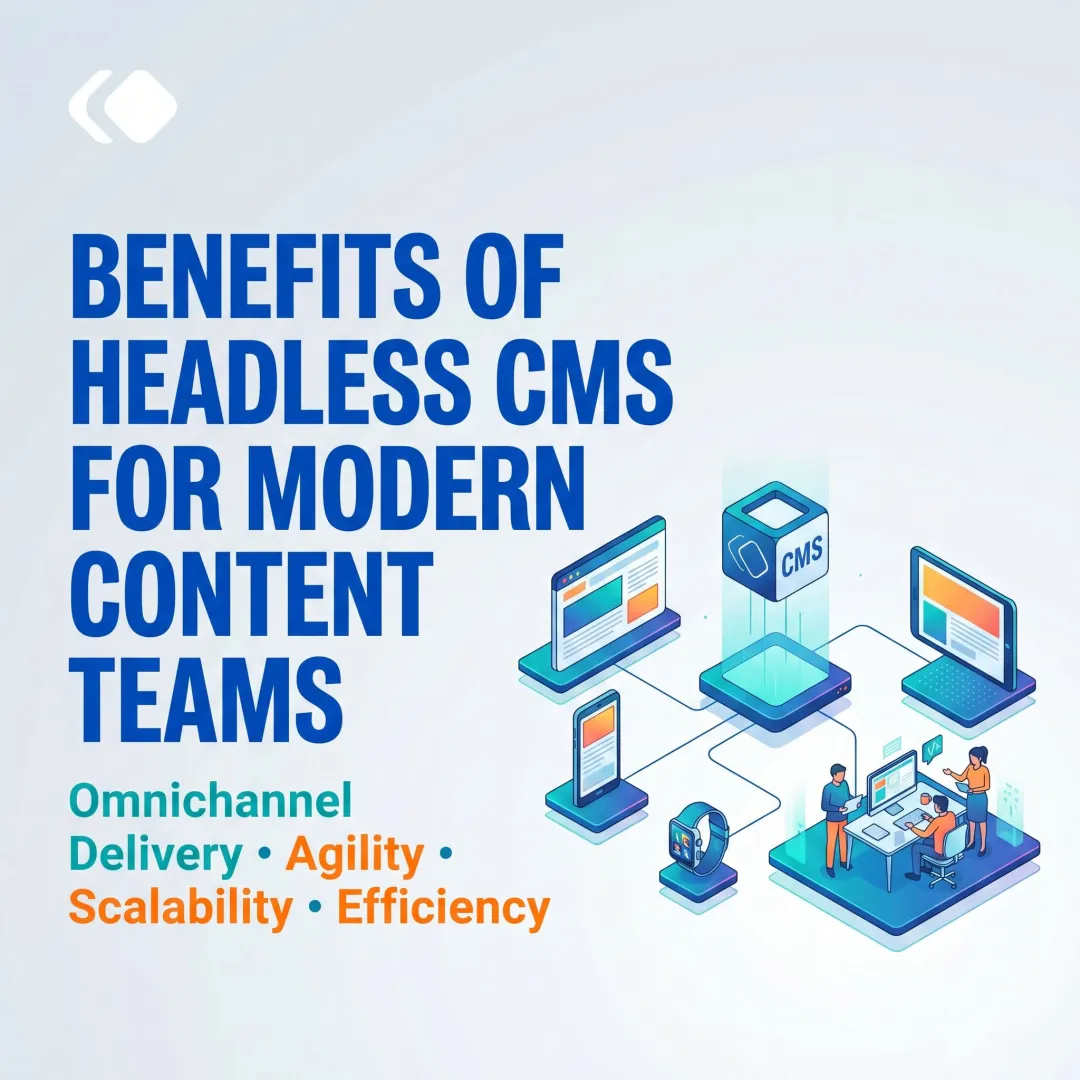
- Headless — front-end presentation completely decoupled from back-end logic, enabling content delivery to any channel
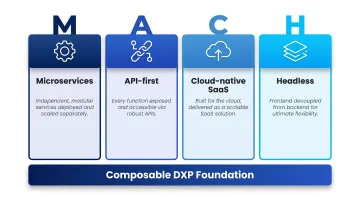
This approach gives teams the freedom to replace or upgrade individual components without overhauling the entire stack. If your personalisation engine underperforms, you can swap it for a better alternative without touching your CMS, analytics, or DAM.
Core Benefits and Operational Impact
Faster iteration on new channels: When TikTok or a new AI search interface emerges, composable architectures adapt quickly. You add an API connection, not re-platform.
Reduced vendor lock-in: The MACH Alliance explicitly lists "No Vendor Lock-in" as a core principle. Organisations maintain freedom to choose the best tool for each specific task.
AI and emerging touchpoint readiness: Voice interfaces, IoT devices, and AI-driven content discovery require structured, API-accessible content—precisely what headless and composable systems deliver natively.
The complexity trade-off: Composable doesn't mean cheaper upfront or zero complexity. It redistributes complexity. Teams gain flexibility but assume responsibility for integration governance, data flow, and system observability across multiple vendors. Gartner finds that 85% of DXP effort and cost goes to integrations—which means the architecture rewards organisations that invest in integration planning before they commit.
Use Cases of a Composable DXP
Composable DXPs deliver clearest value in these scenarios:
Large media organisations publishing across multiple channels: News publishers serving web, mobile apps, newsletters, AMP pages, push notifications, and social syndication simultaneously benefit from content-once-publish-everywhere workflows that composable architectures enable natively.
Enterprises running multiple brands or regional editions: Organisations managing distinct digital properties from a single content hub need modular systems that let each brand customise presentation without duplicating content infrastructure.
Publishers adopting AI-driven personalisation or recommendation engines: Integrating third-party AI tools for content recommendations, audience segmentation, or automated tagging requires API-first architecture. Monolithic systems struggle to support this without extensive customisation.
These scenarios translate into measurable outcomes. Ebner Media, a German publishing house, migrated from WordPress to Contentstack's headless CMS and achieved 50% faster time to market for new digital products, a 50% reduction in developer resources, and created a new revenue stream through a content licensing model that lets partners access and localise content globally. They also consolidated three separate print magazines into one customisable digital edition.
ALM, which operates Law.com, migrated from heavily customised WordPress to Brightspot's headless CMS and unified 18+ legal publications into a single instance — cutting monthly publication volume analysis from hours of manual work to seconds through automated reporting.
What is a Monolithic CMS?
A monolithic CMS is a traditional content management system where the front-end and back-end are tightly coupled in one platform. Examples include legacy WordPress installations with heavy plugin stacks, Sitecore Classic, and Adobe Experience Manager (AEM) in traditional deployment mode.
The Original Appeal
Monolithic platforms held their ground for good reasons:
- Faster time-to-market: Pre-integrated authoring environments, templating systems, and workflow tools meant a single-website launch could happen quickly.
- Accessible for non-technical editors: WYSIWYG editors and visual page builders require minimal training, making them workable for editorial teams without developer support.
- Single vendor accountability: One contract, one support desk, one point of escalation when things break — organisationally simpler for teams without dedicated platform engineering.
These qualities made monolithic CMS the default choice for media and brand websites for over a decade.
Core Limitations That Emerge at Scale
Inability to publish to new channels without re-platforming: Monolithic systems were designed for websites. Adding mobile apps, voice interfaces, or AI search surfaces requires architectural changes—often triggering full migrations.
Developer restrictions from rigid templating: AEM's architecture requires specialized knowledge of Sling, OSGi, and JCR—frameworks outside mainstream web development. This creates scarcity and drives up developer costs by 15-25% compared to general web development.
Expensive upgrade cycles: Organizations report that AEM upgrades require rewriting code for even minor version bumps. Vendor-enforced migrations consume significant engineering capacity while delivering minimal new functionality.
Feature underutilization: Organizations typically use only 20-30% of modules in a monolithic suite while paying for 100%.
Difficulty integrating modern tools: Connecting AI content assistants, real-time analytics platforms, or third-party recommendation engines requires custom integration work that composable systems handle through standard APIs.
When Monolithic Still Works
A monolithic CMS remains pragmatic in three scenarios:
- Single-website publisher with no near-term multi-channel plans: If your digital footprint is one website serving one audience, and that won't change in the next two years, monolithic simplicity may outweigh composable flexibility.
- Small editorial team relying on built-in authoring tools: Teams of 3-5 editors without developer support benefit from integrated WYSIWYG environments that don't require API knowledge.
- Very limited technical resources: Organisations unable to manage a multi-vendor API ecosystem may find monolithic platforms more manageable — provided they accept the long-term trade-offs.
That said, these scenarios describe a shrinking minority. Most organisations outgrow monolithic constraints within 2-3 years — at which point the exit costs (migration, retraining, rebuilding) often exceed what a composable approach would have cost from the start.
Composable DXP vs Monolithic CMS: Which Should You Choose?
Four Decision Factors
1. Scale and channel complexity
Count the platforms you publish to today and project three years forward. If you're serving three or more channels now (website, mobile app, newsletter, social syndication), or will be within 24 months, composable architecture becomes essential. Monolithic systems can technically support multi-channel publishing, but require extensive customisation that undermines the ease-of-use benefit they're sold on.
2. Budget structure
Monolithic platforms typically charge $60,000–$80,000 annually for base CMS licensing (Sitecore), with AEM enterprise deployments often exceeding $1 million per year. Composable alternatives cost roughly half as much for equivalent licensing, though integration work adds to that figure. Ask whether your organisation has upfront software budget available, or if usage-based/modular billing is more feasible.
3. Technical maturity
Does your team have developers comfortable managing API integrations and multi-vendor environments? Composable architecture requires stronger integration governance. The integration burden doesn't disappear in composable systems—Gartner puts 85% of DXP effort and cost squarely in integrations. That work just shifts from the vendor to your team.
4. Content velocity requirements
If your business competes on speed of publishing and personalisation—breaking news, real-time content updates, dynamic audience segmentation—composable systems enable faster iteration. Monolithic platforms can bottleneck teams when new capabilities require platform-wide upgrades or developer intervention.
When to Choose Composable DXP
Choose composable if you:
- Publish content across three or more channels today
- Actively integrate AI tools (content generation, recommendation engines, GEO/AI search optimisation)
- Operate multiple brands or regional editions from a single content hub
- Expect significant growth in digital touchpoints within 24 months
- Have or can hire developers comfortable with API integrations and headless architecture
When to Choose Monolithic CMS
Choose monolithic if:
- Your digital footprint is a single, stable website with no multi-channel plans
- Your editorial team (fewer than 10 people) lacks technical capacity to manage integrations
- Content requirements are predictable and change infrequently
- Your technical team cannot support a multi-vendor API ecosystem
But factor in when these constraints will change. The cost of switching platforms later—in time, money, and disruption—makes the choice you make today worth examining carefully through a TCO lens.
Total Cost of Ownership: The Hidden Costs
The 2025 DevOps Migration Index found that the average business loses $315,000 per platform migration project (approximately ₹2.6 crore), with 57% of IT leaders spending over $1 million on migrations in the prior year. Average project cost overrun: 18%. Migration fatigue results in delays of six months or more for 61% of organisations.
Monolithic TCO drivers:
- AEM developers command 15–25% salary premiums over general web developers—and only 18% hold current certifications
- Vendor-enforced upgrade cycles consume engineering capacity while delivering little new functionality
- Licensing 100% of platform modules while actively using only 20–30%
- Adopting new channels requires full re-platforming rather than incremental additions
Composable TCO considerations:
- Licensing runs roughly half the cost of monolithic platforms for equivalent capability
- Built on open standards (React, Node.js, REST/GraphQL), drawing from a wider developer talent pool
- Individual components can be swapped without triggering platform-wide overhauls
- Integration work still accounts for the majority of DXP effort—Gartner's 85% figure applies here too, with that burden landing on your team rather than a vendor
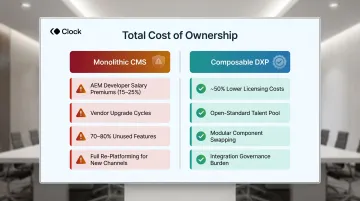
Over a 3–5 year horizon, composable architectures deliver lower TCO for most mid-market and enterprise organisations. The transition itself, though, carries real financial and operational risk—one that migration planning must account for before committing.
How This Decision Plays Out for Media Publishers
Uniquely High Demands for Speed, Scale, and Multi-Format Distribution
News and content publishers face demands that monolithic systems were never designed to handle simultaneously:
Speed: Breaking news requires real-time publishing with zero latency. Editorial teams cannot wait for developer cycles to push urgent updates.
Scale: Traffic spikes during major news events stress infrastructure. The Reuters Institute found that 66% of global audiences access short news videos weekly, with 72% of that consumption happening on third-party platforms (YouTube, TikTok, Instagram)—not publisher-owned sites.
Multi-format distribution: Publishers must serve websites, AMP pages, mobile apps, push notifications, social syndication, newsletters, and AI-indexed content—all from a single content source. Only 22% of audiences access news directly through publisher websites or apps, meaning 78% of your audience consumes content elsewhere.
Core Web Vitals: Measurable Performance Gaps by CMS
Chrome User Experience Report data shows significant performance differences between CMS platforms:
- WordPress sites: 43.44% Core Web Vitals pass rate
- Drupal sites: 59.07% pass rate
- Overall mobile CWV pass rate globally: 43%
Sites meeting CWV thresholds see an estimated 8-15% boost in SEO visibility. For media publishers competing on organic search traffic, this performance gap translates directly to audience reach and advertising revenue.
AI Search and GEO Requirements
Performance alone isn't enough anymore. As AI-powered search reshapes how audiences find content, the underlying content architecture determines whether publishers get cited or get skipped.
McKinsey reports that 44% of AI search users consider it their primary source of insight, surpassing traditional search (31%), brand websites (9%), and review sites (6%). Only 16% of brands track their performance in AI search systematically.
For publishers, the infrastructure implication is direct: content must be structured as atomic, reusable units with clean metadata and schema markup. These capabilities are native to headless/composable architectures and require extensive customisation in monolithic systems.
Gartner predicts that by 2027, 40% of organisations will fail to deliver impactful digital customer experiences due to lack of AI-driven intelligent content coordination. For publishers, that failure traces directly back to CMS architecture choices made today.
What an Ideal Composable Setup Looks Like for Publishers
A composable-forward media stack typically includes:
- A headless CMS managing structured content (articles, videos, multimedia) as the foundation
- Push notification APIs for real-time breaking news alerts
- Social distribution tools for automated syndication across platforms
- Analytics dashboards connected to GA4 and audience engagement signals
- AI-powered workflows for article generation, summarisation, and SEO optimisation
- Core Web Vitals performance built into the delivery infrastructure
- Schema markup automation for AI search discoverability
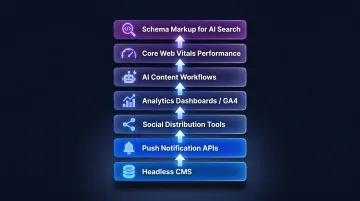
Publive is built around this model. Rather than assembling separate vendors for each layer, it consolidates the stack—headless CMS, push notifications, social automation, analytics, and AI content workflows—into one platform. Its sites achieve a 98% Core Web Vitals pass rate (among the highest of any DXP), and editorial teams report 60% faster content output using its AI-powered tools. For media publishers in India evaluating their content infrastructure, that combination of performance and velocity is what makes the architecture decision concrete.
Conclusion
Neither composable DXP nor monolithic CMS is universally superior. The right choice comes down to your current scale, where you're heading, and whether your team has the technical capacity to execute the transition.
Teams building for multi-channel distribution, deep personalization, and AI integration will find composable architectures better suited to where publishing is heading. The platforms that hold audience attention over the next three to five years will publish faster, reach readers across surfaces — including AI-powered search — and adapt without waiting for a vendor's release cycle.
The infrastructure decision you make today directly enables or limits that capability. Assess honestly: can your current CMS support where you need to be in 24 months? If the answer is uncertain, the cost of migrating now is almost certainly lower than the revenue and reach you'll leave on the table by waiting.
Frequently Asked Questions
What is a composable DXP?
A composable DXP is a digital experience platform built from modular, API-connected components, allowing organisations to select and integrate best-of-breed tools for content, personalisation, analytics, and delivery rather than relying on a single all-in-one suite.
What is the difference between a composable DXP and a headless CMS?
A headless CMS manages and delivers content via APIs but lacks broader experience orchestration tools like personalisation, analytics, DAM, and commerce. A headless CMS is often one component within a composable DXP stack.
What are the hidden costs of a monolithic CMS?
Hidden costs add up quickly across three areas:
- Mandatory upgrade cycles that demand significant engineering time
- Proprietary-platform developers who typically command 15–25% salary premiums
- Lost opportunity when adopting new channels or AI tools requires full re-platforming
When does it make sense to stay on a monolithic CMS?
A monolithic CMS remains reasonable for organisations with a single digital channel, limited technical resources, and stable, predictable content requirements. In practice, most organisations outgrow these conditions within a few years as audience expectations shift and new channels demand faster iteration.
Is a composable DXP harder to manage than a monolithic CMS?
Composable DXPs redistribute complexity rather than eliminate it. They offer more flexibility but require stronger integration governance and technical maturity. Organisations without a dedicated platform engineering team may find a managed composable solution—or a unified DXP that bundles composability with built-in integrations—a more practical starting point.
How does the choice between composable DXP and monolithic CMS affect content publishing speed?
Composable architectures allow teams to adopt AI content tools, new publishing channels, and workflow automation independently, which accelerates publishing speed over time. Monolithic systems can bottleneck teams when new capabilities require platform-wide upgrades or developer intervention for even minor changes.