The market data suggests this isn't a fringe conversation. Future Market Insights projects the headless CMS market will grow from $973.8M in 2025 to $9.16B by 2036 at a 22.6% CAGR, while Grand View Research estimates $1.75B in 2025 expanding to $6.23B by 2033. Both projections confirm sustained double-digit growth. More telling: 69% of B2C decision-makers increased CMS spending in 2024, up 10 percentage points year-over-year.
This article examines the real operational benefits, the honest implementation costs, the emerging AI convergence that's redefining platform selection, and what enterprise decision-makers should actually evaluate before committing budget and technical resources to a headless architecture.
TLDR
- Headless CMS separates content from presentation, enabling API-driven distribution to any channel without reformatting
- Enterprises gain channel flexibility monolithic platforms can't match, but headless comes with higher technical overhead and setup costs
- AI readiness now separates mature from early-stage deployments: 98% of mature composable stacks support AI at scale, versus 33% of early-stage ones
- Modern headless platforms consolidate what previously required 5–7 separate vendors, cutting total cost of ownership significantly
- Not every enterprise needs headless — fit depends on channel complexity, team capability, and content governance requirements
What Is a Headless CMS?
A headless CMS is a content management system where the backend content repository is decoupled from the frontend presentation layer, with all content delivered to any display surface via APIs — typically REST or GraphQL. Traditional monolithic CMS platforms bundle content creation, storage, and display into a single system where content structure is tightly coupled to how it appears on screen.
The "headless" metaphor describes a system where the content "body" (backend) exists independently of any fixed "head" (frontend). A single centralised content repository can serve any frontend — simultaneously and without duplication:
- Web properties and mobile apps
- IoT devices and digital kiosks
- Voice assistants and in-store displays
Each channel pulls the same content and renders it to fit its own context and constraints.
One important distinction: Headless architecture isn't new — enterprise teams have run decoupled CMS systems for decades. What has changed is the rise of natively headless, API-first platforms built from the ground up for omnichannel delivery. Legacy platforms that retrofitted API access as an afterthought carry the integration debt that shows: slower builds, tighter coupling, and higher maintenance overhead. Platforms designed headless from day one avoid those trade-offs entirely.
Why Enterprise Content Operations Are Going Headless
Omnichannel Demands Drive Architectural Change
Enterprises must deliver consistent, synchronized content across web, mobile, apps, OTT platforms, and emerging digital touchpoints simultaneously. A traditional CMS requires rebuilding or reformatting content for each channel. Headless enables a "create once, publish everywhere" model that eliminates redundant work and reduces the operational overhead of maintaining content parity across surfaces.
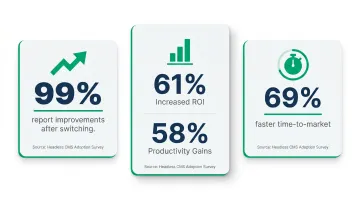
99% of organisations report improvements after switching to headless CMS, with 61% reporting increased ROI and 58% citing productivity gains. More specifically, 69% of headless users report improved time-to-market compared to their previous platform.
Scalability Without Infrastructure Chaos
Headless platforms built on cloud-native, API-first architectures handle traffic spikes, multiple brands, and multi-region content distribution without the plugin-conflict fragility that plagues legacy systems. Businesses using API-first approaches report up to 40% improvement in development efficiency.
Legacy environments tell a different story: 49% of traditional CMS users report it takes over an hour to publish content, with 14% experiencing delays of a full day or more. That gap separates enterprises that respond to market opportunities in hours from those stuck waiting on platform bottlenecks.
Developer and Content Team Independence
Headless architecture removes the dependency between development and editorial work:
- Developers choose their preferred frontend frameworks — React, Next.js, Vue, Svelte — without being constrained by backend templates or proprietary languages
- Content teams manage structured content in a centralised repository with version control, workflow management, and role-based access
This separation accelerates campaign launches and product updates because neither team waits on the other.
The business impact tracks across markets: 86% of Dutch headless CMS users reported increased ROI and 70% of German companies experienced performance and scaling improvements. Virgin Media O2 credited their headless migration with saving millions in operational costs.
Performance and SEO Outcomes
Headless CMS paired with modern frontend frameworks (Next.js, Gatsby, Nuxt) enables faster page loads, better Core Web Vitals scores, and cleaner semantic content structures — all of which directly affect search visibility.
Research from Deloitte and Google analyzing 37 brands and 30 million user sessions found that a 0.1-second improvement in mobile site speed produces measurable revenue impact:
- Retail: +8.4% conversion rate, +9.2% average order value
- Travel: +10.1% conversion rate
- Luxury: +3.6% conversion rate, +8.0% page views per session
Case studies from Google web.dev demonstrate the business value of Core Web Vitals optimisation enabled by headless architectures:
- Vodafone Italy: 31% LCP improvement = 8% more sales
- Tokopedia: 55% LCP improvement = 23% better average session duration
- Nykaa: 40% LCP improvement = 28% more organic traffic
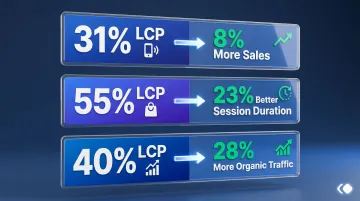
These outcomes depend on how well your platform is built for performance from the ground up. Publive, for instance, achieves 98% Core Web Vitals pass rates across client properties — among the highest of any DXP — while cutting content production time by 60% through integrated AI workflows.
Governance at Scale
As organisations expand across regions, brands, and teams, headless CMS enables centralised content governance — role-based access, approval workflows, version control, audit trails — while still allowing local market flexibility. This is particularly critical for regulated industries like financial services and healthcare, where content accuracy, compliance tracking, and change audit requirements are non-negotiable.
The Real Trade-offs: Where Headless CMS Struggles
Technical Overhead and Frontend Ownership
Headless CMS shifts the responsibility for every presentation layer entirely to the development team. Enterprises must now build, maintain, and test every frontend experience they deliver — functionality that traditional CMS templates handled out of the box. This requires a larger, more technically skilled team and longer initial implementation timelines.
Gartner's Market Guide for Web Content Management notes that user experience in headless platforms is "coming under closer scrutiny," with organisations increasingly questioning whether the architectural benefits justify the added complexity. Common engineering burdens include:
- Building and maintaining custom frontend components from scratch
- Establishing QA pipelines for every new channel or device
- Managing API versioning as content models evolve
- Hiring or retraining developers specifically for headless architecture
Content Author Experience Challenges
That engineering overhead has a downstream effect on content teams. Headless platforms historically offered non-technical editors far less intuitive experiences — no live visual preview, limited drag-and-drop, reduced WYSIWYG editing. Modern platforms are closing this gap, but Storyblok's 2025 research shows 65% of users consider visual editing and developer independence "essential" features.
Buyers must scrutinise the authoring UX carefully before committing — especially if content teams include marketers, subject matter experts, and editors who won't tolerate technical barriers to publishing.
Cost and Complexity Escalation
Authoring friction compounds when organisations also try to replicate every feature of their old monolithic CMS in a headless setup — comments, forms, personalisation, analytics, A/B testing, social sharing. Each capability requires a separate point solution, and each integration adds cost, maintenance overhead, and potential failure points.
Cost comparison (typical ranges, USD):
| Component | Traditional CMS | Headless CMS |
|---|---|---|
| Initial setup | $500 - $5,000 | $10,000 - $100,000+ |
| Enterprise migration timeline | N/A | 6-8 months |
| Simple integrations | Typically included | $5,000 - $15,000 |
| Complex integrations | Typically included | $20,000 - $50,000+ |
The MACH Alliance 2025 survey of 561 senior IT decision-makers at organisations with 5,000+ employees found that composable/MACH implementations are "a lot longer" and "more expensive" to initiate than monolithic solutions, with required skill levels "significantly higher" than traditional CMS platforms.
This is why total cost of ownership deserves as much scrutiny as licensing fees. Unified DXP platforms that bundle analytics, push notifications, AI content tools, and social distribution under one roof can cut this overhead substantially — the alternative is managing five or six vendor contracts, each with its own renewal cycle and integration risk.
Organisational Change Resistance
The cost escalation is easier to forecast than the organisational friction. Moving to headless isn't just a technology switch — it requires restructuring how content teams and engineering collaborate, rebuilding QA workflows, and retraining staff across functions.
Forrester's CMS research found that enterprises struggle with "confusing vendor messaging" around pure headless vs. hybrid solutions, making it "more challenging than ever" to select the right architecture. Internal resistance from both IT and end-user communities has derailed implementations that looked technically sound on paper — which is why change management deserves as much planning as the technical migration itself.
AI + Headless: The Convergence Defining Enterprise Content's Future
Why Headless Architecture Unlocks AI-Native Content Operations
AI tools require structured, API-accessible content to function. In a monolithic CMS where content is tangled with presentation markup, AI cannot easily extract, tag, transform, or personalize at scale. Headless treats content as data — machine-readable, semantically structured, and ready for AI to act on.
The MACH Alliance reports that 98% of enterprises with mature composable implementations can support AI at scale, versus only 33% of companies in early stages of composable adoption. Organizations achieve 6x better AI ROI with a composable foundation.
AI Capabilities Transforming Content Workflows
Modern AI-powered headless CMS platforms deliver specific capabilities that reduce manual effort and increase content velocity:
- Automates metadata tagging and NLP-based classification, cutting hours of manual taxonomy work
- Repurposes a single content piece into multiple format variations across channels
- Personalizes content in real time based on user behaviour, without manual segmentation rules
- Flags content likely to underperform before it goes stale through predictive analytics
- Accelerates multilingual localization, including translation and regional content adaptation
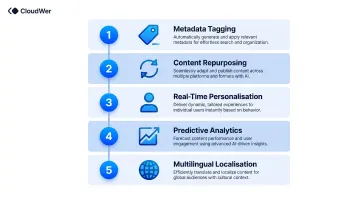
79% of CMS users already employ AI-powered content tools, yet 44% report their current platform lacks built-in AI capabilities. For enterprise buyers, that gap is increasingly the deciding factor in platform migration.
The Enterprise ROI Case
Golfbreaks achieved 78% faster time-to-market for launching on-brand content and campaigns using Contentstack's AI Accelerator, which automated translation workflows, content optimisation, and personalisation rules across multiple international markets.
While 88% of organisations use AI in at least one business function, only approximately 33% have begun scaling AI across the enterprise. Organisations still running monolithic CMS infrastructure are finding it structurally difficult to close that gap — headless architecture is what makes scaling possible in practice.
Where the Human Layer Still Matters
AI in headless systems is not autonomous. It requires editorial oversight for brand voice consistency, factual accuracy, regulatory compliance, and strategic judgement. The best enterprise content operations use AI to handle repetitive tasks: metadata tagging, format conversion, first-draft generation, social post variants. That frees human editors for curation, quality control, and strategic decisions that require judgement.
For enterprise leaders evaluating headless platforms, the practical outcome is reallocation, not reduction — human expertise shifts toward work that AI cannot do, rather than disappearing from the workflow.
Example: Publive's AI-first platform delivers 60% faster content output while maintaining 98% Core Web Vitals pass rates for enterprise publishers and media organisations, demonstrating that AI-native, performance-optimised content management is already operational, not a future concept.
The Trends Accelerating Headless CMS Adoption in 2025–2026
Composable Architecture Going Mainstream
MACH architecture — Microservices, API-first, Cloud-native, Headless — has moved from early adopter phase to mainstream enterprise deployment. 87% of large enterprises have widely implemented MACH solutions, with 90% reporting that implementations met or exceeded ROI expectations.
Enterprises are replacing monolithic suites with composable stacks where headless CMS serves as the core content engine, connected via APIs to CRMs, analytics platforms, commerce systems, and personalisation tools — choosing best-of-breed integration over vendor lock-in.
However, 61% of teams currently use more than one CMS to manage content across regions, departments, or platforms, creating content silos and elevated maintenance costs. The trend toward consolidation is accelerating — a 20% increase in single-CMS adoption occurred in 2025 as organisations work to reduce overhead.
Edge Delivery and Performance Optimization
Headless CMS combined with edge caching and modern static site generation (Next.js, Gatsby) unlocks millisecond content delivery globally. Fastly's analysis of 212 digital publications found that 90% achieved the highest possible LCP scores, with 54% using Fastly's edge network to deliver 79% of websites with LCP under 1.5 seconds.
This performance advantage is critical for media companies, e-commerce brands, and global enterprises competing on user experience, where page speed affects conversion rates, ad revenue, and search visibility.
Compliance and Content Governance Now a Baseline Requirement
The compliance stakes have risen sharply. Key developments shaping enterprise CMS decisions in 2025:
- The European Accessibility Act entered enforcement on June 28, 2025, requiring WCAG 2.1 Level AA compliance across digital products and services
- 95.9% of the top 1M homepages have detectable WCAG failures, with only 2% passing 70% or more of testable criteria
- Over 2,000 ADA website lawsuits were filed in H1 2025 — a 37% increase year-on-year
- In financial services, healthcare, and government, platforms must now support GDPR, India's DPDP Act, and full content audit trails
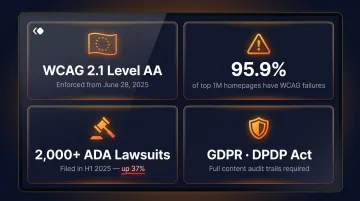
Headless CMS offers a structural advantage here. Because the presentation layer is decoupled from the content repository, teams can update frontends to meet evolving WCAG standards without touching backend workflows or disrupting editors.
What Enterprise Leaders Should Look for in a Modern CMS Platform
Evaluate AI Maturity, Not Just API Depth
The right enterprise CMS platform today must embed AI where it reduces work — content generation, metadata tagging, SEO optimization, performance analytics — and make those capabilities accessible to both marketers and developers. A platform that offers AI only as an add-on or third-party integration is not truly AI-native.
Ask vendors to demonstrate:
- How AI assists content authors during the creation process, not just in post-production
- Whether AI capabilities operate within the editorial interface or require separate tools
- What level of editorial control and override exists for AI-generated output
- How AI recommendations improve over time based on usage patterns
Demand Proven Performance and Reliability at Scale
For enterprise publishers and high-traffic digital properties, platform uptime, Core Web Vitals compliance, and infrastructure resilience must be verified before signing any contract. Look for platforms that can back claims with verified performance benchmarks, not just marketing materials.
Key performance indicators to verify:
- Contractual uptime SLAs with financial penalties for breaches (not just aspirational targets)
- Documented Core Web Vitals pass rates across actual customer implementations
- Infrastructure architecture — cloud-native deployment, auto-scaling, multi-region CDN
- Reference customers operating at comparable scale and traffic volumes
Platforms like Publive deliver 99.995% uptime on AWS infrastructure with the highest Core Web Vitals pass rates among leading DXPs — a benchmark verified across Indian Express and other high-traffic media properties on the platform.
Assess Total Cost of Ownership, Not Just Licensing Fees
The real cost of a headless CMS extends well beyond licensing: development resources, custom frontend maintenance, third-party integrations, ongoing QA, and vendor management all add up. Platforms that consolidate analytics, push notifications, AI content capabilities, and social distribution into a single system cut that overhead substantially compared to a fragmented multi-vendor stack.
Calculate TCO across:
- Initial licensing and implementation costs
- Developer time required for frontend builds and maintenance
- Third-party integration licensing and development costs
- Training and onboarding expenses for content teams
- Ongoing vendor management and contract administration overhead
- Infrastructure and hosting costs (if separate from platform licensing)
For organisations with uneven publishing cycles — common in Indian media and BFSI — usage-based billing typically delivers better value than flat per-seat or per-feature pricing, since costs track actual activity rather than theoretical capacity.
Frequently Asked Questions
Is headless CMS better?
Headless CMS is better for enterprises with complex, multi-channel content needs and the technical resources to manage decoupled architectures. It delivers superior scalability and omnichannel flexibility. However, it may be overkill for smaller organisations with simple web-only publishing requirements or limited developer capacity.
What is a modern headless CMS?
A modern headless CMS is natively API-first and cloud-native — built for omnichannel delivery from the ground up, not retrofitted with API access. Unlike legacy decoupled systems, it includes built-in AI for content generation, metadata tagging, and personalisation.
What are the main disadvantages of a headless CMS for enterprises?
The main trade-offs are higher technical overhead, the need to build custom frontends for every channel, and a steeper learning curve for content teams used to visual editors. Initial implementation costs are also significantly higher than traditional CMS platforms.
How does a headless CMS support omnichannel content delivery?
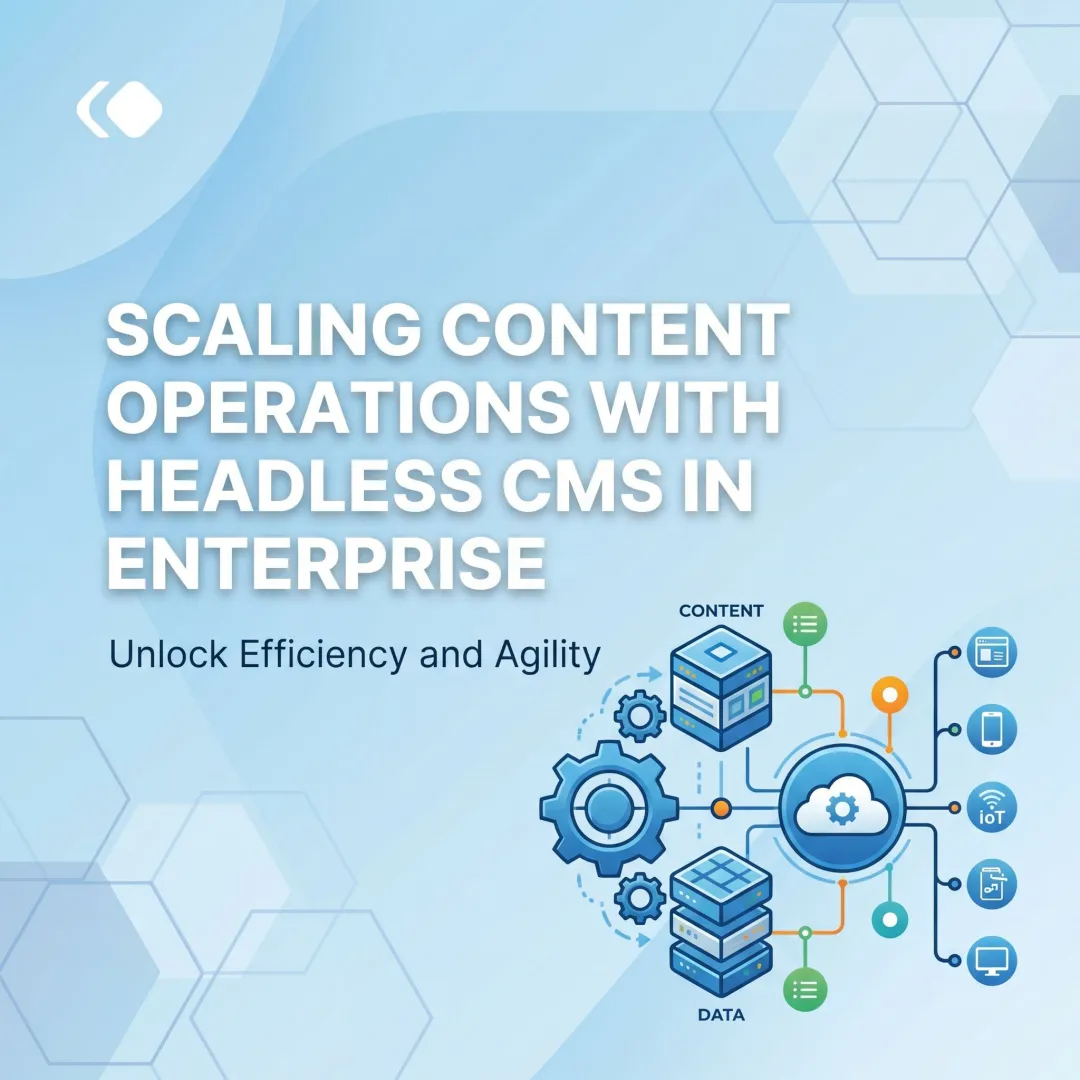
A headless CMS stores structured content in a centralised repository and delivers it via APIs to any channel — website, mobile app, IoT device, digital signage, voice assistant — without rebuilding or reformatting. Each channel renders the same content appropriately for its context.
Is headless CMS a good fit for media and publishing companies?
Yes — media and publishing organisations are among the strongest use cases. Their need to publish simultaneously across web, apps, newsletters, and syndication partners, combined with demands for real-time publishing and structured content workflows, makes headless architecture a natural fit.
What is the difference between a headless CMS and a DXP?
A headless CMS focuses on content storage and API-based delivery. A Digital Experience Platform (DXP) is broader — it adds personalisation, analytics, commerce, and experience orchestration on top of content management. Many modern headless CMS platforms are converging toward DXP territory by consolidating these capabilities.