

Introduction
Digital newsrooms face mounting operational pressure: smaller teams, 24/7 publishing demands, and the expectation to deliver stories faster across an expanding roster of platforms. What began as experimental AI pilots a few years ago has become an operational necessity. According to a 2023 JournalismAI survey of 105 newsrooms across 46 countries, 85% of respondents have at least experimented with generative AI, while a 2024 AP survey of nearly 300 journalists found that 70% of organisations have used generative AI in some capacity.
AI adoption in newsrooms is primarily about augmenting workflows, freeing editorial teams to focus on reporting, analysis, and storytelling. This guide covers how AI is being deployed across the full newsroom workflow — from newsgathering and production to distribution — which tools are leading adoption, and how newsrooms can build a practical AI strategy without compromising editorial standards.
TLDR
- Most newsrooms (85%) have experimented with AI, with 70% actively using it in production, newsgathering, or distribution
- Top use cases automate back-end tasks: transcription, copyediting, metadata tagging, and SEO optimisation
- Successful adoption follows a "human-in-the-loop" model—AI drafts, but editors retain final control and accountability
- Few newsrooms have formal AI strategies, leaving a clear gap between experimentation and organisation-wide adoption
How AI Is Changing Newsroom Workflows
AI has moved from isolated experiments to embedded workflow tools. Rather than being bolted onto the side of editorial processes, AI now sits inside CMS platforms, distribution systems, and planning tools. It automates repetitive tasks while surfacing insights that inform editorial decisions.
The Reuters Institute's Changing Newsrooms 2023 report, which surveyed 135 senior newsroom leaders across 40 countries, found that 74% believe generative AI will increase productivity and improve workflows. The framing is consistently about augmentation and efficiency, not replacement. A further 21% see AI as transformational—fundamentally reshaping every role—but the consensus holds: AI enhances journalism rather than displacing it.
Back-End Automation Leads Adoption
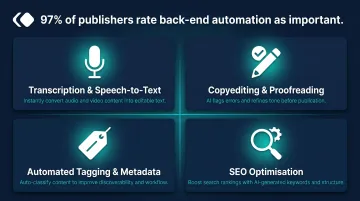
Newsroom leaders prioritise back-end AI applications over front-end content generation. The Reuters Institute Trends and Predictions 2026 report shows that 97% of publisher respondents consider back-end automation important, with 64% rating it "very important". This includes:
- Transcription and speech-to-text for interview processing
- Copyediting and proofreading for error reduction
- Automated tagging and metadata generation for content organisation
- SEO optimisation for search visibility
By contrast, AI for newsgathering scored 82% importance (only 29% "very important"), and AI-generated publishable content remains ranked lowest in priority. The Associated Press's August 2023 generative AI standards explicitly state: "We do not use generative AI to create publishable content and images for our news services."
This cautious approach reflects a core editorial principle: audience trust is the newsroom's primary asset, and visible AI failures in published content pose greater reputational risk than invisible back-end efficiency gains.
The Adoption Gap: Large vs. Small Newsrooms
Larger organisations with R&D budgets, dedicated data teams, and enterprise infrastructure move faster. Newsquest (UK regional publisher) created over 30 "AI-assisted reporter" roles where staff use AI to draft up to 30 stories per day. Tamedia (Switzerland) built an in-house AI Lab and deployed tools to nearly 600 journalists.
Meanwhile, smaller newsrooms cite "limited resources and technical expertise" as their primary barriers (JournalismAI 2023). One-person operations like Velora Cycling demonstrate that lightweight tools can help small teams compete, but the structural advantage of scale is undeniable. The gap narrows when platforms consolidate the functions that smaller teams would otherwise stitch together across separate vendors: CMS, distribution, AI-assisted editing, and analytics in one place.
Publive takes this approach for Indian publishers, combining content creation, SEO tagging, and performance analytics into a single platform. Publishers including Indian Express and News Nation use it to reduce both operational complexity and total cost — the same outcome smaller newsrooms need without the enterprise budget to build it themselves.
AI Tools by Stage: Newsgathering, Production, and Distribution
Newsgathering
AI assists newsrooms in discovering stories earlier, processing interviews faster, and managing multilingual coverage at scale.
Story Discovery and Trend Detection
Tools like Google Trends, Dataminr, and social listening platforms identify breaking stories and trending topics before they peak. Dataminr for News serves over 1,500 newsrooms and 30,000+ journalists worldwide, processing more than 43 terabytes of public data daily from over 1 million sources in 150+ languages. Deutsche Welle reports achieving a 45-minute advance on breaking stories using the platform.
This changes editorial planning cycles in practice. Rather than reacting to competitor coverage, newsrooms can anticipate emerging topics and allocate reporting resources before the story breaks.
Transcription and Speech-to-Text
AI-powered transcription tools (Otter.ai, OpenAI Whisper) convert interviews, meetings, and press conferences into searchable text in minutes. Newsrooms covering multiple languages or regional markets see the biggest gains: reporters can process non-native language interviews, verify quotes faster, and repurpose audio content for digital formats.
Production
Production is where AI cuts the most time. Drafting, editing, and metadata tasks that once consumed editorial hours now take minutes.
AI-Assisted Content Creation
AI tools draft article summaries, generate headline variations for A/B testing, and assist with proofreading and copyediting. The Marshall Project's "Decoding Bureaucracy" project (July 2023) used ChatGPT-3.5 and GPT-4 to summarise prison publication policies from all 50 US states—work that previously took weeks and caused reporter burnout. Each policy summary took approximately 45 minutes with AI assistance, following a four-step human-in-the-loop process:
- Human extracts relevant text from source documents
- AI identifies themes and creates sub-headings
- AI summarises content into predefined categories
- At least four people fact-check every output
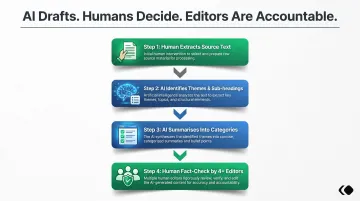
This model is standard across newsrooms: AI drafts, humans decide, and editors remain accountable for everything published.
AI-Powered CMS Platforms
Integrated platforms consolidate content creation, SEO optimisation, and performance analytics into a single system, replacing the fragmented vendor stack most newsrooms still rely on. Publive, for example, operates as an AI-first CMS where editorial teams can accelerate content workflows, repurpose articles across formats, and optimise metadata automatically.
Publishers on the platform report up to 60% faster content output and a 98% Core Web Vitals pass rate, the highest among leading digital experience platforms.
Distribution
Once a story is published, AI determines how far it travels. From social scheduling to search visibility, distribution decisions that editors once made manually are increasingly handled algorithmically.
Social Media Automation
Tools like Echobox and SocialFlow automate social posting schedules, using real-time engagement data to determine optimal timing and messaging. Newsweek reported doubling Facebook traffic and saving 20 hours weekly after adopting Echobox AI for social distribution. The platform supports Facebook, Instagram, WhatsApp, X (formerly Twitter), Threads, Bluesky, LinkedIn, YouTube, and TikTok.
SEO and Search Visibility
AI-driven SEO tools (Ubersuggest, Google Discover integrations) identify high-value keywords and optimise headlines for search algorithms. This is increasingly critical as traffic from traditional social referrals declines and search becomes the dominant discovery channel for digital news.
Audience Personalisation and Content Recommendations
AI curates content to match reader interests, increasing engagement and time on site. Kölner Stadt-Anzeiger (KStA), a German publisher, curates 80% of its front page via AI recommendation, with only 20% managed by the editorial team. The result: an 80% increase in click-through rates and 13% more fully-read articles. KStA began its AI journey in 2017 and aims for 100% front-page automation.
The Top AI Tools Newsrooms Are Using Today
Newsrooms don't rely on a single AI tool — they patch together several, each handling a different part of the production cycle. The problem is that fragmentation slows teams down. Understanding which tools are actually in use today helps editors and digital publishers decide where to invest.
Here's a breakdown of the categories where AI has real traction in newsrooms right now.
AI Writing & Content Assistants
These tools help journalists draft faster, not replace them. Writers use AI assistants to generate first drafts from structured data (earnings reports, election results, sports scores), expand bullet-pointed notes into publishable copy, and rephrase dense content for different audience segments.
Common tools in this category include:
- ChatGPT / Claude — used for drafting, summarising interviews, and generating headline variants
- Wordtune / Jasper — editing and tone adjustment for faster turnaround
- Reuters News Tracer — monitors social media to surface breaking stories, ranked by credibility
Transcription & Audio-to-Text Tools
Reporters filing from the field don't have time to manually transcribe interviews. AI transcription has become standard in most mid-size and large newsrooms.
- Otter.ai — real-time transcription with speaker identification
- Sonix / Descript — used for podcast and video content repurposing
- Google's Live Transcribe — popular in multilingual newsrooms, including Indian regional language coverage
Fact-Checking & Verification Tools
Misinformation spreads fast. AI-assisted verification tools help desk editors cross-check claims before publication.
- Full Fact's automated fact-checking tool — scans claims against known databases
- Logically AI — used by newsrooms to detect coordinated disinformation
- Truepic — verifies the authenticity of images and video before use
SEO, Distribution & Analytics Tools
Publishing a story is only half the job. Newsrooms use AI to optimise headlines for search, identify content gaps, and analyse what's driving traffic.
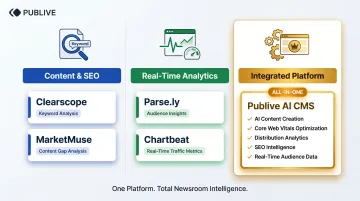
- Clearscope / MarketMuse — content gap analysis and keyword relevance scoring
- Parse.ly / Chartbeat — real-time audience analytics built for editorial teams
- Publive's AI-powered CMS — combines content creation, Core Web Vitals optimisation, and distribution analytics in one platform, removing the need for separate SEO and analytics vendors
Translation & Multilingual Publishing
For Indian digital media houses covering regional audiences, AI translation tools have become essential for scaling content across languages without proportional staff increases.
- DeepL — high-accuracy translation, widely preferred over Google Translate for editorial use
- Reverie Language Technologies — built specifically for Indian languages, supports 22 official languages
- ModernMT — used by wire services for real-time multilingual publishing
The tools above address specific pain points. The more pressing challenge for most newsrooms, though, is getting them to work together — which is where the underlying content infrastructure matters as much as the individual tools themselves.