AI is no longer a "nice to have" add-on in enterprise content management — it is the operational backbone that enables auto-classification, intelligent retrieval, workflow automation, predictive analytics, and faster content output. This article explores how AI transforms ECM systems from passive storage into active intelligence, covers the core capabilities that define an AI-powered platform, and provides guidance on evaluating enterprise solutions in the context of India's regulatory landscape (DPDP Act, RBI compliance) and the emerging Generative Engine Optimization (GEO) landscape.
TLDR:
- AI auto-classifies and tags content at scale, eliminating manual errors and cutting search time by up to 35%
- Semantic search understands intent, not just keywords, surfacing content across repositories and siloed systems
- Content workflows accelerate dramatically — AI assists creation, repurposing, distribution, and experimentation
- Analytics connect content to business outcomes through predictive insights and unified dashboards
- Choosing the right AI-powered ECM is a strategic decision with compounding ROI and lower total cost of ownership
What Makes ECM "AI-Powered"? (And Why Traditional Systems Fall Short)
Traditional Enterprise Content Management systems store, organize, and retrieve files using folder structures, manual tagging, and keyword search. As content volumes scale, manual processes break down, consistency degrades, and teams spend more time managing content than using it.
The scale of the problem is striking: approximately 85% of stored enterprise data is either dark data or ROT (Redundant, Obsolete, Trivial), leaving only 15% as business-critical information.
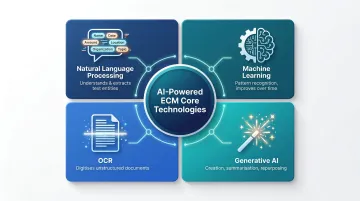
That ratio flips when AI is embedded. The system moves from passive storage to active intelligence — reading, interpreting, and acting on content rather than just filing it. The foundational technologies driving this shift include:
- Natural Language Processing (NLP) for understanding text and extracting entities
- Machine Learning (ML) for pattern recognition and improving accuracy over time
- Optical Character Recognition (OCR) for digitising unstructured documents
- Generative AI for content creation, summarisation, and repurposing
The AI Maturity Spectrum
AI capabilities in ECM systems exist on a spectrum:
Early Stage:
- Basic rule-based automation (if-then tagging rules)
- Limited NLP for keyword extraction
- Manual training and configuration required
Mid Stage:
- Intelligent classification based on content analysis
- Semantic search capabilities
- Learning from user behaviour to improve relevance
- Proactive content suggestions based on usage patterns
Advanced Stage:
- Agentic AI systems that initiate workflows autonomously
- Self-improving algorithms that adapt to changing content patterns
- Predictive content analytics and recommendation engines
CMI's research shows 95% of enterprise marketers use AI-powered applications, yet only 9% have reached advanced or leading maturity stages. This gap between adoption and maturity is the central challenge — bolting AI onto a legacy CMS changes the interface, not the intelligence.
AI-Powered Document Classification, Tagging, and Intelligent Search
Automated Classification and Metadata Tagging
AI analyzes document content — not just file names or manually entered fields — and automatically assigns categories, tags, and metadata. Manual tagging, by contrast, is time-consuming, inconsistent, and error-prone.
For a media publisher, AI can auto-tag articles across dimensions like:
- Topic, format, and publication date
- Author, audience segment, and sentiment
- Related entities and content categories
All without human intervention.
The productivity impact is measurable. McKinsey's research indicates that searchable enterprise records can reduce search time by up to 35% — hours recovered directly from document hunting. For editorial teams publishing dozens of articles daily, automated classification removes the metadata entry bottleneck while keeping content consistent across distributed teams.
AI-Powered Semantic Search vs. Keyword Search
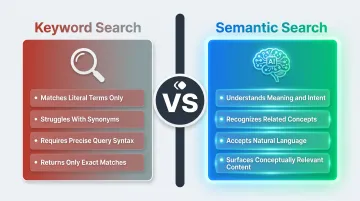
Traditional keyword search requires exact matches — users must know the file name, folder location, or precise tag. AI-powered semantic search understands natural language queries and intent. A user can ask "Show me all campaign briefs for financial sector clients from Q3" and the system retrieves relevant results regardless of how files were named or where they are stored.
Key distinctions:
| Keyword Search | Semantic Search |
|---|---|
| Matches literal terms | Understands meaning and intent |
| Struggles with synonyms | Recognizes related concepts |
| Requires precise query syntax | Accepts natural language |
| Returns only exact matches | Surfaces conceptually relevant content |
Unified Search Across Repositories and Silos
Enterprise content rarely lives in one place — it spans CMS platforms, cloud drives, email archives, and databases. AI-powered search unifies retrieval across these silos, surfacing the right content regardless of source. This is especially valuable for enterprises managing content across regional editions, languages, or business units.
For example, Indian Express Tamil publishes content in Tamil while the main Indian Express publishes in English. An AI-powered ECM can surface related articles across both properties based on topic relevance, not just literal keyword overlap.
Learning From User Behavior to Improve Retrieval
The more teams use the system, the smarter it gets. AI tracks which results users click, which documents get reused, and which searches return unhelpful results. These signals feed back into relevance scoring, so retrieval improves continuously as the system learns how your organisation actually uses its content.
That same intelligence has implications beyond the firewall — shaping how your content performs in external search as well.
AI Search and Generative Engine Optimization (GEO)
AI-powered ECM impacts external discoverability, not just internal findability. Well-structured, properly tagged, AI-optimised content is more likely to surface in AI-driven search results like Google AI Overviews, ChatGPT search, and Perplexity. AI Overview appears in at least 16% of all searches, with ChatGPT serving over 800 million weekly users.
Generative Engine Optimization (GEO) requires content management systems to produce schema-rich, entity-structured content with clear metadata. An AI-powered ECM handles this structuring automatically — meaning enterprises that adopt it now build the content infrastructure that AI answer engines will preferentially cite as traditional search continues to fragment.
AI in Content Creation and Publishing Workflows
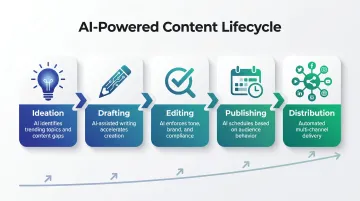
AI transforms the content lifecycle for publishing-focused enterprises:
Ideation: AI suggests topics based on trending search data and content gaps identified in analytics
Drafting: AI-assisted writing and content generation accelerates initial draft creation
Editing: AI checks tone, clarity, and brand consistency against style guide rules
Publishing: AI schedules and distributes across channels based on audience behavior data
Content Repurposing and Adaptation
One of the highest-ROI applications of AI in enterprise content management is repurposing a single piece of content into multiple formats — a long-form article becomes a social post, newsletter excerpt, push notification, and short video script. This multiplies content output without multiplying headcount.
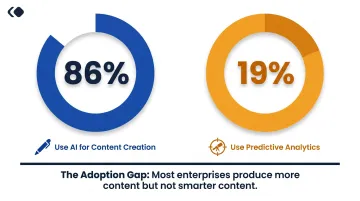
CMI's research reveals 86% of enterprise marketers use AI for content creation, with 84% reporting improved productivity. However, 12% report quality decreased with AI adoption — a reminder that AI-powered ECM platforms must include human-in-the-loop governance and editorial oversight.
Multi-Channel Distribution and Social Automation
High-volume publishing creates a distribution bottleneck that's just as costly as a slow editorial process. AI addresses this by automatically determining optimal publishing times, selecting channels based on audience behaviour data, and triggering distribution workflows — including social media sharing and push notifications — without manual scheduling. News publishers and financial content teams operating under daily volume pressure see the most immediate gains.
Publive's AI-powered content creation, repurposing, and experimentation capabilities deliver up to 60% faster content output for media houses, brands, and financial institutions where publishing velocity directly affects audience reach.
Content Experimentation at Scale
A/B testing headlines, thumbnails, and article formats used to require dedicated resources. AI-powered CMS platforms automate this experimentation, surfacing winning variations faster and continuously optimising content performance without human bottleneck.
Content Quality and Consistency at Scale
AI enforces brand voice, style guide compliance, and editorial standards across large content teams. For enterprises with distributed editorial teams or multilingual publishing operations, inconsistency is a persistent risk — AI flags tone deviations, catches compliance language violations, and ensures regulatory content clears standards before it goes live.
Workflow Automation, Compliance, and Content Governance with AI
AI-Driven Workflow Automation
AI can intelligently route content through review and approval processes based on content type, risk level, author, or publication channel. This eliminates manual handoffs, reduces bottlenecks, and — for regulated industries like financial services and healthcare — becomes a direct compliance requirement rather than a nice-to-have.
Content states (draft → review → approved → scheduled → published → archived) can be configured to match governance lifecycles, with AI automatically escalating content to the appropriate reviewer based on risk signals detected in the text.
The compliance and governance infrastructure described above carries its own cost savings. Gartner projects autonomous AI agents will cut operational costs by 30% by 2029. When AI eliminates manual classification, tagging, search, routing, and compliance checking, enterprises recover hours previously spent on content administration and free up content teams to focus on publishing rather than process.
AI Content Analytics and Performance Intelligence
From Vanity Metrics to Actionable Intelligence
Traditional CMS analytics show pageviews and bounce rates. AI-powered analytics go further, surfacing answers to questions gut-feel publishing never could:
- Which content actually drives conversions (not just clicks)
- Which topics resonate with specific audience segments
- Where in the content journey users drop off
- Which content assets have the highest reuse value across formats
The result is editorial decision-making grounded in evidence, not instinct.
Predictive Analytics for Content Strategy
AI can analyze historical engagement patterns, search trends, and audience behavior to predict what content will perform well before it is created. Editorial teams can then prioritize high-impact topics, cut content waste, and direct resources where they'll have the most effect.
CMI's research shows only 19% of enterprise marketers use predictive analytics/targeting — a clear adoption gap. Most enterprises use AI to produce more content but not to determine which content performs, why, or what to produce next.
Enterprise-Grade Analytics Integrations
Connecting CMS analytics to external signals like Google Analytics 4 (GA4), Google Search Console (GSC), and social performance data is essential. Enterprises need a unified view of content performance across touchpoints — not siloed reports from individual tools.
Platforms with consolidated analytics give content leaders a single source of truth. Publive's Golden Signals Dashboard integrates GA4 and GSC connectors to track page views, active users, scroll depth, Google Discover impressions, newsletter performance, and ad click performance — letting editorial teams pinpoint high-performing content categories and shift strategy accordingly.
How to Choose the Right AI-Powered Enterprise CMS
Core Capabilities to Evaluate
When evaluating AI-powered enterprise CMS platforms, prioritise these six capabilities:
- Auto-classifies and tags content based on actual content analysis, not manual entry
- Supports natural-language queries that surface conceptually relevant results, not just keyword matches
- Enables AI-assisted drafting, adaptation, and multi-format conversion within the same workflow
- Schedules and distributes content across channels based on audience behaviour, not manual triggers
- Routes content through approval workflows and enforces compliance policies automatically
- Provides unified performance intelligence that connects content activity directly to business outcomes
Caution: Ask vendors to demonstrate specific AI use cases, not just feature lists. Gartner's research found 45% of martech leaders say vendor-offered AI agents fail to meet expectations.
Total Cost of Ownership and Platform Consolidation
Tool sprawl is one of the least-discussed costs in enterprise content management. The 2025 Marketing Technology Landscape documents 15,384 martech solutions, a 100X increase since 2011. Yet martech utilisation has dropped to 49%, meaning over half the tools in the average stack sit unused.
An AI-first platform that consolidates CMS, analytics, SEO, social distribution, push notifications, and compliance cuts integration complexity, vendor management overhead, and licensing costs in one move. Publive's unified platform, combining content creation, analytics, distribution, and Core Web Vitals performance, delivers up to 50% lower total cost of ownership for media and publishing enterprises.
Technical and Compliance Requirements
Verify these table-stakes requirements:
| Requirement Category | What to Verify |
|---|---|
| Infrastructure | Cloud reliability, uptime SLAs (99.9%+ expected), disaster recovery |
| Security | Role-based access controls, SSO, audit logging, data encryption |
| Compliance | WCAG 2.1 accessibility, DPDP readiness, regional data laws (RBI, SEBI for BFSI) |
| Integration | API availability, existing tech stack compatibility, third-party connectors |
| Scalability | Content volume limits, concurrent user capacity, publishing velocity support |
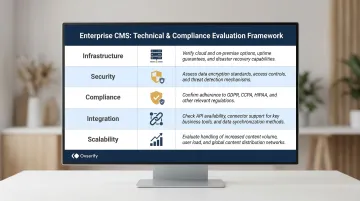
For BFSI organisations in India, compliance infrastructure meeting RBI and SEBI guidelines is mandatory. For media publishers, scalability to handle thousands of articles and high concurrent traffic is essential. For healthcare organisations, WCAG compliance and audit trails are non-negotiable.
Frequently Asked Questions
What is the difference between a traditional CMS and an AI-powered enterprise CMS?
Traditional CMS relies on manual tagging, folder-based organization, and keyword search. AI-powered CMS automates classification, understands natural language queries, and actively assists in content creation, distribution, and performance optimization. The result is a system that works proactively, not just reactively.
How does AI improve content workflow automation in enterprise systems?
AI routes content through approval workflows based on content type and risk level, flags compliance issues automatically, and eliminates manual handoffs, which reduces bottlenecks and accelerates time-to-publish. This is especially valuable in regulated industries like BFSI and healthcare where compliance checks are mandatory.
What are the key benefits of AI in enterprise content management?
Key benefits include:
- 60% faster content output through AI-assisted creation
- Reduced manual effort in tagging and classification
- Smarter search and retrieval, cutting search time by up to 35%
- Automated compliance enforcement that reduces legal risk
- Analytics that connect content performance to business outcomes, not vanity metrics
How does AI enhance content discoverability both internally and externally?
Internally, semantic search retrieves content across repositories based on intent, not just keywords. Externally, well-structured, AI-optimised content surfaces in AI-driven search engines and GEO contexts — appearing in ChatGPT answers, Google AI Overviews, and Perplexity results where over 800 million users now discover information.
Is AI-powered ECM suitable for regulated industries like BFSI and healthcare?
AI ECM is well-suited for regulated industries: it automates compliance checks, applies retention and access control policies, detects PII, and maintains audit-ready logs. With India's DPDP Act imposing penalties up to ₹250 crore, automated governance cuts legal risk and compliance burden significantly.
What should enterprises look for when evaluating AI-powered CMS platforms?
Prioritise these when shortlisting platforms:
- Genuine AI capabilities, not just marketing labels
- Platform consolidation that reduces tool sprawl
- Compliance and security credentials (WCAG, DPDP, RBI/SEBI readiness)
- Analytics depth with unified dashboards
- Uptime SLAs of 99.9%+ and scalability for high-volume operations
Always run a competitive proof of concept before committing.