Today's buyers and readers increasingly find content through AI assistants like ChatGPT, Perplexity, and Google AI Overviews — platforms that require content to be structured, semantically rich, and machine-readable, not just keyword-optimised. ChatGPT sent 243.8 million visits to 250 news and media sites in April 2025 — a 98% increase over January 2025. Meanwhile, Google AI Overviews appeared in 13.14% of US desktop searches in March 2025, and organic click-through rates on AI Overview queries fell 61% to just 0.61%. Traditional search engine volume is forecast to drop 25% by 2026 due to AI chatbots and virtual agents, according to Gartner.
This article explains what AI-native actually means in a CMS context, why legacy platforms are structurally limited, what capabilities to genuinely expect, and what the shift means for publishers, media houses, and content-driven organisations.
TLDR
- AI-native CMS embeds AI throughout the entire content lifecycle — creation, enrichment, distribution, governance, and discoverability
- Legacy platforms were built for human readers and search crawlers — not for large language models or AI agents
- Key gaps in traditional CMS: fixed schemas, siloed workflows, and content that AI cannot interpret or cite
- Expected capabilities: AI-assisted creation, automated schema markup, real-time analytics, cross-channel distribution, and GEO readiness
- Evaluating a new CMS means verifying that AI is embedded in the architecture — not bolted on through plugins or third-party integrations
What Does "AI-Native" Actually Mean in a CMS Context?
AI-native is not the same as AI-enhanced. An AI-native CMS is designed from the ground up with AI as a core component — not a plugin, chatbot, or sidebar feature added later. The distinction matters: AI-augmented systems treat AI as a supporting tool, while AI-native systems are AI-driven at their core, shaping architecture, decision-making, user experience, and the full system lifecycle.
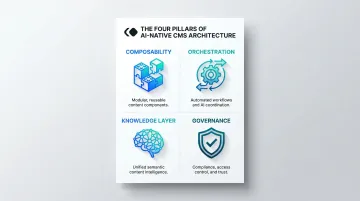
Four Foundational Pillars of AI-Native CMS Architecture
Composability — Content is structured, schema-rich, and API-first. Every asset (paragraph, image, tag) is addressable, queryable, and semantically enriched, enabling AI to extract precise information and cite sources with confidence.
Orchestration — Event-driven automation connects AI services across the content lifecycle. Publishing triggers schema injection, updates trigger re-indexing, and performance thresholds trigger refresh recommendations — all without manual intervention.
Knowledge Layer — Vectorisation and RAG (Retrieval-Augmented Generation) indexing let AI query content meaningfully. Relationships, entities, and context become machine-readable, not just human-readable.
Governance — Audit trails, compliance controls, and human oversight ensure AI-generated content maintains brand integrity and regulatory compliance. Automated guardrails check for policy violations before content reaches reviewers.
Content as a Living Knowledge Graph
The knowledge layer pillar above has a practical consequence worth spelling out. In AI-native systems, every asset carries semantic enrichment — entity relationships, topical authority markers, and contextual metadata that AI systems use to evaluate source credibility. When ChatGPT or Perplexity crawls your content, structure and authority signals matter as much as the words themselves. Citability is determined before a human ever reads the output.
The Economic Argument
AI-native platforms use stateless, serverless architecture that scales with actual demand. Legacy systems maintain always-on infrastructure regardless of traffic — so organisations end up paying to sustain ageing architecture while separately funding AI tools to compensate for its limitations. Cloud-native CMS architectures reduce total cost of ownership through dynamic scalability and the elimination of monolithic server management, often consolidating what previously required multiple vendors into a single platform.
Why Traditional CMS Platforms Are Falling Short
Fragmentation Problem
Over 800 CMS platforms are available as of 2024, and organisations frequently manage multiple content management solutions simultaneously. When content is scattered across disconnected repositories, AI systems cannot retrieve authoritative, unified information. A typical fragmented setup looks like:
- Product pages in one CMS
- Blog content in a second platform
- Knowledge base in a third system
AI assistants cannot connect the dots across these silos to establish topical authority.
Schema-First Constraint
Traditional CMS workflows require editors to predefine content models and fill structured fields. That approach works for static publishing, but breaks down when content originates from transcripts, customer reviews, video captions, or AI-generated inputs that don't map neatly to predefined schemas. Modern content creation is multi-modal and dynamic. Legacy CMS tools are rigid and prescriptive.
Personalization Ceiling
CMS-driven personalisation depends on building separate content variants for each audience segment in advance. AI-native systems generate contextually tailored content in real time without creating new objects per use case. The difference: traditional CMS requires you to create 10 versions of a page for 10 audiences; AI-native platforms generate the right version on demand.
Agentic Consumption Problem
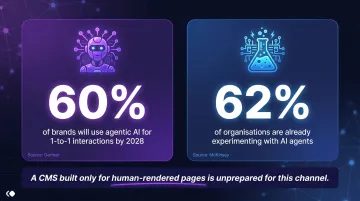
The personalisation ceiling is just one symptom of a deeper structural problem. As AI assistants, shopping bots, and agent-to-agent interactions grow, the classic "branded web page" may never be served to a human at all. Gartner predicts 60% of brands will use agentic AI for one-to-one interactions by 2028, and 62% of organisations are already experimenting with AI agents. Machines will request structured facts and summaries directly. A CMS built only for human-rendered pages is built without this channel in mind.
Core Capabilities to Expect from an AI-Native CMS
AI-Powered Content Creation and Repurposing
Genuine AI-assisted creation operates within the CMS workflow itself — not a third-party writing tool opened in a separate tab. Generation, summarisation, and multi-format repurposing happen inline, with brand voice, editorial guidelines, and compliance rules baked in.
The efficiency gains are real: 75% of publishers report efficiency improvements from AI, 64% report better content production, and 55% report faster publishing times, according to WAN-IFRA's 2025 survey of over 100 media leaders. However, only 9% can point to direct revenue gains — meaning AI-native CMS adoption is best justified on operational efficiency, not immediate revenue uplift.
What to expect:
- Inline content generation with brand voice enforcement
- Multi-format repurposing (article → social post → newsletter → video script)
- Real-time content scoring for semantic relevance and schema completeness
- AI-assisted keyword strategy aligned with LLM interpretation of search intent
Automated Metadata, Schema, and Content Enrichment
AI-native CMS platforms automatically extract metadata, apply semantic tags, and inject structured markup (FAQ, HowTo, Article, Organization schema) at publication — removing the manual tagging burden from editors while making content machine-readable for LLMs and search crawlers.
What to expect:
- Automatic entity extraction and semantic tagging
- Schema.org markup applied at publication (not post-hoc)
- Internal linking recommendations based on topical relevance
- Content enrichment without editor intervention
Real-Time Analytics and Content Intelligence
AI-native platforms offer predictive performance insights, not just historical dashboards. Integration with GA4 and Google Search Console should be native, enabling content teams to see engagement signals, Core Web Vitals health, and content-attributed traffic without switching tools.
Publive's Golden Signals Dashboard exemplifies this capability — enabling publishers to identify top-performing content categories, assess individual article performance, and make editorial decisions based on unified GA4 and GSC data directly within the CMS interface. For teams juggling multiple analytics tabs, having this data consolidated inside the CMS changes how quickly editorial calls get made.

What to expect:
- Predictive performance scoring before publication
- Real-time Core Web Vitals monitoring (LCP, INP, CLS)
- GA4 and GSC data surfaced within the CMS
- Content-attributed traffic and conversion tracking
Omnichannel Distribution and Workflow Automation
Distribution automation — AI-scheduled social sharing, push notifications, and headless API delivery to apps and third-party platforms — should be native to the system, not managed through a separate marketing automation stack.
What to expect:
- Automated social distribution with timing optimisation
- Push notifications triggered by engagement signals
- Headless API delivery for app and third-party consumption
- Content syndication without manual workflow overhead
Content Freshness and Lifecycle Automation
AI-native CMS platforms manage the full content lifecycle post-publication: triggering refresh cycles for aging content, re-indexing updated assets in the knowledge layer, and surfacing performance-based recommendations for what to update or retire.
AI models favour recent, well-maintained content when selecting sources to cite. That makes lifecycle automation a discoverability requirement, not a maintenance afterthought.
What to expect:
- Automated content refresh triggers based on age and performance
- Re-indexing workflows when content is updated
- Recommendations for content retirement based on engagement decay
- Lifecycle tracking integrated with analytics
AI Search Visibility and GEO: The New Expectation for Publishers
Generative Engine Optimization (GEO) means structuring content so it can be interpreted, cited, and surfaced by LLM-powered platforms like ChatGPT, Perplexity, and Google AI Overviews — which increasingly serve as the first touchpoint for readers and buyers.
Research from Princeton, Georgia Tech, the Allen Institute, and IIT Delhi found that adding statistics, quotations, and citations can boost generative engine visibility by up to 40%. The "Cite Sources" optimisation method led to a 115.1% increase in visibility for websites ranked 5th in traditional SERPs, while top-ranked traditional results saw visibility decrease by 30.3% when lower-ranked competitors applied GEO tactics.

What Makes Content AI-Visible
Entity clarity — Structured schema markup (FAQ, HowTo, Article, Organisation) resolves ambiguity around who, what, when, and where, signalling content type and authority to AI models.
Answer-first formatting — AI systems prioritise content that answers the query within the first 2-3 sentences. Content that builds to its conclusion gets deprioritised.
Semantic internal linking — Connecting related content creates topical authority clusters that LLMs use to evaluate source credibility.
Core Web Vitals performance — Only 47% of websites pass Core Web Vitals assessments, yet a 0.1-second load time reduction boosts conversions by 8%. Fast, stable, accessible sites signal trustworthiness to AI models.
GEO in AI-Native CMS Platforms
In AI-native CMS platforms, GEO capabilities ship as default outputs, not add-ons configured after the fact. Publive, built for publishers and media organisations, delivers GEO readiness through structured content delivery, automated schema injection, and a 98% Core Web Vitals pass rate. Its SmartLinks feature automatically surfaces relevant internal linking opportunities — directly supporting the topical authority signals that LLMs weigh when selecting sources.
Governance, Editorial Control, and Compliance in AI-Native Systems
AI-native does not mean AI-uncontrolled. Robust AI-native CMS platforms include human-in-the-loop editorial workflows: approval chains, version control, audit trails, and role-based permissions. Content quality and brand integrity are maintained even as production velocity increases.
Architectural Difference: Upstream Governance
Instead of relying on manual review to catch errors downstream, AI-native governance applies automated guardrails, real-time compliance checks, and brand voice enforcement at the generation stage, before content ever reaches a human reviewer.
What to expect:
- Automated compliance checks for regulatory requirements
- Brand voice scoring and enforcement during generation
- Content provenance tracking for AI-generated or AI-enriched content
- Role-based permissions and approval workflows
Compliance Expectations for Regulated Industries
Publishers, financial institutions, and healthcare organisations should look for platforms with WCAG accessibility compliance, data protection readiness (such as India's DPDP Act), and enterprise-grade security standards. Here is what each of those requirements means in practice.
WCAG 2.2 (published October 2023) contains 86 success criteria, including 9 new requirements such as minimum target sizes (24x24px) and accessible authentication. CMS-generated templates must be audited against WCAG 2.2 AA, not just 2.1.
India's DPDP Act 2023 was notified on November 13, 2025, with a 12-18 month phased compliance timeline. Penalties reach up to ₹250 crore per breach. CMS platforms serving Indian audiences must embed consent management, data erasure workflows, and multilingual notice capabilities.
For BFSI specifically, the gap between regulatory expectation and institutional readiness is stark: only 32% of financial services institutions have an AI governance committee, yet 78% of consumers expect AI content to be labeled. AI-native CMS platforms for BFSI must treat the following as native capabilities, not external add-ons:
- Consent management
- Content provenance tracking
- Accessibility auditing
- AI content watermarking
Frequently Asked Questions
What is AI-native content?
AI-native content is content designed, structured, and managed to be interpretable and usable by AI systems. This includes content created with AI assistance as well as content formatted with semantic metadata and structured schema so LLMs can accurately extract and cite it.
What is the difference between an AI-native CMS and a traditional CMS?
A traditional CMS stores and publishes content for human readers via browsers. An AI-native CMS is built from the ground up with AI embedded across every workflow — creation, enrichment, governance, and distribution — making content machine-readable and AI-discoverable by default.
Does switching to an AI-native CMS require migrating all existing content?
Full migration is not always necessary. AI-native platforms can often point to existing content repositories and process them in place, indexing and enriching assets without a disruptive object-by-object migration.
How does an AI-native CMS improve visibility in platforms like ChatGPT or Perplexity?
AI-native platforms automatically apply structured schema, semantic metadata, and answer-first formatting that large language models use to evaluate source authority — making it more likely that content is retrieved and cited in AI-generated responses.
Can AI-native CMS platforms handle editorial governance and compliance for regulated industries?
Yes. AI-native platforms built for enterprise use include approval workflows, audit trails, and automated compliance checks. Most also support WCAG accessibility standards and regional data protection requirements such as India's DPDP Act.
Which types of organisations benefit most from an AI-native CMS?
Media houses, digital publishers, financial institutions, and healthcare organisations — essentially any organisation that produces high volumes of content, operates in a regulated environment, or depends on content-led audience growth — stand to gain the most from AI-native CMS adoption.