

Platforms combining analytics and content insights close this gap by giving teams a unified view of what content is performing, why it is working, and how to replicate success across campaigns. This guide covers the top platforms doing this well, how they are evaluated, and what to look for when choosing one.
TL;DR
- Analytics-content platforms cut decision lag at every stage of the campaign lifecycle
- The best tools unify content performance, audience behaviour, SEO signals, and distribution data in one workflow
- Evaluate platforms on real-time analytics depth, SEO integration, martech compatibility, and how well they scale with your team
- Publive, HubSpot, Semrush, Chartbeat, and BuzzSumo represent leading solutions across different use cases
- Your primary need — publishing workflows, SEO campaigns, live editorial decisions, or competitive research — determines the right fit
What Are Platforms That Combine Analytics and Content Insights?
These platforms go beyond standard analytics dashboards by connecting audience and performance data directly to content creation, distribution, and optimization workflows. They enable a feedback loop between data and editorial or marketing decisions, allowing teams to act on insights in real time rather than simply reporting what happened after the fact.
Siloed tools create a specific problem: when analytics live in one system and content operations in another, insights arrive too late to change anything. The fragmentation has measurable costs — according to Chief Martec's 2022 research, enterprise marketing teams globally use only 42% of their martech capabilities, down from 58% in 2020. Campaigns underperform not from lack of data, but from lack of connected data.
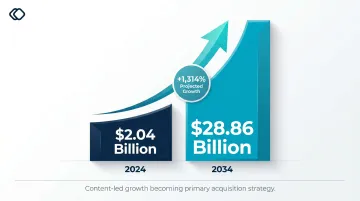
Demand for integrated content analytics platforms has surged as content-led growth becomes a primary acquisition strategy. The global content intelligence market sits at $2.04 billion in 2024 and is projected to reach $28.86 billion by 2034. Media houses, digital publishers, and brand marketing teams are consolidating their technology stacks — and the market growth reflects exactly that shift.
Top 5 Platforms Combining Analytics and Content Insights for Campaign Success
These platforms were selected based on their ability to bridge content intelligence with actionable analytics, serving teams from independent publishers to enterprise brands.
Publive
Publive is an AI-first digital experience and content management platform built for media houses, publishers, brands, financial institutions, and healthcare organizations. It delivers a fully integrated stack combining content creation, distribution, and enterprise-grade analytics in a single system.
What sets Publive apart is its Golden Signals Dashboard powered by GA4 and GSC connectors, which gives decision-makers granular visibility into content performance alongside AI-driven tools for content generation, social distribution, and push notifications. The platform achieves a 98% Core Web Vitals pass rate and delivers 60% faster content output with AI, reducing the need for multiple vendors and consolidating essential workflows.
| Feature Category | Details |
|---|---|
| Key Features | AI-powered content creation and repurposing, GA4 and GSC analytics integration, Golden Signals Dashboard, AI social media distribution, push notifications, WCAG + DPDP compliance |
| Ideal For | Media houses, digital publishers, brands, financial institutions, and healthcare organizations seeking an all-in-one content and analytics platform |
| Analytics Capabilities | Enterprise-level real-time analytics, content performance tracking, audience behavior insights, SEO signals via GSC connector, and GEO discoverability metrics |
HubSpot
HubSpot is a leading marketing and CRM platform that combines a content hub for creating and publishing blog posts, landing pages, and email campaigns with built-in analytics tracking content performance, lead attribution, and campaign ROI across the full funnel.
HubSpot's strength lies in connecting content performance directly to pipeline outcomes. Teams can see which blog post, email, or landing page drove a conversion and optimize accordingly. Its Campaign Analytics tool consolidates performance data across channels into a single dashboard, making it especially useful for B2B and mid-market brand teams running inbound campaigns. HubSpot serves 247,939 customers as of December 2024, with 86% using the platform daily, and has been named a Leader in Gartner's Magic Quadrant for both B2B Marketing Automation and Content Marketing Platforms.
| Feature Category | Details |
|---|---|
| Key Features | Content hub, campaign analytics dashboard, SEO recommendations, lead attribution, email analytics, A/B testing, CRM integration |
| Ideal For | B2B brands, inbound marketing teams, and mid-market companies looking to connect content performance to revenue outcomes |
| Analytics Capabilities | Full-funnel attribution, traffic source analysis, email engagement metrics, content performance by topic cluster, and campaign ROI tracking |
Semrush
Semrush is known primarily for SEO and competitive intelligence, but its Content Marketing Toolkit extends it into a full content analytics and planning platform — covering ideation, optimization, publishing, and performance tracking in one place.
Its real edge is tying content decisions directly to search performance data. The Content Audit tool identifies performance gaps in existing content, while the SEO Writing Assistant and Topic Research tools ensure new content is built on validated demand signals. This makes it powerful for teams where organic search is a primary campaign channel. Semrush reported $411.6 million ARR as of December 2024, serving approximately 117,000 paying customers with a database covering 27.9 billion keywords and 43 trillion backlinks.
| Feature Category | Details |
|---|---|
| Key Features | Content audit tool, SEO writing assistant, topic research, backlink analytics, position tracking, competitor content gap analysis, social media poster |
| Ideal For | SEO-driven content teams, digital agencies, and brand marketers focused on organic traffic and competitive content strategy |
| Analytics Capabilities | Organic search performance tracking, keyword ranking data, content performance benchmarking, backlink profile analysis, and competitor share of voice |
Chartbeat
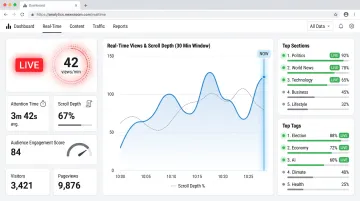
Chartbeat is a real-time content analytics platform purpose-built for digital publishers and media organizations, providing live data on how audiences are consuming content across every page, article, and section of a website.
What makes Chartbeat distinctive is its editorial focus: rather than reporting on past performance, it surfaces real-time signals including attention time, scroll depth, and recirculation rates that help editors make immediate decisions about content promotion, headlines, and story placement. Its Heads Up Display and Publishing Dashboard are widely used by newsrooms that need to act on audience data as stories break. Chartbeat serves thousands of global publishers, with 90% of revenue derived from large enterprise media companies.
| Feature Category | Details |
|---|---|
| Key Features | Real-time dashboard, attention time tracking, scroll depth analytics, headline testing, publishing performance reports, audience loyalty metrics |
| Ideal For | Digital newsrooms, media publishers, and editorial teams that need real-time data to guide content decisions during active news cycles |
| Analytics Capabilities | Live traffic and engagement metrics, attention-based performance scoring, audience loyalty segmentation, and multi-page content journey tracking |
BuzzSumo
BuzzSumo is a content intelligence and research platform that helps marketing teams discover what resonates, track competitor performance, and identify trending topics. It's built for the research and planning phases of content-led campaigns — before a brief is written or a word is drafted.
Its content discovery engine analyzes billions of pieces of content to surface what earns engagement, backlinks, and shares — broken down by topic, format, and competitor. Teams use it to:
- Validate content ideas before committing to production
- Benchmark performance against direct competitors
- Identify high-performing formats for their specific audience
The platform indexes 8 billion articles worldwide and tracks engagement across Facebook, X (Twitter), Reddit, YouTube, and TikTok.
| Feature Category | Details |
|---|---|
| Key Features | Content discovery and research, competitor content analysis, trending topics tracker, influencer identification, backlink analysis, brand monitoring alerts |
| Ideal For | Content marketing teams, digital agencies, and brand strategists focused on content ideation, competitive benchmarking, and campaign planning |
| Analytics Capabilities | Engagement analytics across social platforms, content performance by format and topic, share velocity tracking, and historical content trend data |
How We Chose the Best Platforms
Platforms were shortlisted based on how deeply they integrate analytics into the content workflow — not just reporting after the fact, but informing decisions at every stage from ideation to distribution.
A common mistake teams make is choosing a platform based on dashboard aesthetics or brand recognition, rather than asking whether the analytics actually improve content output.
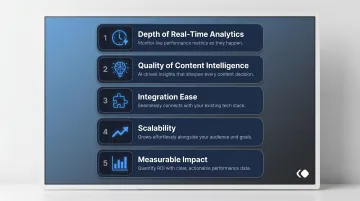
Core evaluation factors included:
- Depth of real-time analytics — Can teams access live performance data and act on it immediately?
- Quality of content intelligence features — Does the platform offer topic research, SEO signals, and performance benchmarking?
- Integration ease — How well does it connect with existing martech stacks?
- Scalability — Can it serve teams of different sizes and content volumes?
- Measurable impact — Is there evidence of campaign improvements for existing users?
Beyond these criteria, the best platforms reduce operational complexity by replacing what previously required multiple vendors with a single, unified workflow. This cuts costs and gives campaign teams faster access to the data that drives decisions. Organizations that address martech fragmentation through integration report 93% meet or exceed customer experience goals.
Conclusion
In a content-saturated environment, the competitive edge belongs to teams that can close the loop between analytics and content decisions. The platforms that do this well don't treat analytics as a reporting afterthought — they embed data into the content workflow itself.
Evaluate platforms not just on feature lists but on whether the analytics are actionable within your actual workflow. Ask whether a performance insight from last week's campaign can directly shape what your team publishes tomorrow — or whether that data lives in a separate tab that nobody checks.
For media houses, publishers, and brands seeking an enterprise-grade platform that natively combines content creation, distribution, and analytics in one system, Publive brings together AI-assisted content workflows, GA4 and GSC connectors, and a unified dashboard — so your team spends less time switching tools and more time acting on what the data shows. Explore how it works at Publive's integrated analytics platform.
Frequently Asked Questions
How to track ROI in influencer marketing?
ROI in influencer marketing is tracked by assigning unique tracking links, promo codes, or UTM parameters to each creator, then measuring attributed traffic, conversions, or sales in an analytics platform. Advanced tools also calculate Earned Media Value (EMV) to capture brand awareness impact beyond direct conversions.
What is the average ROI for influencer marketing?
Businesses report an average ROI of $5.78 for every dollar spent on influencer marketing, though ROI varies significantly by influencer tier, industry, and campaign objective. Platforms combining content analytics with campaign tracking help brands improve on this average by optimising based on real performance data.
What are the 4 M's of influencer marketing?
The 4 M's are Make, Manage, Monitor, and Measure. Together, they cover content creation with influencers, campaign and relationship management, real-time performance monitoring, and post-campaign measurement against goals.
What are the 3 R's of influencer marketing?
The 3 R's are Reach, Relevance, and Resonance: the core criteria for evaluating an influencer's fit. Reach is audience size, Relevance is topical and demographic alignment, and Resonance measures the quality of engagement their content generates.
What is the difference between content analytics and campaign analytics?
Content analytics measures how individual pieces perform — engagement, time on page, scroll depth, organic reach. Campaign analytics measures the aggregate impact of a coordinated effort toward a specific goal such as leads, conversions, or brand awareness. The strongest platforms surface both views in a single dashboard.
Why do media houses and brands need integrated analytics and content platforms?
Siloed tools slow down decision-making by forcing teams to manually connect data from separate systems. Integrated platforms reduce this lag, enabling real-time content optimisation, faster campaign pivots, and clearer attribution of content investment to business outcomes.