- 86% of U.S. adults consume news digitally, but only 22% visit publisher sites directly, making multi-channel distribution essential for reach
- Omnichannel distribution means integrated, platform-native content across all touchpoints, not identical posts copied everywhere
- Publishers building anchor assets (long-form articles, research) can generate 6-10 derivative pieces across channels from one source
- AI-powered platforms consolidate CMS, social scheduling, email, push notifications, and analytics, cutting operational overhead while accelerating output
Introduction
Audiences no longer gather in one place. According to the Reuters Institute Digital News Report 2024, direct traffic to publisher sites has collapsed from 32% in 2018 to just 22% today, with readers splitting their attention across social media, search, email newsletters, podcasts, and web browsing in roughly equal measure.
Publishing the same blog post to every platform won't solve this. Cross-posting identical content across channels underperforms because each platform rewards native formatting - LinkedIn favours 1,200+ character posts, Instagram rewards sub-30-word captions, and push notifications demand urgency in under 100 characters.
Omnichannel content distribution offers a better path: one core asset, adapted for every relevant channel without duplicating effort. This article covers the definition, the four pillars, a step-by-step strategy, channel-specific execution, tools, and measurement frameworks for scalable publishing.
What Omnichannel Content Distribution Actually Means (and What It Doesn't)
The Real Definition
Omnichannel content distribution is a strategy where content creation, adaptation, and delivery are unified across all audience touchpoints - website, social media, email, push notifications, syndication, and AI search surfaces. Every channel reinforces the same narrative while respecting platform-native norms.
Omnichannel vs. Multichannel
The two terms are often used interchangeably, they shouldn't be.
| Multichannel | Omnichannel | |
|---|---|---|
| Channel presence | Multiple platforms, managed in silos | Multiple platforms, coordinated centrally |
| Content approach | Disconnected, team-specific output | Unified editorial calendar, consistent narrative |
| Audience journey | Fragmented across touchpoints | Seamless between channels |
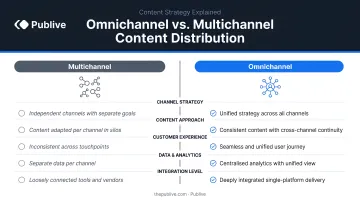
Cross-posting identical content to every platform is multichannel at its worst, not omnichannel. Analysis of 10.2 million posts shows Threads delivers 73.6% higher engagement than X (6.25% vs. 3.6%), proving that platform-specific dynamics demand platform-specific content.
That platform-specificity is exactly where the most common omnichannel misconception falls apart.
The Repurposing Myth
Smart omnichannel distribution isn't about slicing one blog post into 10 social captions. It's about designing a content ecosystem where each derivative piece has a platform-specific format, angle, and call-to-action that serves the larger editorial or business objective.
A 1,500-word investigative article becomes:
- Three social posts tailored to LinkedIn (professional insight), Instagram (visual storytelling), and X (sharp takes)
- One email newsletter excerpt with editorial context
- One push notification teaser driving immediate traffic
- One short-form video script for vertical feeds
Each format respects the channel's content grammar while maintaining editorial coherence.
The 4 Pillars of an Effective Omnichannel Content Distribution Strategy
Pillar 1: Unified Content Core
Every omnichannel strategy starts with a strong anchor asset - a long-form article, research report, video, or news story containing enough substance to be adapted into multiple formats. Investing in the depth of this core asset determines the quality of everything distributed downstream.
Shallow anchor content produces shallow derivatives, a 500-word generic blog post can't sustain six platform-specific adaptations. A 2,000-word data-driven article with original research, expert quotes, and concrete examples, on the other hand, can generate a week's worth of high-value content across channels.
Pillar 2: Consistent Brand Voice Across Channels
While format and length vary by platform, tone, messaging hierarchy, and brand perspective must remain consistent. Brand consistency can increase revenue by 10-20%, yet 77% of companies deal with off-brand content, according to Lucidpress research.
For media brands and financial publishers, inconsistency across channels erodes trust, the foundation of credibility. A publisher that's authoritative on the website but casual on X and promotional on LinkedIn confuses the message and weakens brand identity.
Pillar 3: Channel-Native Adaptation
Each channel has its own content grammar:
- LinkedIn rewards long-form professional insight. Posts with 1,200+ characters get 3x more engagement than shorter posts
- Instagram favours visuals and brevity, captions under 30 words yield highest engagement
- Push notifications demand urgency in under 100 characters, breaking news alerts are capped at 95 characters on Apple News
- Email newsletters reward curation and context, not just headlines
Successful omnichannel distribution respects these norms rather than overriding them.
Pillar 4: Centralised Workflow and Governance
Respecting channel norms only pays off when your team can execute consistently across all of them. Without a single system managing content creation, approvals, scheduling, and distribution, teams duplicate work, miss publish windows, and produce inconsistencies. Centralised governance ensures content moves from ideation to every channel without bottlenecks.
These four pillars are interdependent. Skip channel-native adaptation and your core content becomes generic cross-posts. Skip centralised governance and channel-native work collapses into disconnected silos. Each pillar only holds when the others do.
How to Build a Scalable Omnichannel Content Distribution Strategy
Step 1: Audit Your Current Channels and Audience Behaviour
Map where your target audience actually consumes content before distributing anywhere. Research which channels drive the most engaged traffic - time on page, return visits, conversions - versus vanity metrics like impressions.
Simple audit framework:
- Export traffic source data from Google Analytics (last 90 days)
- Segment by channel: direct, organic search, social (by platform), email, referral
- Calculate engagement rate (time on page, pages per session) and conversion rate per channel
- Identify demographic overlap, which channels reach your core audience versus adjacent segments
- Prioritise 3-5 channels to build depth before expanding
Digital Content Next's 2024 survey of 115 publishers found that 98% say referral traffic has moderate or very significant impact on annual revenue, yet 82% expect Facebook traffic to continue declining.
Step 2: Identify and Create Your Core Anchor Content Assets
Develop a content calendar built around anchor pieces,long-form articles, original research, video explainers,rich enough to be disaggregated. The content multiplication principle: one anchor asset should generate 6-10 derivative pieces across formats and channels without losing substance.
What makes a strong anchor asset:
- Data or research that can be visualised differently per platform
- Expert quotes that work as standalone social posts
- Step-by-step processes that can be animated or turned into carousels
- Statistics that answer common questions
Publive's AI-powered repurposing workflows accelerate content output by up to 60%, turning a single anchor asset into platform-ready derivatives without manual reformatting.
Step 3: Map Content Derivatives to Channels
For each anchor asset, plan the derivative content explicitly. Don't improvise during distribution, map it in advance.
Example: 1,500-word article on regulatory changes in BFSI
| Anchor Asset | Derivative Content | Channel | Format |
|---|---|---|---|
| Long-form article | Professional analysis post | 1,200-character post + link | |
| Same article | Key stat visualisation | Carousel graphic + 25-word caption | |
| Same article | Sharp opinion take | X | 280-character thread |
| Same article | Curated context + excerpt | Email newsletter | 200-word intro + CTA |
| Same article | Breaking update alert | Push notification | 80-character teaser |
| Same article | Explainer script | YouTube Shorts | 60-second vertical video |
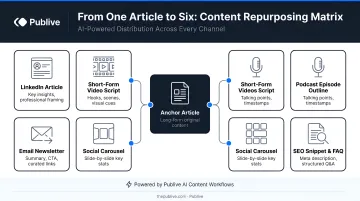
This content-to-channel matrix ensures every derivative serves a clear purpose on the right platform.
Step 4: Build a Cross-Channel Editorial Calendar
An omnichannel calendar isn't just a schedule of publish dates. It maps the relationships between core assets and their derivatives, staggers distribution timing to maximise reach without audience fatigue, and aligns publishing cadence with audience peak engagement windows.
Calendar structure:
- Week 1: Anchor asset publishes on website (Monday); social derivatives roll out Tuesday-Thursday; email newsletter Friday; push notification for breaking angle
- Week 2: Second anchor asset; repurpose Week 1 content into video or podcast format
- Week 3: Evergreen content refresh; redistribute high-performing derivatives
Publive brings this entire calendar into one unified system, CMS, social scheduling, email automation, and push notifications managed from a single dashboard rather than juggled across separate tools.
Step 5: Establish Feedback Loops for Continuous Optimisation
After each content cycle, analyse performance by channel:
- Which formats drove the most engagement?
- Which channels generated the most conversions?
- Which anchor assets produced the strongest derivative performance?
Use these insights to refine both your content calendar and your channel-to-format mapping. If LinkedIn consistently outperforms X, shift resources there. If push notifications spike traffic but time-on-page stays low, the content angle, not the channel, needs adjustment.
Channel-Native Adaptation: Publishing Content That Fits Each Platform
Website and SEO
The anchor content lives here. Optimise for search intent, structured data, internal linking, and Core Web Vitals performance (LCP, CLS, INP). For media publishers, this is where long-form storytelling, in-depth analysis, and original reporting build topical authority.
Critical for 2025: Google's AI Overviews and GEO (Generative Engine Optimization) are now distribution surfaces you can't ignore. When AI summaries appear, traditional link clicks drop from 15% to 8%, according to Pew Research. Publishers must structure content for both human readers and AI summarisation.
GEO best practices:
- Add citations to content (approximately 40% visibility improvement in generative engine responses)
- Include direct quotations (approximately 40% improvement)
- Use statistics and numerical data (approximately 37% improvement)
Social Media Channels: LinkedIn, Instagram, X
Each platform demands a distinct content grammar:
LinkedIn example: "BFSI compliance changes in 2025: New RBI guidelines require financial institutions to implement multi-factor authentication across all digital touchpoints by Q3. Here's what this means for customer onboarding workflows, legacy system integration, and compliance timelines. [Link to full analysis]"
Instagram example: Visual carousel showing "5 Key BFSI Compliance Changes in 2025" with one stat per slide. Caption: "New RBI rules reshape digital banking, swipe for what changes."
X example: "RBI's new MFA mandate drops Q3 2025. Legacy banking systems weren't built for this. Compliance scramble starts now. [Link]"
Email Newsletters and Push Notifications
Email is the highest-intent owned channel. Subscribers have opted in, so content should prioritise curation, context, and editorial voice over volume. Average open rates in business and finance sectors sit at 31.35%, with 2.78% click-through rates, per Mailchimp benchmarks.
Push notifications are the highest-urgency channel, best for breaking news, time-sensitive content, or driving traffic spikes. Rich images boost CTR from approximately 3% to 8–9%, according to OneSignal data.
The distinction matters operationally: email rewards depth and editorial framing, push rewards immediacy. Don't send the same content through both, use email for curated weekly roundups and push for breaking developments.
Emerging Channels: Podcasts, YouTube Shorts, AI Search Surfaces
Three channels now demand dedicated attention in any distribution plan:
- Podcasts: 32% of U.S. adults get news from podcasts, up from 22% in 2020. Repurpose long-form interviews and analysis into audio-first formats.
- YouTube Shorts and vertical video: Publishers including Time, CNN, and The New York Times are investing here. Video ads command 25–40% higher CPMs than standard display, per Digiday reporting.
- AI search surfaces: As GEO gains traction, treating AI platforms (Perplexity, ChatGPT, Google AI Overviews) as distribution endpoints, not just traffic referrers, requires structured, citation-rich content.
The strategy framework stays consistent across all three. The channel map, however, should be reviewed every quarter, new surfaces emerge faster than most editorial calendars can accommodate.
Tools and Workflows That Make Omnichannel Distribution Scalable
The Core Technology Stack
Omnichannel distribution at scale requires:
- Headless or API-first CMS for content storage and delivery
- Social media scheduler for channel-specific publishing
- Email automation platform for newsletter delivery
- Push notification system for real-time alerts
- Unified analytics layer for cross-channel performance tracking
Siloed tools create data gaps and workflow bottlenecks that undermine the "unified" promise of omnichannel. Gartner's 2025 Marketing Technology Survey found martech utilisation has dropped to as low as 33%, with CMOs managing an average of 9 channels. Without integration, that tool sprawl wastes budget and creates friction at every handoff.
The Case for Consolidated Publishing Platforms
Rather than stitching together 5-7 separate tools, AI-first platforms like Publive consolidate content creation, AI-powered repurposing, automated social distribution, push notifications, and analytics into a single system. This cuts operational costs, removes vendor management overhead, and gives editorial teams one place to track performance across every channel.
Indian publishers including Indian Express, News Nation, and TheSootr use Publive to manage omnichannel workflows from a unified platform, replacing the fragmented tooling that previously slowed their teams down.
That platform foundation only goes so far, though. Even the best-integrated tech stack breaks down when teams lack clear ownership of the distribution process.
Defined Team Roles and Approval Workflows
Omnichannel distribution fails not just from bad tools but from unclear ownership. Cross-functional alignment - editorial, social, SEO, and distribution teams working from the same calendar and content repository - separates publishers who scale from those who create bottlenecks.
Critical governance elements:
- Assign ownership explicitly: who creates anchor content, who adapts it for each channel, who signs off before distribution
- Use version control so conflicting edits across channels don't reach audiences
- Enforce a shared editorial standard across every format and channel
- Design approval workflows lean enough that they protect quality without killing publishing speed
Measuring Omnichannel Content Distribution Performance
The Right KPIs by Channel Type
Distinguish between three metric layers:
Awareness metrics:
- Impressions
- Reach
- Share of voice
Engagement metrics:
- Time on page
- Social shares
- Email open rates (31.35% average for business/finance)
- Push notification CTR (approximately 3% baseline, 8-9% with rich images)
Conversion metrics:
- Leads
- Subscriptions
- Ad revenue per article
- Return visits
Tracking only top-of-funnel metrics (likes, impressions) gives a misleading picture of omnichannel effectiveness. A post with 100,000 impressions but 0.5% engagement underperforms a post with 10,000 impressions and 8% engagement.
Once you know which KPIs matter for each channel, the next challenge is assigning credit correctly, because readers rarely convert on first contact.
Content Attribution Across Channels
In omnichannel distribution, a single reader might encounter the same story as a push notification, a social post, and a search result before converting. Last-click attribution significantly undervalues the contribution of those earlier touchpoints, and in practice, it can make your highest-awareness channels look like they're not working at all.
Simple multi-touch attribution approach for media publishers:
- Track first touch (initial discovery channel)
- Track last touch (final conversion channel)
- Use GA4's data-driven attribution model to distribute fractional credit across touchpoints
- Connect Google Search Console data to measure organic search contribution
- Tag social and email links with UTM parameters for channel-specific tracking
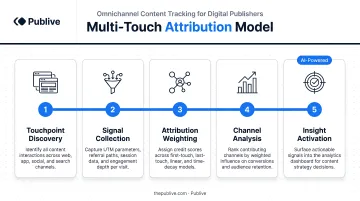
The practical goal is a simple truth table: channel X builds awareness, channel Y closes. That distinction shapes where you invest, what you optimise, and which metrics you report to stakeholders.
Frequently Asked Questions
What is omnichannel distribution?
Omnichannel distribution is the strategy of delivering content across all audience channels in an integrated, consistent manner. Unlike multichannel approaches where platforms operate in silos, omnichannel coordinates message, timing, and format across owned, earned, paid, and shared channels as one unified system.
What are the 4 pillars of omnichannel?
The four pillars are:
- Unified content core - strong anchor assets that anchor all downstream formats
- Consistent brand voice across every channel and touchpoint
- Channel-native adaptation - respecting each platform's content format and norms
- Centralised workflow and governance - one system managing the full distribution process
What are the 4 channels of distribution?
The four primary distribution channel types are: owned channels (website, email, push), earned channels (SEO, PR, syndication), paid channels (sponsored content, ads), and shared channels (social media). Omnichannel strategy coordinates all four.
What is an example of omnichannel content distribution?
A media outlet publishes a long-form investigative article (website), sends a teaser to email subscribers, pushes a breaking-news alert, shares platform-specific social posts on LinkedIn and Instagram, and optimises the piece for AI search surfaces, all from a single editorial workflow.
What is the difference between omnichannel and multichannel content distribution?
Multichannel means presence on multiple platforms, often siloed. Omnichannel means those channels are integrated, content is consistent, and the audience experience flows seamlessly across all touchpoints with coordinated messaging.
How do you measure the success of omnichannel content distribution?
Measure success across three layers: awareness (reach, impressions), engagement (CTR, time on page, open rates), and conversion (subscriptions, revenue per piece). Multi-touch attribution helps you understand what each channel actually contributes to the overall result.