
 for Modern Media Companies](https://file-host.link/website/thepublive-y5me3k/assets/blog-images/31aabb71-c0de-4a28-9368-e1a1bfdccc9e/1777999576699216_4dfcd9466101450ab3d434bb95de2288/360.webp)
Introduction
Digital publishing has entered a new era. The global digital publishing market was valued at USD 163.89 billion in 2025 and is projected to grow at a CAGR of approximately 11.6% through 2030, driven by smartphone penetration and accelerated content digitisation. Yet most media companies still run on publishing infrastructure that wasn't built for today's demands.
The cost of the wrong platform is steep. 53% of mobile visits are abandoned if pages take longer than 3 seconds to load, cutting into both search rankings and reader retention. Siloed tools compound the problem, with enterprise CMS deployments often exceeding ₹8 crore in five-year total cost of ownership.
Analytics gaps leave editors guessing on what content actually works — and the stakes keep rising. Google search traffic to publishers declined globally by approximately one-third in the year to November 2025.
This post delivers a vetted list of the best digital publishing platforms for modern media companies, evaluated against metrics that actually matter: performance, AI capability, distribution, monetisation, and total cost of ownership.
TL;DR
- Modern digital publishing platforms unify content creation, analytics, and distribution — going far beyond basic CMS tools
- Prioritise Core Web Vitals compliance, AI-assisted workflows, and audience analytics when evaluating any platform
- Your scale and use case determine the right fit — enterprise newsrooms, magazines, and brand publishers have different requirements
- Publive offers AI-native workflows, performance guarantees, and deep analytics purpose-built for media houses
- Evaluate total cost of ownership, not just licensing fees — developer dependency and plugin stacks add up fast
What Is a Digital Publishing Platform?
A digital publishing platform is more than a CMS. It's the full-stack infrastructure through which media companies create, optimise distribute, and monetise content—covering everything from article authoring to audience analytics and ad integration.
Not all publishing tools are built the same. Three broad categories exist:
- Generic website builders (WordPress, Squarespace) serve broad audiences but lack media-specific editorial workflows and monetisation features
- Legacy magazine platforms (Issuu, flipbook tools) focus on PDF-based distribution rather than real-time publishing at scale
- Media-grade Digital Experience Platforms (DXPs) are purpose-built for high-velocity publishing, with AI-powered content creation, automated social distribution, and advanced audience intelligence
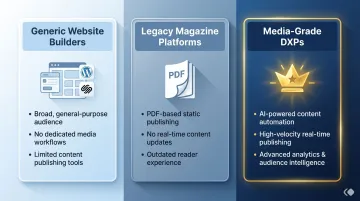
That last category is where the real distinction lies. Forrester defines a DXP as "much more than a CMS—it's customer data, content, marketing, and commerce." With algorithm-driven discovery, AI search, and shrinking reader attention all reshaping how content gets found, the publishing platform an editorial team chooses now shapes their growth ceiling.
What to Look for in a Digital Publishing Platform
Performance and Core Web Vitals Compliance
Page load speed and interactivity scores directly affect Google rankings. A platform that consistently fails Core Web Vitals will suppress organic reach regardless of content quality. Google states that achieving good Core Web Vitals is critical for success with Search and user experience.
Good scores require:
- Largest Contentful Paint (LCP) under 2.5 seconds
- Interaction to Next Paint (INP) under 200 milliseconds
- Cumulative Layout Shift (CLS) under 0.1
Only 43.44% of WordPress sites achieved good Core Web Vitals scores in June 2025, ranking last among major CMS platforms. Media companies should ask for documented pass rates before signing any contract.
AI-Powered Content Workflows
Look for platforms that embed AI natively into the editorial process — covering content generation, repurposing, headline experimentation, and social distribution — not layered on as an afterthought.
The adoption numbers bear this out:
- 79% of publishers used AI in 2025, up from 35% in 2024
- 75% report efficiency improvements, with 55% publishing faster
- South China Morning Post saves 300+ hours monthly through AI-assisted summarisation, editing, and translation
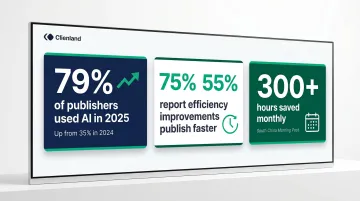
Platforms without native AI capabilities push editorial teams into fragmented, multi-tool workflows that erode those gains.
Analytics Depth and Audience Intelligence
Basic pageview dashboards are insufficient. Modern media companies need publisher-grade analytics tied to engagement signals, traffic source attribution, and content-level performance data that connects directly to editorial decisions.
63% of newsrooms now use AI or automation to evaluate engagement patterns. Yet the Reuters Institute Digital News Report 2025 finds traditional news media "struggling to connect with much of the public, with declining engagement, low trust, and stagnating digital subscriptions."
The gap is rarely the data — it's whether the platform surfaces insights in a format editors can act on before the news cycle moves on.
Multi-Channel Distribution and SEO Architecture
Those audience insights only create value when the platform can act on them at distribution speed. The platform should support structured data, schema markup, sitemaps, and GEO (Generative Engine Optimization) readiness so content surfaces in both traditional search and AI-powered discovery tools. Distribution to social, push notifications, and email should be automated — not dependent on manual scheduling.
Why GEO matters:
- Organic CTR plummeted 61% for queries where AI Overviews appear
- Media leaders expect traffic to decline by an average of 43% over the next three years
- The Washington Post reports AI-referred visitors show a 4-to-5x higher subscription conversion rate
Content with proper schema markup has a 2.5x higher chance of appearing in AI-generated answers.
Total Cost of Ownership and Scalability
Evaluating platforms on base licensing alone is a mistake. Factor in developer dependency, plugin costs, infrastructure spend, and support overhead. Platforms that consolidate tools into a single environment typically deliver lower TCO at scale.
Newspack publisher Lookout Santa Cruz reports saving more than $100,000 per year by consolidating to a single integrated platform versus a fragmented stack.
Best Digital Publishing Platforms for Modern Media Companies
The following platforms were selected based on their capabilities for media and publishing use cases—covering enterprise news operations, digital magazines, and brand content teams.
Publive
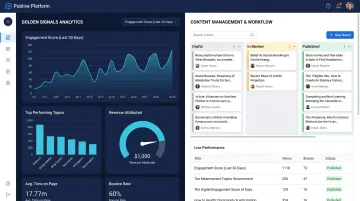
Publive is an AI-first, enterprise-grade Digital Experience Platform built specifically for media houses, publishers, and brands—trusted by outlets like Indian Express, News Nation, Sambad, and Kanak News. It consolidates content creation, distribution, analytics, and web performance into a single platform, replacing the patchwork of CMS tools, hosting vendors, and analytics plugins that most media operations accumulate over time.
What sets Publive apart:
- 98% of sites on the platform pass Core Web Vitals (the highest rate among leading DXPs)
- AI-powered content tools that reduce time-to-publish by up to 60%
- Golden Signals analytics dashboard built on GA4 and GSC connectors
- Automated social distribution and push notification system
- WCAG and DPDP-ready implementation
- 99.995% uptime on AWS with 24/7 white-glove support
| Feature Category | Details |
|---|---|
| Key Features | AI content creation and repurposing, push notifications, social automation, Core Web Vitals optimisation, Golden Signals analytics dashboard, GEO and AI search readiness |
| Best For | Media houses, news publishers, magazines, financial institutions, and brands running content-led growth operations |
| Pricing Model | Usage-based billing; custom enterprise contracts—contact Publive for a quote |
WordPress (with Newspack or Headless Setup)
WordPress powers a significant share of the world's news websites and remains the most widely deployed CMS in digital publishing. 43.4% of all websites run on WordPress, with a 61.2% CMS market share. With the Newspack plugin (developed with Google), it gains publisher-specific features including subscription management, ad management, and reader revenue tools.
Trade-offs to consider:
WordPress offers unmatched flexibility and a vast plugin ecosystem, but media companies at scale often face performance challenges. Only 43.44% of WordPress sites achieved good CWV scores in June 2025—over 15 percentage points behind fifth-ranked Drupal and 40 points behind leader Duda. Headless WordPress setups can overcome some performance limitations but require significant developer investment.
| Feature Category | Details |
|---|---|
| Key Features | Open-source CMS, Newspack publisher tools, WooCommerce for subscriptions, Jetpack for performance, REST API for headless deployment |
| Best For | Independent publishers, regional news outlets, and media companies with in-house developer resources |
| Pricing Model | Open source (free core); hosting, plugins, and development costs vary widely |
Adobe Experience Manager (AEM)
Adobe Experience Manager is an enterprise-grade content management and digital experience platform used by large media organisations managing multi-brand, multi-region publishing operations. It connects directly with Adobe Creative Cloud for asset management and supports headless content delivery via GraphQL APIs.
Powerful capabilities, high total cost of ownership:
AEM is named a Leader in Gartner's 2025 Magic Quadrant for Digital Experience Platforms, positioned highest for Ability to Execute and furthest for Completeness of Vision. It offers powerful multi-site management, AI-assisted content optimisation (via Adobe Sensei), and enterprise-grade infrastructure.
However, it carries a high total cost of ownership, long implementation timelines, and significant dependency on Adobe's ecosystem—making it less agile for fast-moving editorial teams. Gartner notes that AEM can be "complex and expensive, often requiring significant technical expertise and a high total cost of ownership."
| Feature Category | Details |
|---|---|
| Key Features | Multi-site manager, headless CMS with GraphQL, Adobe Creative Cloud integration, AI governance agents, WYSIWYG and drag-and-drop editing |
| Best For | Large enterprise publishers and media groups managing multiple brands or geographies |
| Pricing Model | Custom enterprise contracts; known to start in the tens of thousands annually |
Shorthand
Shorthand is a no-code digital storytelling platform used by media organisations, universities, and NGOs to create visually immersive, long-form editorial content—including feature stories, annual reports, and investigative pieces—without developer involvement.
Built for flagship editorial content, not everyday publishing:
Shorthand excels at producing high-quality branded narrative content with scrollytelling effects, embedded multimedia, and responsive design. It's not a full CMS replacement but a powerful complement for media companies that want to elevate their flagship editorial and branded content without custom development. Customers report up to 10x higher engagement compared to CMS-created content.
| Feature Category | Details |
|---|---|
| Key Features | No-code drag-and-drop editor, scrollytelling and native animations, responsive design, team collaboration tools, template library, embeds in existing CMS |
| Best For | Editorial teams producing feature stories, investigations, brand storytelling, and long-form digital reports |
| Pricing Model | Tiered subscription plans; paid tiers start from approximately $19/month (billed annually)—check Shorthand's pricing page for current rates |

Where Shorthand handles narrative depth, Issuu addresses a different gap: getting existing print-format publications in front of digital audiences at scale.
Issuu
Issuu is one of the most widely recognised digital magazine publishing and distribution platforms, with over 100 million monthly visitors and 30 million publications on its network. It converts PDFs and documents into interactive flipbooks, articles, and social content—making it a go-to for digital magazines and content marketers.
Use case fit and limitations:
Issuu is strong for magazine-format content distribution and monetisation (subscriptions, digital sales) and offers solid reach through its own content network. However, it is not designed as a primary CMS for news operations and offers limited control over SEO architecture and site performance. It serves a specific niche: publishers who want to digitise print-format content and distribute it across a built-in discovery network.
| Feature Category | Details |
|---|---|
| Key Features | PDF-to-flipbook conversion, digital sales with zero commission, social post and GIF creation, lead generation forms, Adobe InDesign integration, analytics |
| Best For | Magazine publishers, content marketers, and brands focused on digital distribution and publication monetisation |
| Pricing Model | Free basic plan; paid tiers start from $19/month—check Issuu's pricing page for current rates |
How We Chose These Platforms
Platforms were assessed against the needs of modern media companies—specifically, their ability to handle high content velocity, deliver measurable audience outcomes, and scale without exponentially increasing operational costs.
A common mistake publishers make: evaluating platforms on feature lists alone, without testing real-world performance under publishing load.
Non-Negotiable Evaluation Factors
- Core Web Vitals pass rates verified under real publishing conditions, not vendor-supplied benchmarks
- AI capabilities built into editorial workflows natively, not added through third-party plugins
- Analytics depth that goes beyond pageviews to surface publisher-grade audience insights
- Distribution reach across SEO, social, push notifications, and GEO channels
- Total cost of ownership, factoring in developer dependency and how many vendors the platform replaces
Range of Options
Platforms were selected to cover different tiers and use cases. The list includes enterprise-grade DXPs built for high-velocity news publishing, mid-market CMS options for growing digital teams, and specialist tools for magazine and long-form storytelling. Media companies at different stages of scale should find at least one directly relevant option.
Conclusion
Choosing a digital publishing platform is as much an editorial and commercial decision as a technical one. A platform that consistently fails Core Web Vitals, lacks AI workflow support, or silos analytics away from content decisions will cost a media company audience, revenue, and competitive ground over time.
Assess platforms against your specific operational reality: content velocity, team size, monetisation model, and scalability needs—not just against a generic feature checklist.
For media companies looking to consolidate their tech stack, improve platform performance, and accelerate content output with AI, Publive is built specifically for this. With a 98% Core Web Vitals pass rate, 60% faster content output through AI workflows, and deployments across Indian Express, News Nation, and Sambad, the platform is already running at scale across Indian media. Contact the team at support@thepublive.com to see how it fits your operation.
Frequently Asked Questions
What is the best platform for publishing online?
No single platform wins across every use case. The right choice depends on your content type (news, magazine, brand publishing), scale, and technical resources. Enterprise media companies tend to benefit from AI-first DXPs like Publive, while independent publishers may start with WordPress or Issuu depending on their format and team size.
How is a digital publishing platform different from a CMS?
A CMS manages content creation and storage, while a digital publishing platform integrates the full stack—performance optimisation, multi-channel distribution, audience analytics, and monetisation—in a unified environment built for publishing workflows. DXPs consolidate tools that would otherwise require multiple vendors.
What features should a digital publishing platform have for media companies?
Look for platforms that cover:
- Core Web Vitals compliance
- AI-assisted content workflows
- Publisher-grade analytics
- SEO and structured data support
- Multi-channel distribution
- Scalable infrastructure
Platforms that consolidate these capabilities reduce total cost of ownership and operational complexity.
What is the best digital publishing platform for news websites?
News websites require platforms optimised for high content velocity, real-time publishing, strong SEO architecture, and audience analytics. Platforms like Publive (built for media houses) and WordPress with Newspack are common choices depending on scale, technical resources, and performance requirements.
How do digital publishing platforms support monetisation?
Platforms support display advertising, subscription and paywall management, digital sales, and reader revenue tools. The strength of these features varies significantly by platform—enterprise DXPs typically offer deeper integrations with ad networks and subscription systems than generic CMS tools.
What is GEO and why does it matter for digital publishers?
GEO (Generative Engine Optimisation) refers to making content discoverable through AI-powered search tools like ChatGPT and Google's AI Overviews. Publishers need platforms with structured content, schema markup, and clean HTML architecture to appear in these results. This traffic is lower in volume but converts at a higher rate than traditional search clicks.