
Introduction
Content teams face an uncomfortable truth: they're producing more content than ever, yet much of it fails to move audiences forward. The problem isn't poor writing or weak storytelling — it's that most content gets published without understanding where the audience actually is in their decision-making process.
71 percent of consumers expect personalised interactions, and 76 percent get frustrated when brands fail to deliver them. Meanwhile, up to 60 percent of all marketing content goes entirely unused because it doesn't address real customer needs at the right moment.
AI platforms now connect content creation workflows directly to customer journey intelligence — so teams know what to publish, for whom, and when. Rather than static content calendars, they work from behavioural signals that reveal where audiences are in their decision-making and what would actually move them forward.
TLDR
- AI platforms link content creation to customer journey stages, ensuring relevant content reaches audiences at the right moment
- Traditional content calendars prioritise publishing schedules over customer intent; AI platforms correct this by reading behavioural signals in real time
- Each of the 5 customer journey stages requires distinct content types, tones, and distribution strategies
- Effective AI platforms analyse journey data to inform what content teams should create next, not just generate drafts
- Connecting content output to journey mapping produces measurable gains — stronger engagement at awareness, faster conversion at decision, and lower churn post-purchase
Why Content Creation and Customer Journey Mapping Must Work Together
Most organisations operate with a structural silo: content creation lives in editorial or marketing, while customer journey data sits in analytics or CRM. These teams rarely collaborate, resulting in content calendars filled with articles, videos, and social posts that don't serve customers at critical decision points.
Journey-mapped content takes a different approach. Each piece is intentionally designed for a specific stage of the customer's relationship with a brand — from first discovery through to loyal advocacy. This contrasts sharply with volume-first strategies that optimise for output quotas rather than audience relevance.
The business cost of misalignment is significant. McKinsey research shows that personalisation drives 10 to 15 percent revenue lift, with company-specific gains spanning 5 to 25 percent. Companies growing faster drive 40 percent more revenue from personalisation than their slower-growing competitors.
AI changes this equation entirely. Instead of quarterly planning sessions built around persona documents, AI platforms analyse real-time behavioural signals (scroll depth, time on page, content type engagement, return visit patterns) to continuously inform what content is needed and when. The journey map updates as the audience does, creating a dynamic feedback loop between audience behaviour and content production.
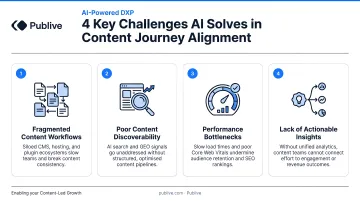
Key challenges AI solves:
- Unifies journey data with content workflows, eliminating the gap between editorial and analytics teams
- Replaces static annual calendars with dynamic, behaviour-driven content recommendations
- Identifies underserved journey stages before gaps translate into churn
- Connects content performance directly to journey progression metrics
The 5 Stages of the Customer Journey and What Content Each Demands
Not all content serves the same purpose — and the biggest mistake content teams make is publishing without knowing where their audience actually sits. Each stage of the customer journey calls for a different tone, format, and goal. Get the stage wrong and even well-crafted content fails to move anyone.
Awareness
At the awareness stage, customers have a problem or curiosity but may not yet know your brand exists. Content must educate, attract, and establish relevance without pushing for immediate action.
High-performing formats at this stage:
- Explainer articles and how-to guides
- Short-form social content and video
- SEO-optimised blog posts addressing common questions
- Industry trend analysis and thought leadership
AI helps identify trending topics and audience questions in real time, enabling teams to create top-of-funnel content that matches current search intent rather than last quarter's editorial themes.
Consideration
Once a customer recognises a problem, they start comparing options — and they want proof, not pitches. This stage demands depth and credibility over volume.
Content that builds trust:
- Case studies showing real results
- Comparison guides and evaluation frameworks
- Detailed how-to content and tutorials
- Expert opinion pieces and whitepapers
AI can analyse which formats and topics drive the longest dwell times, then generate more of what drives deeper engagement. For publishers and media companies, this often means identifying which article structures keep readers coming back across multiple sessions — not just one-and-done visits.
Decision
By this point, the customer has done their research. They're close to acting — but a single unanswered objection can stall the process. Decision-stage content removes that friction.
Formats that drive decisions:
- Product detail pages with clear benefits
- Customer testimonials and social proof
- FAQ sections addressing common objections
- Demo videos and pricing transparency
AI personalises this content dynamically based on what users have already engaged with, ensuring the right proof appears at the right moment without manual curation.
Retention and Engagement
Post-purchase or post-sign-up, customers need content that delivers ongoing value and keeps them actively engaged with your brand.
What works here:
- Onboarding guides and usage tips
- Email newsletters with relevant insights
- Product update announcements
- Community-building content
AI-powered push notifications and personalised content feeds become especially powerful here, keeping the relationship active without requiring manual segmentation and scheduling.
Advocacy
Loyal customers who feel consistently well-served become amplifiers. Content at this stage encourages sharing, referrals, and community participation.
Content that amplifies:
- Behind-the-scenes stories and brand narratives
- User-generated content prompts
- Referral program communications
- Exclusive community content
AI can identify high-engagement users and trigger advocacy-oriented content at optimal moments based on behavioural patterns, converting them into a measurable referral channel rather than leaving advocacy to chance.
How AI Platforms Are Bridging Content Creation and Journey Intelligence
AI platforms that integrate journey mapping with content creation rely on behavioural data to make publishing decisions precise. They analyse signals — page-level engagement, content completion rates, return visit frequency, referral sources — to identify where each audience segment sits and flag gaps where no suitable content exists.
Behavioral Signals Drive Content Decisions
Modern analytics platforms track engagement far beyond page views. GA4 measures engagement time in milliseconds, capturing how long users actively focus on content. An engaged session is defined as lasting longer than 10 seconds, containing at least one conversion event, or involving at least two page views.
These signals reveal where users sit in the journey:
- First-visit content consumption points to awareness
- Repeat visits to comparison or product pages indicate consideration
- High-intent page views signal decision readiness
- Post-conversion engagement reflects retention health
AI-Assisted Content Generation That's Stage-Aware
Rather than producing generic drafts, advanced AI writing tools can be configured with journey-stage parameters. Teams can brief AI to generate "consideration-stage comparison articles" or "awareness-stage explainer content" at speed.
McKinsey estimates that generative AI could increase marketing productivity by 5 to 15 percent of total marketing spend. About 75 percent of generative AI's value falls across customer operations, marketing and sales, software engineering, and R&D.
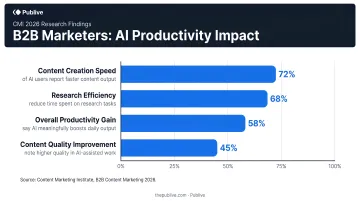
According to CMI's 2026 survey of 1,000+ B2B marketers:
- 87 percent say AI improved productivity
- 80 percent report improved operational efficiency
- 65 percent cite improved creative capabilities
- 58 percent report improved content quality
Automated, Journey-Informed Distribution
AI platforms with integrated distribution capabilities route content to the right channel — web, push notification, social, email — based on where users are in their journey. Content isn't just published; it's targeted.
For media organisations, this might mean automatically surfacing retention-stage content (deep-dive series, member-exclusive articles) to returning readers via push notifications, while distributing awareness-stage content (trending news, explainers) through social channels to attract new audiences.
The Analytics Feedback Loop
That distribution activity generates performance data — and what happens next is where the integration earns its value. When content performance feeds back into the creation layer, teams see which pieces accelerate journey progression and which cause drop-off. AI surfaces recommendations and flags underperforming stages automatically.
Platforms connecting GA4 and Google Search Console to content workflows let teams measure stage-to-stage progression directly, not just top-level traffic numbers.
Predictive Content Planning
The most sophisticated AI platforms project content gaps before they become churn events. By analysing historical engagement patterns and journey velocity, they predict what content a segment will need in the next cycle.
This shifts content teams from reactive publishing to proactive pipeline management. Instead of filling editorial calendars after the fact, teams build pipelines around what audiences are likely to need next.
What to Look for in an AI Content-Journey Platform
Unified Data and Creation in One Environment
The most important capability is a platform that doesn't force teams to toggle between a CMS, analytics dashboard, and separate AI tool. Look for systems that embed journey-signal data directly into the content creation workflow.
Forrester's Wave evaluation of content management systems now defines third-generation CMS as platforms delivering value through AI-powered content generation at scale and AI agents that enhance content team interactions with digital content.
Editors and strategists should be able to see how a piece will serve the journey without leaving their workspace — analytics informing creation in real time, not in quarterly review meetings.
Stage-Aware AI Writing, Repurposing, and Experimentation
The platform should generate and repurpose content with journey-stage intent built into prompts — not just generic text generation. The ability to run content experiments (A/B testing headlines, formats, CTAs) at the stage level is a strong differentiator.
In practice, this lets publishers test distinct variables by stage:
- Which article structures drive return visits (consideration stage)
- Which headlines attract first-time readers (awareness stage)
- Which CTA formats convert loyalists into subscribers (decision stage)
Multi-Channel Distribution with Journey Context
Distribution needs to do more than broadcast. Platforms that route push notifications, social publishing, and on-site personalisation based on behavioural stage reduce operational overhead while delivering content that actually matches where the reader is in their journey.
Reference customers in Forrester's CMS evaluation cited "time to market" as the primary growth driver and "digital properties consolidation" as a major operational efficiency gain — two outcomes that depend directly on how well a platform connects distribution to the journey layer.
How to Get Started with Journey-Mapped Content
Begin with a Content Audit Mapped to Journey Stages
Before layering in AI, teams need clarity on what content they already have and which stages it serves.
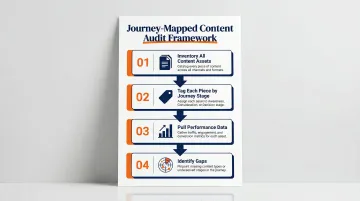
Simple audit framework:
- Inventory all content assets — articles, landing pages, videos, newsletters, social posts
- Tag each piece by journey stage — awareness, consideration, decision, retention, advocacy
- Pull performance data — engagement metrics, conversion influence, return visit patterns
- Identify gaps — which stages are over-served, which are starved
MarketingProfs recommends the "Teaches/Proves/Decides" framework: categorise content as "Teaches" (early-stage), "Proves" (mid-stage), or "Decides" (late-stage). If content hasn't influenced a pipeline opportunity in six months, archive it.
Configure Behavioral Tracking to Surface Journey Signals
Ensure analytics tools capture signals that indicate journey stage — not just page views, but engagement depth, return behaviour, conversion events, and content consumption sequences.
Key metrics to track:
- Engagement time — duration of focused attention on content
- Scroll depth — how far readers progress through articles
- Pages per session — breadth of content exploration
- Return visit frequency — loyalty and retention indicators
- Conversion event triggers — decision-stage actions
GA4's engaged session metric provides a strong proxy for consideration-stage engagement, while conversion events clearly signal decision readiness.
Use an AI-First Platform to Generate and Test Stage-Specific Content at Scale
Platforms like Publive combine AI-powered content creation with GA4 and GSC-connected analytics, push notification distribution, and a Golden Signals Dashboard — giving content teams a single place to act on journey intelligence rather than piecing together outputs from separate tools.
Built-in AI workflows surface SEO recommendations, content scoring, and keyword suggestions during creation. Real-time analytics then show which content moves audiences through each journey stage, so teams can double down on what's working rather than publishing on instinct.
For media organisations and publishers, the practical payoff looks like this:
- Identify retention-stage formats — pinpoint which article types, lengths, or topics drive return visits
- Automate multi-channel distribution — push content to newsletters, social, and notifications based on audience behaviour patterns
- Eliminate reactive publishing — replace manual curation cycles with data-backed content decisions
Frequently Asked Questions
What are the 5 stages of the customer journey mapping?
The five core stages are Awareness (customer discovers a problem), Consideration (actively researching solutions), Decision (ready to act), Retention/Engagement (post-purchase value delivery), and Advocacy (loyal customers become brand amplifiers). Each stage carries a distinct mindset and content need — from first discovery through to long-term loyalty.
How does AI help create content for different customer journey stages?
AI analyses behavioral signals — engagement data, session patterns, conversion events — to identify which journey stages lack suitable content. It then generates or recommends stage-specific content matched to audience intent, tone, and format at each point in the decision process.
What is the difference between content mapping and customer journey mapping?
Content mapping organises existing assets against audience needs, tagging each piece by the stage it serves. Customer journey mapping visualises the full behavioral and emotional path a customer takes with a brand across all touchpoints. AI now manages both dynamically within a single integrated workflow.
How can media companies and publishers use AI to align content with audience journeys?
Publishers can analyse reader behavior — article completion rates, return frequency, topic affinity — to understand where each segment sits in their engagement journey. AI uses these signals to generate more of the content types that build loyalty and reduce churn, personalising distribution based on individual reading patterns.
What data signals indicate which stage of the journey a customer is in?
First-visit content consumption suggests awareness stage. Repeat visits to comparison or in-depth content indicate consideration. High-intent page views or form interactions signal decision readiness. Post-conversion engagement shows retention health. Social sharing and referral activity indicates advocacy readiness.
How do you measure whether content is working at each journey stage?
Use stage-specific KPIs. Awareness content should be measured by reach and time-on-page. Consideration content by return visits and engagement depth. Decision content by conversion rate. Retention content by re-engagement frequency. Advocacy content by referral rate and sharing metrics. Each stage requires different success indicators.